|
| Cover art by Will Kelly |
I had the privilege of meeting Hammer of the Huguenots cover illustrator Will Kelly in person when he joined us on the Knox
500 Tour summer 2014. He’s a humble fellow so it wasn’t until near the end of the tour that I
learned he was an artist, the real kind. I remember sitting down with Will near
the dock at Loch Levin Castle and beginning conversation about book
illustrations. He’s agreed to chat about the process of creating a book cover for my
forthcoming book.
Bond: I love what you have done on this cover!
Tell us about your background as an artist. Where did you learn to do this kind
of thing?
Kelly: Thanks
Mr. Bond! The book cover was a real pleasure to work on. And that was a great
day at Loch Levin - I remember that conversation well - and I also remember
they served a pretty great latté!
My background as an artist is fairly straightforward, if a little
unorthodox. Like many kids, I grew up drawing in my spare time, mostly comic
strips. I had a love for the simple storytelling that could be found in comic
strips such as Peanuts. Charles
Schulz was a real hero of mine as a child, and since then I've actually
acquired some of his pen nibs that he drew his strip with every day. I learned
to emulate his work by creating my own strips in a similar style to his.
I was homeschooled all the way through highschool, and as I
entered my highschool years I started to become frustrated with my drawing
abilities. I wanted to create things that were beyond my skill level, and I
really couldn't. I was reaching a point where I wanted to figure out what I
wanted to do as a career. I thought about a lot of things, but
"Illustrator" wasn't one of them. It was at this point when I read
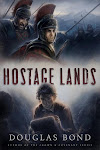
your book "Hostage Lands" for the first time - and although the story
really grabbed my imagination, it was also the cover art that really hit the
right note for me (and full disclosure, this is a true story, and Douglas Bond
isn't paying me to say this!). After reading the book, I looked up the artist's
website and discovered that Illustration was indeed a viable profession that
combined art and storytelling, two things that I really love. Since then, the
illustrator (Justin Gerard) has become a friend and a mentor and his
encouragement has really made the journey of making it in illustration much
easier. As far as formal training, I have very little, aside from a few college
art classes. I do try to learn all I can by attending art workshops and
studying on my own. It's all about consistent practice.
 |
| Bond and Kelly on KNOX 500 TOUR |
Bond: Readers might be interested to know how
it is that you came on the Knox tour and when and how you first discovered some
of my books.
Well, like I mentioned earlier, I was homeschooled, and in my
family we love books. My mom introduced me to the original Crown and Covenant series, and I really enjoyed those. Since then
I've tried to keep up with the latest Bond books, and I've especially enjoyed
the last few in the Heroes & History series,
of which Hammer of the Huguenots is
the latest. I had just finished Hand of
Vengeance and decided to look up your website. I have wanted to travel to
Scotland for years, (I'm a huge anglophile, and I watch my share of BBC
television!) especially since my ancestry goes back to Scotland. After I
realized that you led tours, and discovered The Knox at 500 tour, it was a
no-brainer. I love traveling, and history, so it was a perfect combination of
the two. And let me tell you, the trip was an amazing experience, especially
getting to experience the sights with other like-minded folks who were so kind
and shared a passion for travel and the amazing narrative of the history of the
Church. Scotland was magnificent, and there's rarely a day that goes by that I
don't think about going back.
Bond: What were the particular challenges of
creating a book cover for this book?
That's a great question. As it turns out, I'm actually relatively
new on the publishing scene, so every new project is a challenge. Not only am I
striving to make a solid product, but I also feel like I have to make it up as
I go. Often my creative process feels like I'm throwing spaghetti at a wall and
seeing what will stick. But in all seriousness, there were quite a few
challenges to this particular project. In particular, working in this
particular painterly, more realistic style is something that I don't do a whole
lot of. I create a lot of children's characters in my own work, and painting in
a realist style is much more of a challenge, although the principles are still
the same. It's all in the technique. It was also a challenge to convey the character's
emotion and personalities in a single static image. Getting the characters
right was important - it's what the whole piece hinges on really. Also,
maintaining a cohesive look with the other books in the series was always in
the forefront of my mind. Justin Gerard's artwork (Hostage Lands, Hand of Vengeance, and other bond covers) has been an inspiration to me
for years, and I'm very familiar with the processes he uses. So I worked in a
similar method to his, but of course you'll be able to look at my art and tell
that it's something totally new, but hopefully engaging. I hope it connects
with the readers and gives them something to fire their imagination.
Bond: Does it help a book illustrator to know
the author’s books, to have read some of them, to be familiar with the
particular character of the books?
Not always, but in the case of Hammer
of the Huguenots it was helpful. Not so much for the story, but for the
overall look of the series. I was familiar with the size of the other books,
the way they looked, etc. I actually had all of them close at hand to refer to
as I worked on my cover. Melissa Craig (the editor at P&R publishing)
was very helpful and encouraging and helped keep the direction of the art on
track to fit the tone and theme of the series and the book itself. Having a
general idea of the story is helpful, and in some cases an artist does need to
know as much as possible about the book. Sometimes however, knowing too much
about a story gives an artist too many details and makes it harder to decide on
a single scene to illustrate. We had a clear vision for the cover image from
the start, so that part of the process was fairly straightforward. As for the
Hammer of the Huguenots, I've actually not even seen a manuscript yet, so I'm
going to be as surprised as everyone else to read it for the first time!
Bond: What other illustration projects have
you worked on, and were there specific adaptations you had to make to work on
this one? Every illustrator has their unique style and preferred approach to
illustration, but with a book cover, especially when it is in an existing
series, how much charting of new waters is required for the illustrator to fit
with the feel of covers in books in the series already?
Most of the illustration work I've done up to this point has been
for either independent publishers or for myself (personal projects). I've done
a few books, a couple of comic book covers, and (my personal favorites so far)
a series of illustrations for Story Warren, a website devoted to inspiring
children and their families to foster Godly imagination through storytelling.
My usual method of creating art is fairly simple, usually starting with line
work and simple coloring. It's a style that's more at home in a children's book
or magazine I suppose. But I do enjoy doing more complex pieces, and with this
project I knew from the start it would be a challenge. One thing I think is
important for an artist is not to get too stuck on one particular
"style". Style is a deceptive word, and many beginning artists
(myself included) tend to fall into the trap of searching to find their own
unique style. This is somewhat of a myth, because it's really all about doing
what's best for the project at hand, what will make that image work the best.
Some of the most successful illustrators that I know work in multiple styles,
and different clients hire them for different needs. It's all about being as
versatile as you can, and just being as good as you can at making art in
general.
Bond: When did you know you wanted to be an
artist? Were you inspired by any particular artists along the way in your
career? Which ones and why?
I think somewhere in the back of my mind, I've been hard-wired to
be an artist since birth, but I guess I only finally woke up to the fact when I
was about twenty and started getting serious about improving my drawing and
painting abilities. Justin Gerard, like I mentioned earlier was the first
illustrator that I really connected with and got my career started. But I've
been inspired by so many artists along the way. James Gurney was my first major
influence as a kid - he created a wonderful series of books called Dinotopia about an island in the 1860s
populated by dinosaurs and humans who live together. It's an amazing series,
and it really hit all the right notes for me growing up. The paintings were
detailed, and he carefully constructed this fantasy world that felt real - I
spent many hours doing the same thing as a result of those books. I got to meet
Mr. Gurney back in 2012, and it was just so great to finally meet a childhood
hero. Of course, there's many others: Hergé - the creator of the Belgian
"Tintin" books, Norman Rockwell, P. J. Lynch. Of course there are so
many others, I could go on for quite some time... :)
Bond: What artist from the past would you
most want to sit down and have a meal with and what would you want to ask the
artist? (you can add what you would order to eat etc if you would like)
Oh, that's a great question! It's also a tough one. I think it
would have to be N. C. Wyeth. There are so many things I admire about his work
and I would love to talk to him about his craft. His mastery of storytelling
and color and light are simply brilliant. And he had the opportunity to
illustrate so many classic tales, Arthurian Legends, Treasure Island, and even
Biblical stories. I know I would have a lot to learn from him. He also
illustrated the Robert Louis Stevenson story Kidnapped, which of course takes place in Scotland, so I would have
to say it would be appropriate to meet with him in a Scottish pub, preferably
in Edinburgh, over a hearty shepherd's pie, peas and chips paired with a nice
pint of McEwan's scotch ale!
Bond: Wyeth is a favorite of mine, as well! What is your advice to a young artist
who would like to become a professional illustrator?
Well, this answer might get a little long-winded, but it's only
because it's something I'm very passionate about. I really love to see younger
artists coming along and learning the same lessons that I've learned in the
last 6 years or so. I've had the opportunity to follow the progress of several
teenage artists via social media such as Instagram, and their blogs, whose
drawing abilities have skyrocketed in just a short amount of time. I am excited
to see these younger individuals coming up and learning the art of telling
stories with pictures. It's what I love to do, and I love to see them do it. My
advice would be work consistently, but don't burn yourself out. Work hard, but
not too hard. Ultimately, your success really doesn't depend on the amount of
work you do, but the amount of sincerity and integrity with which you do it.
Start by drawing what you love drawing. Study the masters. Find artists that
speak to you through their work and emulate them. Copy their work! Learn what
makes it tick. Get out and try to connect in person with other artists and
illustrators (don't be shy - illustrators are some of the nicest people I
know!) But most of all, if you want to be successful, understand that making
art isn't about boosting your own ego or image, it's about sharing the gift of
art and imagery with others. Creativity is a gift that's been given to us by
God, and we can only truly enjoy it when we're sharing it with other people.
Bond: What is your purpose for creating art?
Purpose can often be a hard thing to nail down! But I can say for
sure that as a "Sub-creator" (as Tolkien so eloquently put it) I see
my purpose of creating art as a chance to emulate the creativity of the Creator
of the Universe. The story of the Redemption of Jesus Christ is very much a
reality to me, and I try to live my life as an artist as a reflection of that
story. Of course, that's a constant challenge, because every day I deal with
the issues of my own pride in what I do, doubts, whether or not I'm popular, how
many likes my art gets on Facebook, and so on. But when I step back from all of
that noise, and really get to the root of why humans are hard-wired to create
things in the first place, my response becomes a lot more humble in knowing
that God has made us with desires to create and bring even a feeble amount of
beauty into the world. Placing my trust in the reality of a God who is
sovereign and has given me the desire to be an artist has been very freeing, and
really gives me purpose in even the most meager attempts I make at creating
art. Good art, or poor, everything I'm doing has purpose and meaning in the
ultimate plan of His will. It gives me a lot of peace and freedom to be able to
follow my path as an artist with conviction and gladness.
Thanks, Will! What a delight partnering with you on this book and cover!
Thanks so much for inviting me to do this interview! Best wishes
for the new book - I'm very excited to read it. And let's see about planning
another trip to Scotland, eh? :)
And if anyone would like to stay in touch, I'd love to hear from
them! You can find my website at www.willkellyillustration.com or just follow
me on twitter @w_t_kelly (I mentioned networking in my response about young
artists - here you go guys, here's your chance! Feel free to show me the art
you're working on! :) )


.JPG)




 Posts
Posts