Showing posts with label John Calvin. Show all posts

Tuesday, October 15, 2019

Grunting Hogs and Braying Asses--How Not to Sing in Church

WORSHIP AND IDOLATRY
 
Calvin and Luther on music in worship
T
he late Kurt Cobain likely did not have a clue he was screaming the anthem of an entire generation in his 1991 hit “Entertain us.” 

With the lights out it’s less dangerous;
Here we are now entertain us.
I feel stupid and contagious;
Here we are now entertain us.

Cobain and many pop musical entertainers like him became the idols of a youth culture that wanted what they were delivering, entertainment. But, tragically, it was not only the teen spirit of the unbelieving world that joined in the mantra “entertain us.”
Christians in the contemporary church have been stumbling over themselves to catch up with the world. The transformation is nearly complete. We have refashioned what we do in worship to look like pop entertainment on the stage at a Nirvana concert, necessary changes constantly being revised to match the vicissitudes of each iteration of the latest thing since 1991.

IDOL FACTORIES
“…every one of us is, even from his mother's womb,” wrote John Calvin, “a master craftsman of idols.” Calvin and the Reformers of the 16th century knew something that we have almost entirely ignored today. Left to ourselves, we will create idols out of almost anything, including those who entertain us. Intractable rebels against God, we cast about to find something else to venerate, to bow down to, to worship. But when we Christians do it, we keep telling ourselves that we’re not doing it, that it’s still all about Jesus.
Nowhere was this more obvious than in medieval worship in the Roman Catholic Church. Of course, the RCC continued to talk about Jesus, his deity, his virgin birth, his bodily resurrection, but over the centuries they had added rivals. Layers of sacraments, including prayers to saints, to Mary, bowing down before images of saints and Mary, lighting candles to them, going on pilgrimages to venerate their relics—all of these and more had supplanted the true worship of God. And Calvin took these perversions seriously because he believed “...there is nothing more perilous to our salvation than a preposterous and perverse worship of God.”
Hence, the Reformers set about returning to the Bible alone, wherein they discovered that we are justified by grace alone, through faith alone, in Christ alone, to the glory of God alone. This rediscovery of the gospel of grace led to a return to robust biblical theology about salvation and the gospel. Concurrent with the Reformation of theology was a Reformation of doxology, of how we enter into the presence of the living God in worship.
Knox, Calvin, and the Reformers proceeded to help break the chains of the idolatrous medieval corruptions that had been allowed to infect every dimension of corporate worship.
Because “The mind of man is like a work place of idolatry,” as Calvin put it, they scoured the Scriptures to learn what worship pleases God.

THE REGULATIVE PRINCIPLE
From their labors came what theologians call the Regulative Principle of Worship. I’d like to demonstrate that everybody in the worship wars has a regulative principle, that is, some controlling idea behind the choices that are made about what we do in church, how we order our service, the place and role of the sacraments, how and what we pray, read, preach, and sing. These components of worship never emerge out of thin air. We do them, or don’t do them, based on what is regulating our understanding.
Everybody has a regulative principle. Some churches regulate their worship by the past, tradition, and how they’ve always done things. There may have been more foundation in generations past, but for all intents and purposes today, they do what they do, how they do it, because that’s just how they’ve always done it.
Others regulate what they do in worship by their preference. These churches order their service of worship by what people like. What makes them feel good in worship, what gives them a sense of having worshiped when they’re finished. People who choose to attend these churches might say, I go to this church because it’s what I like and enjoy.
Still other churches organize their gatherings by the pragmatic principle of worship. They do what they do and how they do it because they believe it works. They regulate how they worship by what fills the church, what draws people into the church. For these churches what is popular and entertaining works. It draws people in.
Closely related to the pragmatic principle of worship are those churches that have concluded that they can do anything in church as long as it is not specifically prohibited in the Bible.
The Reformers rejected all of these principles informing worship. They believed that idolatry results from regulating worship by the past, by the pragmatic, by personal preferences, by doing anything not prohibited.  Calvin and the rest concluded that a prescriptive principle of worship ought to regulate what and how we come into the presence of the living God in worship. They concluded that true worship is commanded worship; we may only include in our worship what God has commanded us to include in his Word.
The Regulative Principle of Worship is summarized in John Knox’s emphatic assertion: “All worshiping, honoring, or service, invented by the brain of man in the religion of God, without his own express commandment, is idolatry.”
This meant some pretty serious housecleaning for the Reformers. Iconoclasm, the breaking of idols, resulted throughout Scotland and much of Europe as men, zealous for purity of doctrine and of doxology, tore down the idols that cluttered medieval church buildings.
A century later, the Westminster Divines, the leading pastors and theologians of sixteenth century England and Scotland, encapsulated the Regulative Principle of Worship in the most careful and thorough Reformed confession of faith:

The acceptable way of worshiping the true God is
instituted by himself, and so limited by his own
revealed will, that he may not be worshiped according
to the imaginations and devices of men, or the
suggestions of Satan, under any visible
representation or any other way not prescribed in the
holy Scripture (WCF 21.1).

Put simply, these godly men wanted the Church to worship God’s way not the world’s way.

PRESCRIPTIVE SINGING
What does the Regulative Principle of Worship tell us about music, about what and how we sing in worship?
For the answer, we will find it instructive to hear practical ways the Reformers employed music in worship. Calvin and Luther agreed about the power of music: “There is scarcely anything in this world which can more turn or bend hither and thither the ways of men. We know by experience that music has a secret and almost incredible power to move hearts.” Though he argues against those who wanted to condemn all music, still, this knowledge about the force of music led Calvin to be more cautious than Luther. “Therefore, we ought to be even more diligent in regulating it in such a way that it shall be useful to us and in no way pernicious.”
Calvin, who believed that all good things were gifts of God, also knew that, intractable sinners that we are, good gifts can easily become idols. Good things can become god things, as one man put it.
Yet, Calvin maintained a high view of the importance of music in worship. “And in truth we know by experience that singing has great force and vigor to move and inflame the hearts of men to invoke and praise God with a more vehement and ardent zeal.”
Because Calvin knew the “force and vigor” of music, he gives us wisdom on what kind of music is appropriate in the house of God:

Care must always be taken that the song be neither
light nor frivolous; but that it have weight and
majesty (as St. Augustine says), and also, there is a
great difference between music which one makes to
entertain men at table and in their houses, and the
Psalms which are sung in the Church in the
presence of God and his angels.

Calvin understood something about music that we have suppressed in the last generation. Music is not neutral. There are different kinds of music that may be appropriate in various settings, but musical styles are not interchangeable. Not all music is capable of bearing the weight of the majesty of the God into whose presence we are entering to adore. Calvin ranks entertainment music as “light and frivolous” and thereby inappropriate for corporate worship. Only music with “weight and majesty” was appropriate for the worship of the God revealed in Scripture.
Geneva was a party city, a trading center, a crossroads where many merchants, far from home, came and went. He had seen the abuse of music on the streets and in the taverns, music that gave only “…foolish delight by which it seduces men from better employments and occupies them in vanity.” Geneva was a vanity fair, the Las Vegas of Europe, a culture, like ours, screaming to be entertained, and this atmosphere exerted its pressures on the church, as it does today. Calvin had heard with his own ears the force of music when it was combined with unwholesome lyrics:

When melody goes with [music], every bad word
penetrates more deeply into the heart…Just as a
funnel conveys the wine into the depths of the
decanter, so venom and corruption are distilled into
the very bottom of the heart by melody.  

MUSIC WITH WEIGHT AND MAJESTY
Above everything, Calvin wanted music and singing in Saint Pierre to exalt the glory of God, and where better to find such songs than in the inspired Psalms of David? In the Psalms, Calvin discovered “an anatomy of all the parts of the soul.”
Meanwhile, Geneva became the refugee center of Europe, and Calvin soon learned that God had brought several people with particular musical gifts to the city-state. Clement Marot, court poet of France, he put to work versifying the Psalms in French, and enlisted musician Louis Bourgeoise to compose melodies with “weight and majesty,” but that would also be accessible to common folks worshiping in the church.
 While Calvin was in exile from 1538-1541 in hymn-singing Strasbourg, he wrote several treatises, but he never wrote anything against singing hymns of human composition rather than only Psalms in corporate worship. An inexplicable omission for Calvin, if he was as vehement as some are about exclusive Psalm singing as some insist.
What’s more, during his time as pastor of the French-speaking church in Strasbourg, a hymn of human composition appeared entitled, “I greet Thee who my sure Redeemer art.” Some historians and hymnologists believe it was written by Calvin himself. We may never know this side of eternity, but we do know that when Calvin returned to Geneva, he included this hymn and others in the Geneva Psalter 1551, set to Toulon a fine melody composed by Louis Bourgeois.
Imagine Calvin leading his congregation at Saint Pierre in singing this glorious hymn, not only as a call to worship, but as a rehearsal of the whole of the gospel and the life of a Christian whose only hope is in “the King of glory and of grace.”

I greet thee, who my sure Redeemer art,
My only trust and Savior of my heart,
Who pain didst undergo for my poor sake;
I pray thee from our hearts all cares to take.

Thou art the King of mercy and of grace,
Reigning omnipotent in every place;
So come, O King, and our whole being sway;
Shine on us with the light of thy pure day.

Calvin knew that if we are to worship aright, we must preserve the pure doctrine of the gospel, and understanding and adoring God’s sovereign authority over salvation and all things was non-negotiable, both in life and as we “walk through the valley of the shadow of death.”

Thou art the life, by which alone we live,
And all our substance and our strength receive;
O comfort us in death’s approaching hour,
Strong-hearted then to face it by thy power.

Thou hast the true and perfect gentleness,
No harshness hast thou and no bitterness;
Make us to taste the sweet grace found in thee
And ever stay in thy sweet unity.

Our hope is in no other save in thee;
Our faith is built upon thy promise free;
O grant to us such stronger hope and sure
That we can boldly conquer and endure.

The God that Calvin adored with all his being, was a God of “true and perfect gentleness,” one in whom alone the Christian could “taste the sweet grace,” and by whose power and keeping alone be enabled to “boldly conquer and endure.”

GRUNTING OF HOGS
We’ll never know for sure if Calvin wrote that marvelous hymn, but we know for certain that Luther wrote a number of hymns, including the musical accompaniment. Luther is less guarded and speaks of music with little of the caution Calvin used.  
Alongside Calvin, Luther completes our understanding of the role of singing in worship. He laid out his plan: “I wish to compose sacred hymns so that the Word of God may dwell among the people also by means of songs.” Setting to work early, Luther published his first congregational hymnbook, Geystliche Gesangbuchlein, in 1524. He repudiated the “lazy worship” whereby everything was performed for them and the congregation was passive, observing but not participating in singing. But they needed to learn how to sing together. So, Luther began teaching his people to sing like God sings, with full voice.
Ranking music even higher than Calvin, Luther declared, “Music is an outstanding gift of God and next to theology. I would not give up my slight knowledge of music for a great consideration.” He was being overly modest. He played the lute, composed original music, and was called “The nightingale of Wittenberg” for his skillful singing ability. So important was music, he was an advocate of formal musical education in the school curriculum for all German children.
Typical of Luther’s Teutonic bluntness, he had little good to say about someone who disliked fine music.

A person who does not regard music as a marvelous
creation of God, must be a clodhopper indeed and
does not deserve to be called a human being; he
should be permitted to hear nothing but the braying
of asses and the grunting of hogs.

Of Luther’s thirty-six hymns, “A Mighty Fortress” is by far and away his best loved. Written likely while Luther was sequestered in Coburg Castle during the Diet of Augsburg, it is a rousing hymn loosely drawn from Psalm 46, wherein Luther defies “the prince of darkness grim” and demonstrates the Christologic hermeneutic of all the Scriptures, recovered in the Reformation. For Luther, Christ Jesus is the “right man on our side.” Though Christ’s name doesn’t appear in Psalm 46, Luther was hermeneutically and theologically correct to name Christ Jesus in his hymn.

Did we in our own strength confide,
Our striving would be losing,
Were not the right man on our side,
The man of God’s own choosing.
Dost ask who that may be?
Christ Jesus, it is he;
Lord Sabaoth, his name,
From age to age the same,
And he must win the battle. 

Jesus Christ and his gospel regulate what and how we sing in worship, and he is the same yesterday, today, and forever, or as Luther put, “From age to age the same.” It is inimical to the timeless enduring truth of justification by faith alone to recast it with music that is fashionable, but only for the moment. The trendy vulgarizes the eternal. In the warfare for true biblical worship, Jesus Christ “must win the battle.”

Douglas Bond is author of Grace Works! (And Ways We Think It Doesn't) and more than twenty-five other books of historical fiction, biography, devotion, and practical theology. He is lyricist for New Reformation Hymns, directs the Oxford Creative Writing Master Class, speaks at churches and conferences, and leads Church history tours in Europe. Watch for his forthcoming book God Sings! (And Ways We Think He Ought To), from which this post is an excerpt; preorder a signed copy of God Sings! at bondbooks.net.

Wednesday, January 30, 2019

Doctrines of Grace: Total Depravity and Unconditional Election (part 3 from The Scriptorium podcast on Dort)

Doctrines of Grace: Total Depravity and Unconditional Election

Ephesians 1:1-14

From my visit to Amsterdam, 2007
Mingle-mangle
            It has been said of the Reformers in England, “Cambridge grew them; Oxford slew them.” Hugh Latimer, Bishop of Worchester, Cambridge scholar and preacher, royal chaplain to Henry VIII and Edward VI, was one of those who died at the hands of haters of the Word of God and the Gospel. Latimer was a preacher of Sola Scriptura, the Bible alone, but concerned that some in England misread their Bibles, he urged preachers and laymen alike not to “make a mingle-mangle” of the sacred text.
            The Reformation was essentially a return to the sole authority of the Bible and an embrace of what it teaches about how a man is saved and becomes a part of the church. Rome had her teachings on these things, but Latimer and the Reformers found in the actual words of the Bible that salvation was by grace alone. Sinners contribute nothing--but their sins.
            A young man who is serious about being a Christian will diligently search and know what the Bible teaches about salvation and the grace of God. He must be absolutely clear about the extent of his sins, about the roles of Father, Son, and Holy Spirit in salvation, and about sanctification and the life of holiness God has called him to. In short, a real man must not make a mingle-mangle of the Bible’s doctrine of salvation.

Ability
            In Luther’s great debate over free will with humanist scholar Erasmus, Luther thanked his opponent for going down to the root of the debate: the nature of man. In Bondage of the Will, Luther argues that the fundamental difference between the Roman Catholic view of sin and the Bible’s view is that man is in bondage to his sinful nature; this bondage includes his will. His depravity is so total it makes him not only unwilling but unable to come to God.
Most post-conservative American Christians agree that man is depraved, but not so totally that he is unable to come to God, to respond to the universal call of the gospel as an act of his free will. Wittingly or unwittingly, they agree with Jacobus Arminius, sixteenth-century divinity professor at the University of Leyden.
Well-meaning Christians who insist man is free and able to choose salvation, base it on passages like Revelation 22:17, “Whoever is thirsty let him come, and whoever wishes, let him take the free gift of the water of life.” Or on Paul’s call to the Philippian jailer to “Believe on the Lord Jesus Christ and you will be saved.” The argument proceeds as follows: If the Bible invites whoever wishes to come, and if Paul tells the jailer to believe and be saved, then men must be able to come and believe as acts of their free will.
Notice carefully, however, that these conclusions are deduced by implication but not from an explicit statement in the text. In neither text, for example, does the author explicitly tell us that men have the ability to come, to thirst, or to believe. It is implicit, Arminians insist, but clearly it is not explicitly taught in these texts. If you genuinely want to know what the Bible is saying, take the explicit over the implicit; otherwise you will make a mingle-mangle of its teaching on total depravity.

Inability
Compare Scripture with itself on man’s depravity and you will find many explicit texts that clear up any confusion. There is nothing left to inference, for example, when Jesus tells his hearers why they refuse to understand him: “Because you are unable to hear… the reason you do not hear is that you do not belong to God” (John 8:43-47). Clearly, Jesus was teaching that these men’s unbelief was based not on a lack of will but on a lack of ability. Turn back a page and Jesus’ consistent message is clearer still: “No one can come to me unless the Father has enabled him” (6:65).
Paul repeatedly makes the same point about the bondage of man’s will and his inability to believe as an act of his will: He says sinners “cannot know” (I Corinthians 2:14), that “none seeks” (Romans 3:10-12), they “cannot see” (II Corinthians 4:4), that “the sinful mind does not submit to God’s law, nor can it do so,” and that man “cannot please God” (Romans 8:7-8).
The words “can” and “cannot” are words that indicate ability or inability; they have nothing to do with wanting or wishing. So when Jesus explicitly declares, “No one can come to me unless the Father who sent me draws him” (John 6:44), he is plainly telling his hearers that no one can come as an act of will; they’re unable to do so. Men come when God draws them.
If you genuinely want to know what the Bible teaches about total depravity, find it in the explicit passages. Don’t build a theology of free will and ability on implicit texts, especially when the deduced conclusions require you to defy explicit biblical statements.

Cavil at Calvin
            We sinners, not surprisingly, chafe when the Bible exposes the depth of our total depravity. Still more, we particularly get our back up when it says that God unconditionally predestined some men to salvation and some to damnation. This goes too far.
When Paul lists predestination, “according to the plan of him who works out everything in conformity with the purpose of his will,” as chief among the blessings we have in Christ in the heavenly realms, we modern American Christians are sure that the text just can’t mean what it says.
Thus, we raise two standard objections to predestination: “It makes God unfair,” and, “How could God blame me for my sins?” After all, if predestination is true, then everything happens “according to the plan of him who works out everything in conformity with the purpose of his will,” just as Paul wrote. Paul’s statement sounds too undemocratic, and it, frankly, offends us.
It offends us because, deep down, we agree with poet William Ernest Henley who declared, “I am the master of my fate; I am the captain of my soul.” More than two thousand years before Henley, Greek dramatist Sophocles observed that, “Man desires to be more than man, to rule his world for himself.” It’s in our fallen nature to entertain exaggerated notions about having god-like power over our own lives. Predestination requires a “steepling plunge,” and we desperately squirm and writhe when confronted with it.
John Calvin wrote, “The predestination by which God adopts some to the hope of life, and adjudges others to eternal death, no man who would be thought pious ventures simply to deny, but it is greatly caviled at.” To cavil is to make frivolous objections to something, objections without foundation.
The most common cavil goes like this. “If predestination is true then why witness or send missionaries to heathen lands?” Notice, again, how this objection sets aside the clear words of Scripture in favor of a line of human reason.
So long as men cavil, the debate rages on, but it’s not because the Bible is unclear about predestination. Read Paul in Ephesians and wherever the Bible speaks about God’s sovereignty and grace you will find explicit teaching consistent with what has come to be called Calvinism. The debate rages precisely because the Bible is so clear, and because what it says is so contrary to what we naturally think about ourselves.
Calvin is correct: biblically informed Arminians cannot deny predestination by name; the word and its parallels appear throughout the Bible. They do, however, redefine the clear meaning of the word and shift the bases of election to God’s foreknowledge. They insist that God merely foresaw that some would choose him, so on the basis of men’s choice, he chose them. Believe this and you’re forced to redefine the clear meaning of words, and you’re left scratching your head at why, if predestination wasn’t true, the Bible would bother giving specific answers to man’s cavils at it.

Love and hate 
Perhaps there is no more unadorned statement of predestination than Paul quoting Malachi in Romans 9:13, “Jacob I loved, but Esau I hated.” The careful reader is forced to reject the theory that by predestination Paul meant that God passively foresaw that men would choose him and then he chose them. He is forced to reject this theory because of Paul’s own words in the Bible. Paul knew his teaching on predestination would raise this question: “What then shall we say? Is God unjust” (9:14)? Paul anticipates the standard human objection: Predestination makes God unjust; things just wouldn’t be fair if election were true.
If Arminianism were true, however, Paul would immediately say something like this: “Hold everything! You’ve misunderstood my entire meaning. When I speak of predestination, I don’t really mean predestination. I mean God just sees that you will have faith and “chooses” you based on you having already chosen him.” Paul says nothing of the kind. In fact he raises the bar: “It does not depend on man’s desire or effort, but on God’s mercy… Therefore, God has mercy on whom he wants to have mercy, and he hardens whom he wants to harden” (9:18).
Read your Bible with integrity and there’s no mingle-mangle here. It’s abundantly plain. Nevertheless, men continue to cavil at predestination, and Paul anticipates their next objection: “One of you will say to me: ‘Then why does God still blame us? For who resists his will’” (9:19)? Paul is saying in effect, “I know what you’re thinking: You think that if what I’m teaching about predestination is true then God can’t blame you, or hold you responsible for your sins. You’re thinking that if he sovereignly hardens one and chooses another, then it’s not fair for him to judge you for your sins.”
Again, if Arminianism were correct, Paul would immediately protest, “Hold the phone! That’s not what I mean at all!” But he doesn’t say this. He is working through a carefully crafted inspired argument based on his certain knowledge that predestination is vein-bulgingly objectionable to proud human beings like you and me.
Here is the ultimate test of whether you’ve got the Bible’s understanding about predestination: Paul’s teaching provokes men to object and say that it makes God unjust. Therefore, any theology of salvation that does not prompt that objection is not Paul’s teaching and is, therefore, a mingle-mangle of the Bible’s teaching about predestination.
Why do men have so much trouble here? It goes back to total depravity. We don’t like predestination because we don’t think we need it. We’re not such terrible sinners that we can’t make our own choices about our life. Besides, we’re Americans and we believe in self government, you know, in ruling our world for ourselves. No, this predestination stuff might work in ancient Israel, or in Geneva, or in Scotland, but it’s not for us modern Americans.
It’s not just Henley or Arminius. Nobody likes predestination. No fallen sinner likes facing the harsh reality of how utterly lost he is and how impossible it is for any of us to be saved by anything we can will, or believe, or do. Jonah got it right: “Salvation is of the Lord,” but we, like Jonah, resent the fact.

Other troubles with election
            Though it is less likely today, some may have another kind of difficulty with predestination. The devil may raise doubts in a sinner’s mind by suggesting to you that there’s no use in seeking the Lord, no use in calling out to the Lord to have mercy, because you’re probably not elect anyway. So what’s the use of attempting to come to God if he has, from all eternity, barred you from his salvation and forgiveness?
            The tempter tried this one on John Bunyan, and for a time it worked. But only for a time. Bunyan longed to bask in the sunny side of the mountain that seemed to bar his way from peace with God. Others in Bedford seemed to have found the warm, refreshing pastures of grace and salvation, while he sank in the miry bog of his unworthiness. And when hints of light shone through the narrow passageway to the warm side of the mountain, he was “assaulted with fresh doubts.” These doubts came in the form of a question: “Was I elect?” The Scripture seemed clear about these things, but it trampled on all his desire when he read, “It is not of him that wills, nor of him that runs, but of God that shows mercy” (Romans 9:16).
            Satan fanned the flames of his doubt with relish. “How can you tell if you are elected?” the tempter whispered in Bunyan’s ear. “And what if you are not?” Bunyan had no answer but his groans of despair. “Why then,” Satan persisted, “you might as well stop now and strive no further.”
            Holy Mr. Gifford, pastor of St. John’s parish church in Bedford, had taught the poor tinker the whole counsel of God. Bunyan knew his biblical theology. “That the elect only obtained eternal life, I without scruple did heartily agree; but that I myself was one of them, there lay my question.”
            Then Bunyan heard, as it were, the Lord speak, “Begin at the beginning of Genesis, and read to the end of Revelation, and see if you can find that there was ever any that trusted in the Lord and was confounded.” With those words his confusion and perplexity began to vanish:
Take heart in divine sovereignty and predestination. If you are to be saved it will be God’s doing, first to last. But no man who has ever seen his sins and felt his need, who has longed to have peace with God, has ever been turned away. After all, the knowledge of your sins and the desire to be rid of them is also a gift from God. Bunyan took encouragement from this knowledge, and so ought you.

Delightful doctrine
            We might be tempted to think that a man like Jonathan Edwards—the last New England Puritan--was a copper-bottomed Calvinist from birth. But not so. He confesses early doubts and objections to God’s sovereignty and predestination in his Personal Narrative. 

My mind had been full of objections against the doctrine of God’s sovereignty, in choosing whom he would to eternal life, and rejecting whom he pleased; leaving them eternally to perish and be everlastingly tormented in hell. It used to appear like a horrible doctrine to me.

Eventually, Edwards became “convinced, and fully satisfied, as to this sovereignty of God, and his justice in thus eternally disposing of men, according to his sovereign pleasure.” He credits the “extraordinary influence of God’s Spirit,” for the change. “My mind rested in it; and it put an end to all those cavils and objections.”
The next stage of Edwards’ understanding he described as “a wonderful alteration in my mind, with respect to the doctrine of God’s absolute sovereignty and justice, with respect to salvation and damnation; [sovereignty] is what my mind seems to rest assured of.”  His early conviction deepened into “quite another kind of sense of God’s sovereignty. I have often since had not only a conviction, but a delightful conviction. The doctrine has appeared exceeding pleasant, bright, and sweet. Absolute sovereignty is what I love to ascribe to God. But my first conviction was not so.”
A man who claims to love God and his word, is not at liberty to begrudgingly concede to any biblical doctrine. The young man who wants to be set free by truth, will strive for that maturity that lays aside flawed notions about God and his ways and seeks to find all of God’s self-disclosure “pleasant, bright, and sweet,” though truth may not look so at first blush. 
If you find yourself still kicking and squalling at the sovereignty of God, do as young Edwards did: seek and know the Lord as he is revealed in the Bible. “The first instance that I remember of that sort of inward, sweet delight in God and divine things that I have lived much in since, was on reading those words, I Timothy 1:17 ‘Now unto the King eternal, immortal, invisible, the only wise God, be honor and glory forever and ever, Amen.’”

Finally, if what you conclude about predestination gives glory to God alone, then you have embraced what the Bible teaches on this grand subject. Soli Deo Gloria!

Douglas Bond, author, speaker, tour leader, hymn writer, publicist. Listen to Bond's podcast at bondbooks.net/the-scriptorium-podcast

Wednesday, November 1, 2017

Luther's Timing: Why He Nailed His 95 Theses on All Hallow's Eve

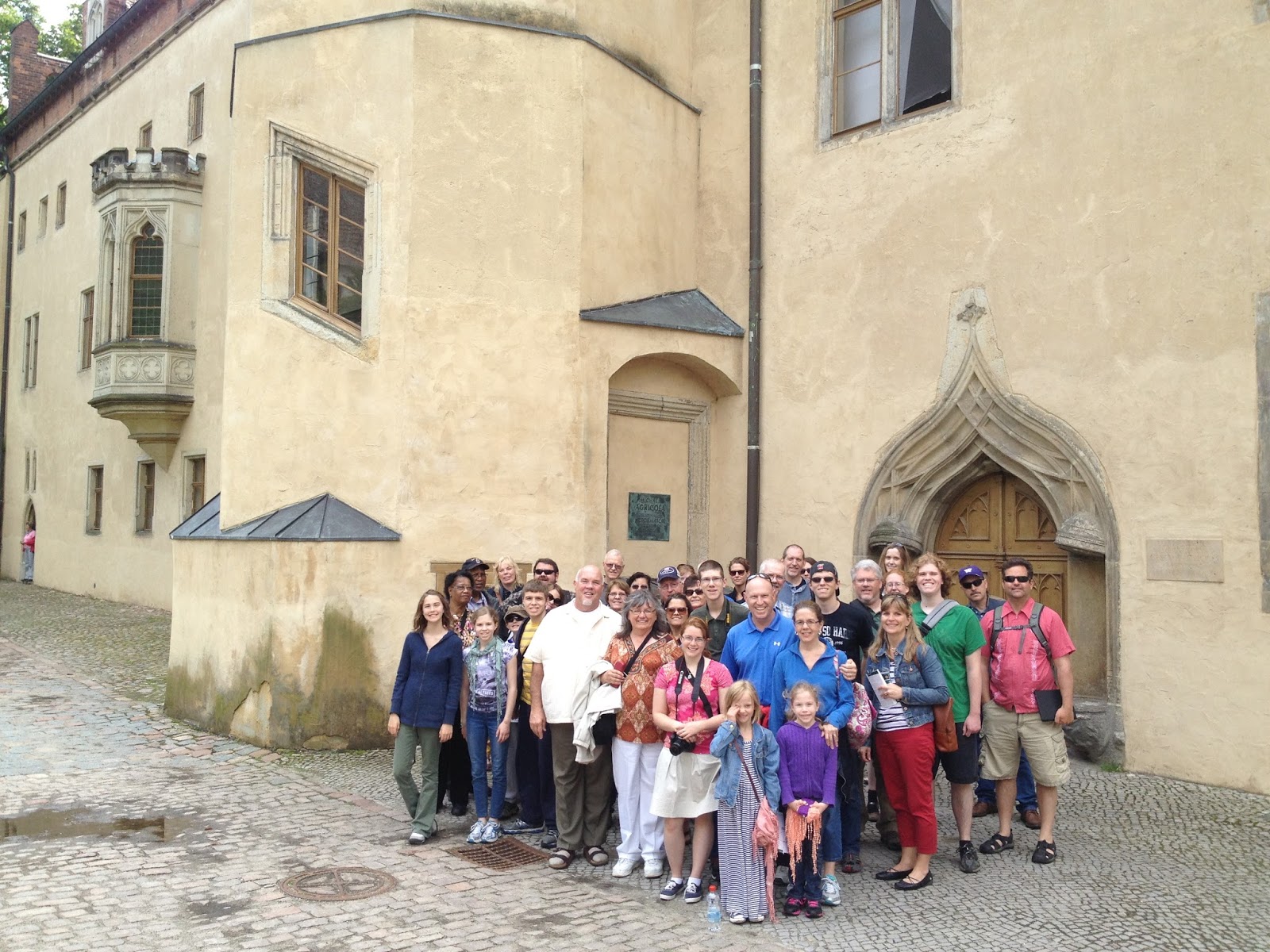
Bond tour group at Luther & Katie's cloister home
All Hallow's Eve, 1517, Luther had timed things appropriately. All Saints' Day, November 1, 1517 Duke Frederick put on a huge exhibition of his latest reliquary acquisitions--the latest additions to his bone collection--pilgrims coming to venerate (and pay handsomely for the privilege), earning 1000s of years off purgatory in the bargain. No coin collector could have been more devout; the duke was serious about his reliquary, and wanted to make Wittenberg into the Rome of Germany. Luther scholar Roland Bainton tallied the elector's treasury of merit: 

"The collection had as its nucleus a genuine thorn from the crown of Christ, certified to have pierced the Savior's brow. Frederick so built up the collection from this inherited treasure that the catalogue illustrated by Lucas Cranach in 1509 listed 5,005 particles, to which were attached indulgences calculated to reduce purgatory by 1,443 years. The collection included one tooth of St. Jerome, of St. Chrysostom four pieces, of St. Bernard six, and of St. Augustine four; of Our Lady four hairs, three pieces of her cloak, four from her girdle, and seven from the veil sprinkled with the blood of Christ. The relics of Christ included one piece from his swaddling clothes, thirteen from his crib, one wisp of straw, one piece of the gold brought by the Wise Men and three of the myrrh, one strand of Jesus' beard, one of the nails driven into his hands, one piece of bread eaten at the Last Supper, one piece of the stone on which Jesus stood to ascend into heaven, and one twig of Moses' burning bush. By 1520 the collection had mounted to 19,013 holy bones. Those who viewed these relics on the designated day and made the stipulated contributions might receive from the pope indulgences for the reduction of purgatory, either for themselves or others, to the extent of 1,902,202 years and 270 days. These were the treasures made available on the day of All Saints."

Luther had taken a great risk posting his 95 Theses decrying indulgences the day before. The duke was his patron, and though he appreciated the popularity his university had gained by Luther's bold teaching and preaching, this was too far. Luther was undaunted because he had seen through the whole hoax of indulgences and a righteousness earned by ones own imagined merit. “The church’s true treasure," he wrote, "is the merits of Christ in the gospel.”

From studying and teaching the Psalms, Galatians, Romans, and Hebrews, Luther had come to know that Rome had flipped everything around and had, thereby, done violence to the gospel, and that venerating the saints and their supposed merits was a supplanting of the merits of Jesus Christ. The realization was at first a personal one. “I must listen to the gospel," he wrote. "It tells me not what I must do, but what Jesus Christ the Son of God has done for me.” 

Transformed by the power of the gospel and the gift of faith, Luther had to tell the Good News to others. And he did, as only Luther could do. “The most damnable and pernicious heresy that has ever plagued the mind of men was the idea that somehow he could make himself good enough to deserve to live with an all holy God.”

Luther knew that the dukes exhibition scheduled for All Saints' Day, November 1, 1517 must be confronted. It was an affront to the gospel of grace, a supplanting of the authority of the Word of God, and an offense to true Christian worship. “The highest worship of God is the preaching of the Word, because thereby are praised and celebrated the name and the benefits of Christ.”

Finally, for Luther the risks to his person were worth it. Why? It was worth it because the Son of God is the only Savior and true friend of sinners. Johann Franck, German Lutheran pastor in the next generation expressed it this way: "Jesus, priceless treasure, fount of purest pleasure, truest friend to me."

Douglas Bond is author of many books, including LUTHER IN LOVE (2017). He leads Church history tours, including the Armistice 100 Tour, June 15-25, 2018, (Reformation tour of France, teen Calvin in Paris, Calvin's birthplace in Noyon; including teen atheist 2/Lt CS Lewis raging at God in the trenches of WW I, Huguenots in Rouen and Amiens, and the failure of Modernism in WW I and WW II). Space is limited so register (what better day to register than All Saints' Day, the day after REFORMATION DAY!). You can purchase a signed copy of LUTHER IN LOVE and his other books at bondbooks.net 

Monday, June 4, 2012

"Not like beet pancakes" WSC Reviews my book THE BETRAYAL

In the past few years there have been a number of cookbooks which give recipes that sneak healthy food into tasty dishes. I have firsthand experience with some of these recipes and can testify that some are hits (spinach brownies) and some are misses (beet pancakes—youch!). As a husband and father I am always trying to make palatable those things that I feel are important and significant for my family to know. As most of us who love theology and history have surely realized, our passions and interests are not always the same as the passions and interests of those we love. So we try to be creative and make the goods (theology, etc…) as interesting and palatable as possible for those nearest and dearest to us.
 
The Betrayal (P&R) is a biographical novel about the great Reformer John Calvin written by Douglas Bond. This book is definitely not like the beet pancakes... read more

Saturday, April 30, 2011

So Many rich conversations with readers at the CHHC today

One after the other, I had so many conversations that blessed me at this conference in Redmond, WA, conversations about grace and Christ and his glorious gospel of free, unmerited grace and the dangers of slavish legalism for us who have discovered homeschooling. My youngest son, Giles, was my manager, even signing books (under his name on the dedication pages). I spoke yesterday afternoon on John Knox to several hundred listeners, and then had many chats with folks about the importance of Church history as a means of developing heroes who were passionate followers of Jesus Christ, and who found Christ's strength and grace to slay arguments and overcome the enemies of the cross in their day. Listen below or at www.bondbooks.net

CHURCH HISTORY MATTERS: THE THUNDERING SCOT, April 29, 2011

MODELS OF CHRIST-LIKE LEADERSHIP FROM CHURCH HISTORY, April 30

CHRIST-CENTERED RELATIONSHIPS, April 30

THE DEVIL HATES GOOSE QUILLS, April 29

Sunday, May 31, 2009

NEW RELEASE: The Betrayal, a novel on John Calvin


THE BETRAYAL, a novel on John Calvin (click to order) is now available. Here's what some reviewers have writtten about the book.
"Douglas Bond introduces John Calvin to us in a gripping way, colorfully taking us back to Geneva and its times, unveiling Calvin as the principled man of action, commitment, and love that he was. The Betrayal makes for an exciting read, showing the great Reformer's heart for theology, piety, and doxology, while almost effortlessly and implicitly undoing caricatures about Calvin along the way. If you want Calvin and his times brought to life in a page-turner, this is the book for you!"
Joel R. Beeke
President
Puritan Reformed Theological Seminary
Grand Rapids

"With masterful insight, Douglas Bond offers us an illuminating portrait of the life, ministry, and theology of John Calvin. For readers of all ages, this well-researched, historical fiction takes us back to the sixteenth-century Reformation as if we were eye-witnesses of all that God accomplished in and through the life of His humble servant John Calvin. If you enjoy reading the fictional works of C. S. Lewis, you will love this book."
Burk Parsons
Editor of Tabletalk magazine
Minister of congregational life at Saint Andrew’s Chapel in Sanford, Florida

"Another great piece of historical fiction from Douglas Bond! As in his previous books, Bond provides a compelling narrative with clear historical accuracy and rich theological reflection. I don’t know if I have ever seen these aspects so compelling combined as in Bond’s books. This is why Douglas Bond is one of my family’s favorite authors. In this book Bond helps the reader grasp the humanness of Calvin, the manner of life in 16th century Europe and the real struggle for the gospel. This is a great entry way into the life of Calvin and the Reformation in general. It is entertaining and spiritually edifying. I commend it heartily."
Ray Van Neste, Ph.D.
Director, R. C. Ryan Center for Biblical Studies
Union University, Jackson, TN

“The events and ideas of John Calvin are captured in a lively, historical fiction, giving the famous theology a heart and voice. Douglas Bond’s eye for cultural detail frames the debates of the day in a specific time and geography, resulting in a fresh vision for our own times. Well done.”

Dr. Mike Sugimoto

Monday, May 25, 2009

Bond article in MODERN REFORMATION

Modern Reformation, special John Calvin quincentenary issue, June/July, 2009, features an article by Douglas Bond, On The Road: In the Footsteps of John Calvin. Click here to order a commemorative copy of the magazine http://twitpic.com/5kk63. Below is an excerpt:

History is filled with ironic convolutions. Consider the bungling of Scottish moderns placing a life-size bronze statue of John Knox in the ambulatory of St. Giles, Edinburgh, the very church in which Knox preached against idolatry. Or consider John Calvin decrying simony after his conversion when funding for his entire education had come from benefices his father had secured for him in his childhood.

Or consider thousands of Calvinists flocking to Geneva July 10, 2009 to commemorate the 500th birthday of the man who considered the medieval sacrament of pilgrimage to be one of the "faults contravening the Reformation." Is this yet another instance of self-contradictory theological buffoonery, a quest for merit tallied by stamps in the passport?

Tempting as these conclusions are to critics, I think not. As he lay dying, Calvin insisted that his body be buried in an unmarked grave. Some believe this was Calvin trying to avoid being the object of what he termed the “fictitious worship of dead men’s bones.” I’m inclined, however, to think that his dying request is yet another myth-buster; he didn’t want his bones enshrined because Calvin was so taken with the glory of Christ that the veneration of John Calvin never occurred to him. And for such humble piety alone Calvin would be worthy of our perennial attention.

SANCTIFICATION BY IMITATION
Theodore Beza, Calvin’s successor, in whose arms Calvin died, wrote of him on the final page of his account of Calvin’s life, “Having been a spectator of his conduct for sixteen years… I can now declare that in him all men may see a most beautiful example of Christian character, an example which is as easy to slander as it is difficult to imitate.” ...

THE BETRAYAL, A novel on John Calvin, by Douglas Bond, available soon.