Wednesday, January 17, 2018

Symbols, Suffering, and Showing (not telling)--INKBLOTS

Gargoyle straining under the weight of the world
After many weeks away and apart, Inkblots reconvenes, at last. Good to be back together again. Let's make sure we don't have gaps of this size again (my fault really, busy fall speaking schedule largely to blame, though a rich and  beneficial time, at least for me it was). We read from Psalm 131 and discussed some of the things that are too marvelous for us to grasp, and talked about God's providence, his will and way, so often mysterious to us, certainly always high above us. And about calming ourselves before the Lord's marvelous mysteries, sometimes, perhaps often, painful to feeble sinners in a broken world, longing for life in a world of death.

SYMBOLS

I led off reading a paragraph from Rosemary Sutcliff's Shield Ring, which I just finished reading with my daughter Gillian this evening before 'Blots (while she worked on her CC science project spread all over the living room; multiple reads over the years with the bigs). Sutcliff deftly elevated a ring on Bjorn's finger to the level of a symbol, a collector of meaning, a tangible connector to his past, a symbol of his heritage, of his Saxon ethnicity, of his identity and place in the new Viking world that he now lived in, now imminently under the threat of being crushed by Norman invaders (Reformation France/Armistice 100 Tour will be visiting William the Conqueror's birthplace in charming Bayeux and the Medieval tapestry, and where he is buried in Caen at Abby des homes--a few spaces still open, but not for long).

WRITING AND SUFFERING

Sidney will lead off with a portion of a novel she is writing, a passage that is informed in part by the death of her brother Isaiah the day before Thanksgiving. It is emotional and personal. This is clearly white-hot out of suffering and the immediate experience of loss and grief. But very much in control. there's no blubbering here (though there is absolutely nothing wrong with blubbering in our grief), no exploiting, only writing what she needs, as Lewis urges all writers to do, "Write what you need." Sidney is doing so brilliantly. There are so many rich uses of words here: Silent whisper of life; low moan, rattling of the throat, hastened footsteps (this reminds me of Lewis's description in Surprised by Joy of the night his mother died when he was nine); candles, their wax frozen mid drip; kiss of a ghost; silently giving up his soul to the blackness; a tender reed upon which life had trampled, and much more. 

This passage demonstrates the power of fiction. Sidney could write this as a non-fiction blog post (I've been reading her posts, and she has done so, very ably, with maturity beyond her years), but here there is a transcendence as if we the reader are looking from on high at the tragic and dramatic scene, and at the same time we are transported into the hospital room, the sights, sounds, smells (I think you could give us more of the smells), the wailing, the painful intake of breath. It is so painfully real, I am torn. I want to be there, and yet I want to run away (you want to be careful in an opening chapter to not be so weighty that your reader feels they need to run away or be crushed). The word painting is incomparably wonderful. But none of us are perfect. I have a few suggestions. Help readers have a clearer sense of from whose eyes we are seeing the world through. Mostly it is the boy, but then it seems to shift to the woman, the mother, who appears to take her own life, to the anguish of her son. Some of Sydney's description dangles, is not tightly connected to and affecting the protagonist. And there needs to be greater clarity on who, the protagonist actually is. I lost the thread of the boy's point of view. It may be in part your use of Time personified in the feminine and hence the shift to "She" pronouns. Compound that with the She pronoun for the mother. Clarify pronouns. "I hate and mistrust pronouns, every one of them as slippery as a fly-by-night personal-injury lawyer." Stephen King, On Writing

Patrick commented that there is a problem of whose world we are seeing things from, and, I'm interpreting him, maybe it is overly dense for a first chapter. I agree on a certain level. I think Sidney gives us too much in the opening chapter; it is lengthy for a first chapter, probably too lengthy. For a nine year old, the boy has intensely mature perspective and processes the action going on around him like an adult. I'd suggest giving the nine-year-old a legitimately mature vantage point on what is going on by making it clear that he is looking back on it all from an older perspective. Leave some of the backstory for a later chapter. You don't have to cover it all in the opening chapter, in fact, it is best not to do so. Maybe mapping it out would be helpful at this stage. Where are you going, at least in broad strokes. This will give more direction and clarity to how you use your artist brush in each chapter and episode.

I interviewed a young writer on my podcast The Scriptorium the other day and cautioned her that being a writer meant being a sufferer. Suffering is not a smorgasbord. There's no menu with lots of options. We don't get to request the particular flavor of suffering we would like, or how we would like it cooked. God chooses for us. He is sovereign over suffering, over all things; he is all-wise in the exercise of his sovereignty, and he is motivated purely by love for his children. Hence, "What ere my God ordains is right." Sidney, who is passing through some very deep waters, is writing what she needs in her suffering, as so richly illustrated in this passage she shared with us this eveing. Wonderful writing!

SHOW DON'T TELL

Patrick read next, his sci-fi futuristic yarn. Welcome to Mars. I love it. familiar hiss, I think that needs more work; maybe a simile or metaphor for the hiss, one that relates to and further intensifies the Mars context. Patrick does a fine job of keeping the action and pace moving forward. It's clearly his strength. But there's some work to do on showing rather than telling, creating depth and breadth to the narrative as it moves forward. For example, he writes, "The idea thrilled him." Could you show his thrill, his reaction, hastening of his pulse, sharp intake of breath, or better. Let the reader read what you have shown and say "he is thrilled." Another example, "Cloudless sky." Could you describe the color of the sky over Mars, with a comparison to a vintage car color, or?

"But first he had to introduce himself." You don't need to announce things like this. It's far more effective to do it, than to tell us you're going to do it, then do it. You could nuance this by showing body language that shows he forgets basic human relational interactions; silly me. Or the woman he needs to introduce could say something that jolts him into introducing her. I would also like to hear more dialogue. Patrick has lots of narrative sequential description, but it feels static. I feel like I am seeing a series of still photographs, with changes between shots, but not smoothly connected like the minute and fluid movements of a movie camera. As to introductions, when you do have them near the end of your reading with Joanna, it feels stilted, unnecessary to maintaining the pace. "Defiantly," avoid adding adverbs to attributions (Stephen King says that the road to hell is paved with adverbs). Show defiance in the words themselves, his posture, or tone, or a gesture.

We talked about the length of speculative fiction short stories, "short" is fairly long in this genre (9,000 words). How to create episodes and natural pauses without chapter breaks?

Where did the two hours go? Great to be back together with Inkblots. See you in a couple of weeks. Check out my new and improved (improving) web page bondbooks.net. Thanks to the amazing work of my summer marketing intern Sionna Spears.

Douglas Bond, author of more than twenty-five books, is husband of Cheryl, father of six, and grandfather of four. He is Director for the Oxford Creative Writing Master Class, two-time Grace Award book finalist, adjunct instructor in Church history, advisory member to the national committee for Reformed University Fellowship,  award-winning teacher, hymn writer, speaker at conferences, and leader of Church history tours in Europe. He broadcasts weekly at The Scriptorium. Follow him here and at bondbooks.net

Tuesday, January 16, 2018

Losing Your Mind--The Insanity of the Gospel

The Vicarage, Newton's home in Olney, Cowper's behind
"He's bonkers," they used to say of someone with insanity. In WW I, "He's blighty," they would refer to a soldier with shell shock. We call it mental illness, PTSD, dementia, early-onset dementia, or Alzheimer's. Whatever society calls it, we feel that something is not right about someone's words and behavior. "Have you lost your mind?" we say when something is not connecting the way the rest of us feel like it ought to connect. Or the way it used to connect.

BECOMING A CHILD AGAIN

My eighty-two-year-old father-in-law has lost his mind. Once a can-do-anything man, an ironworker, certified to weld every ore on the planet, now has stage-six Alzheimer's. The man of laughter and endless stories of bygone days with which he held his grandchildren spellbound and belly laughing for hours, not only doesn't remember any of those stories; he doesn't know his own wife, children, or grandchildren.

For him, the earlier stages of the disease were more difficult, when he knew he didn't know things he ought to know, and was frequently frustrated by that knowledge. But now there is a mercy in his mental oblivion. Mercy for him, though not for his dear wife and children who know he doesn't know them and are in anguish at the knowledge. "The more knowledge, the more grief," wrote the author of Ecclesiastes (1:18). Whatever else this means, surely it applies to a family watching a dear loved one steadily lose his mind. At the last, they become like a child in an old body, an infant again, who must have everything done for them.

Let's be honest. There's a nagging question that inevitably creeps into our minds, or onto our children's lips: "If Grandpa doesn't know anything or anyone anymore, does he still know Jesus?" Is he safe? When he has lost his mind, is his soul lost too? Is he still saved? God our Heavenly Father wants to hear all our lisping, all our stammering, all our quavering questions. And his Son answers this one. "Unless you become like little children," said Jesus to his disciples, "you will never get into the Kingdom of Heaven" (Matthew 18:3).

SUFFERING--THE SCHOOL OF POETRY

My travels take me frequently back to Olney in the United Kingdom, John Newton and William Cowper's village, the geographical origin of my literary endeavors over the last nearly twenty years. As I prepare for another visit, I am reminded again of the expansive reach of the gospel of grace. We can so easily slip into thinking that Christianity is for the morally upright, for people who have it together, for normal people, functional people, smart people, witty people, people who have not lost their minds. You know, people like we want others to think we are.

We scowl and attempt to explain what Paul really meant when it begins to dawn on us how the gospel actually works (or we clutch at our perceived good works and grind our teeth like the religious leaders of Jesus' day). It doesn't seem to connect. Jesus came for the sick, not for the well, for those sick in mind as well as in body. For smelly fisherman, not well-perfumed religious leaders; for lepers, not people with all their fingers and toes; for prostitutes, for victims of sexual abuse, for sexual abusers, not self-righteous moral purists; for swindlers, not for well-suited accountant types; for the illiterate, not for the strutting sophisticated academic; for the demon possessed, for those with dementia, with mental illness, for those who have lost their minds. For those who have lost their lives. For the dead.

William Cowper, born in 1731, one hundred years after the death of his ancestor and fellow poet John Donne, was one of those with great needs, special needs. He was one of the blighty. He was crushed under repeated bouts of insanity, even attempted suicides, odd behavior, dark depression, at times feeling himself a castaway, "whelmed in deeper gulfs" than any other. And yet God raised him up by the grace of the gospel, ministered to him through the love and kindness of his neighbor and pastor, John Newton, to be one of the Church's greatest hymn writers. 

FROWNING PROVIDENCE

Perhaps it was not in spite of, but because of Cowper's lifelong struggle with mental illness that he became one of the most tender of our hymn writers. He knew that God truly does "move in mysterious ways his wonders to perform." He knew that behind a "frowning providence" God truly does "hide a smiling face." Cowper gently, experientially teaches us that, "Blind unbelief is sure to err and scan his work in vain." God truly does work "deep in unfathomable mines of never failing skill." He truly does "treasure up his bright designs and works his sovereign will." God in his gospel truly "is his own interpreter and he will make it plain," in his time, in his way. 

With all of his mental challenges, Cowper knew that there really is a sort of insanity about the gospel. It is completely counter-intuitive. It defies economic sense, quid pro quo, this for that, balance the scale of bad deeds with good deeds. No. The gospel of Jesus Christ is a tertium quid, something altogether outside of and above all other religions. I want to get this, down deep in my soul. "O for a closer walk with God!" as Cowper cried. O to see more clearly the Light that "rises with healing in his wings." O to be washed in the precious "blood drawn from Immanuel's veins," there to "lose all [my] guilty stains." 

GOSPEL HEALING

We will always get the gospel distorted when we think it is only for the functional, the repectable, for people like we want to believe we are, and not for the insane, the ones who have lost their minds, for the dead, who must be raised to life by the gracious, sovereign mercy of God. Cowper reminds me of that.

When I am most honest about my own heart, my desperate need for grace--justifying grace, sanctifying grace, daily enabling grace--then I know that I am in some real sense much more like William Cowper with all of his mental disorders, or more like my father-in-law who has lost his mind, but not his soul. When I see myself as a little child, a nursing infant (Luke 18:15), one who needs to have everything done for me, one who must be carried into the Kingdom of Heaven, then God has made the gospel plain. He has been his own interpreter. Behind his "frowning providence," I see his "smiling face." And am healed of all my diseases (Psalm 103:3).

Douglas Bond, author of more than twenty-five books, is husband of Cheryl, father of six, and grandfather of four. He is Director for the Oxford Creative Writing Master Class, two-time Grace Award book finalist, adjunct instructor in Church history, advisory member to the national committee for Reformed University Fellowship,  award-winning teacher, hymn writer, speaker at conferences, and leader of Church history tours in Europe. He broadcasts weekly at The Scriptorium. Follow him here and at bondbooks.net

Wednesday, January 3, 2018

FEAR: Let's Be Honest


"We're going on a bear hunt. We're not scared," reads the charming, safe-scary children's board book. Forget bear hunting; the fact is, most of us are scared--afraid--a good deal of the time.  I'd like to pound my chest and tell you that I am never afraid. O, I used to be when I was a little 'fraidy-cat kid and didn't know any better, but now that I'm a grown man, I've conquered my childish fears and march unafraid into the fray. But it would be a lie. A pretty big one. I turned fifty-nine in 2017, and I've been calling my hair "premature" gray (now very much, white) for a number of years. My wife informs me it's well past time to drop the adjective. Birthdays are supposed to be happy occasions, but they have aging lurking menacingly in the shadows. Human beings are afraid of aging. The more honest ones admit it. 

Since my untimely (humanly speaking) termination from decades of teaching (I was replaced by two people, neither with gray hair), I've found that in my flesh I am a very timorous person, fleeing when no one is pursuing, yet fleeing, nevertheless--running scared. It doesn't reveal itself in trembling lip, and constant glancing over my shoulder, not literally. But there are plenty of the internal tremblings, anxieties, uncertainties, worries, hand wringing, the tossing-and-turnings of raw fear on sleepless nights. And sometimes it begets impatience, frustration, even anger, which, like Spenser's Dragon Error, feeds on its own offspring and produces more of the same--Fear. 

"No one ever told me that grief felt so like fear," wrote CS Lewis in the opening lines of A Grief Observed, penned after the death of his wife in 1960, just three years before his own death. Lewis got so many things right, especially when we take into account that he had no formal theological training, and he didn't even have Ligonier and the ministry of the late RC Sproul "to bridge the gap between Sunday School and seminary." But someone did tell him about fear. God did. "Fear not," is the most ubiquitous imperative in the Word of God. Why? Because fear is the universal result of sin and the curse. It clutches at the innards of everybody. "The day you eat thereof, you shall surely die." And death, philosophy's great problem, terrifies all of us. "But timorous mortals start and shrink.../And fear to launch away," as Isaac Watts put it. 

What a happy thought for the New Year! Well, in an important sense it is a happy one. Owning our sin and its just consequence, death and fear of death, is the first principle of abandoning all hope in solving the problem on our own hook. There is no solving it apart from God.  "God is our refuge and strength, a very present help in trouble," wrote the Psalmist (46:1). Because God chose to make his habitation with us, in the incarnation, to be tempted in every way, like we are--including tempted to raw fear of suffering and death--because God in Christ is our ever-present help.,"Therefore we will not fear..." (46:2).   

Just as there is the Grand Exchange of my sin and guilt imputed to Christ on the cross, and His perfect obedience imputed to my account, making me forensically righteous before His holy Father, there is in the Good News an exchange of fear. "Fear not, O little flock the foe/ That madly seeks your overthrow./Dread not his rage and power," wrote German hymn writer Johann Altenburg. In Christ, my Mighty Fortress, fear of man in all its pernicious forms fades away. And in its place comes right fear of God. 

"The fear of the Lord is the beginning of wisdom, and knowledge of the Holy One is understanding" (Proverbs 9:10). Right knowledge of ourselves as sinners before a Holy God who is justly angry with us for our sins produces the leading edge of right fear of God. God is good and we are not, so we fall down in terror and repent, crying to him for mercy. And then he purges us with the burning coal of true forgiveness. Then filled with grateful awe, we worship, we adore, we trust, we feed on, we live for, and, by grace alone, obey the glorious God who has stooped to rescue us from sin and death--and fear. 

I've never attempted to write a hymn on the theme of the fear of God before, but while reading through Proverbs and Table Talk for January 2018, I managed to write a hymn on the gracious blessing of fearing God, progressing, stanza-by-stanza, from the man, the woman, the sons, the daughters, the home, and the church that fears the Lord. My hope is that you will be blessed meditating on this important biblical theme with me. "How blessed is the man who fears the Lord... His heart is steady; he will not be afraid" (Psalm 112:1,8).

How blessed the man who fears the Lord!

Who daily feeds upon his Word,

And falls down at the mercy seat,

And casts his fears at Jesus’s feet.


How blessed is she who fears the Lord! 

Delighting, trusting in his Word:

She fears no danger, threat, or harm

While resting safe in Jesus’ arms.


How blessed are sons who fear the Lord!

Who hear and heed the Spirit’s Word.

No tyrant’s heel can hurt them here

Since they the Sovereign Lord revere.


How blessed when daughters fear the Lord!

And love God’s ways, his holy Word.

Disease and dying hold no fear

Since Christ who conquered death is near.


How blessed the home that fears the Lord!

Adoring the incarnate Word;

Like cherubim and seraphim,

In humble awe, God's praises hymn.


How blessed the church that fears the Lord!

Her Savior's work, her sure reward;

With wondrous voice, high praise repeats,

And bows in awe at Jesus' feet.

           Douglas Bond © January 2, 2018

Read and listen to more New Reformation Hymns at bondbooks.net where you can purchase Rise & Worship, Bond's recently released album with Greg Wilbur and Nathan Clark George. Follow Bond's podcast at blogtalkradio.com/thescriptorium

Monday, December 25, 2017

Why Christmas Carols Terrify Me

The bar is so high with carols. It is remarkable to me just how much charm and sentiment collect on the music we listen to, hum in the shower, sing at the wheel of our cars, and scramble to choose and sing our favorites at advent family devotions. Though "Jingle bells" and "Frosty the Snowman," predominate, Christmas is the one time of year when it is possible to stroll into a department store at the mall (I've heard about people doing this. I never do) and hear some of the Gospel being broadcast throughout the store, Charles Wesley's "Hark! The herald angels sing, glory to the newborn King!" echoing through the retail aisles as people shop for gifts. The climactic importance of the incarnation to the plan of redemption deserves the finest poetry and melodies. Nothing is more beautiful than God stooping to become man, to send his only begotten Son to save his people from their sins. Hence, carols are the Church's most endearing hymnody, and, in spite of the devout devotees to irreligious secularism who every year attempt to be Grinch and steal Christmas and her hymnody from the rest of the world, carols are intensely resilient. They are pervasive and even on some level captivate at least many of our otherwise secular-minded neighbors.

That's why they terrify me. Hence, as a hymn writer, I have given carols a wide berth, gazing longingly at them from the heights of Pisgah, but feeling barred from entering the hymnological Promised Land of carols. With such a vast and rich heritage in the whole canon of hymnody, it's terrifying enough to set oneself to write hymns on other biblical themes and passages, when so many others far more gifted and able than I have written hundreds of enduring hymns. It seems presumptuous. I constantly feel the great gulf seemingly fixed between my hymn writing heroes and my halting efforts. But writing a carol? "Miserable little pygmy, dust and ashes," as Luther berated himself attempting to perform his first mass, springs often to my mind as I write.

Terrified as I have been, I wrote one. Or attempted to. What Wonder Filled the Starry Night (Long Meter, LM, 8.8.8.8.) took me several years to go from initial brainstorming notes, idea banks and word banks, to actually completing the carol. And then with fear and trepidation I sent it out to critics and composers, and resorted to what any respectable poet would do: gnawed away on my fingernails, warily eyeing my inbox. Curiously, I have had more musicians, aspiring composers, and professional musicians write tunes for this carol than for any of my other hymns. Most recently Greg Wilbur has composed a charming tune (complete with subtle sleigh bells on Rise & Worship album). If my memory serves, Greg told me he thinks this might be his favorite of all my lyrics on our New Reformation Hymns album released August 2017.  I hope you have a Merry Christmas, and that you are blessed by my New Reformation Hymn carol (both advents, humiliation and exaltation).


What wonder filled the starry night
          When Jesus came with heralds bright!
I marvel at His lowly birth,    
          That God for sinners stooped to earth.
       
His splendor laid aside for me,
          While angels hailed His Deity,
And shepherds on their knees in fright
          Fell down in wonder at the sight.

The child who is the Way, the Truth,
          Who pleased His Father in His youth,
Through all His days the Law obeyed,
          Yet for its curse His life He paid.         
         
What drops of grief fell on the site
          Where Jesus wrestled through the night,
Then for transgressions not His own,
          He bore my cross and guilt alone.

What glorious Life arose that day
          When Jesus took death’s sting away!
His children raised to life and light,
          To serve Him by His grace and might.

One day the angel hosts will sing,  
          “Triumphant Jesus, King of kings!” 
Eternal praise we’ll shout to Him
          When Christ in splendor comes again!

                             Douglas Bond (December 16, 2010)

You can order the entire New Reformation Hymns album Rise & Worship at bondbooks.net

MERRY CHRISTMAS!

Wednesday, November 1, 2017

Luther's Timing: Why He Nailed His 95 Theses on All Hallow's Eve

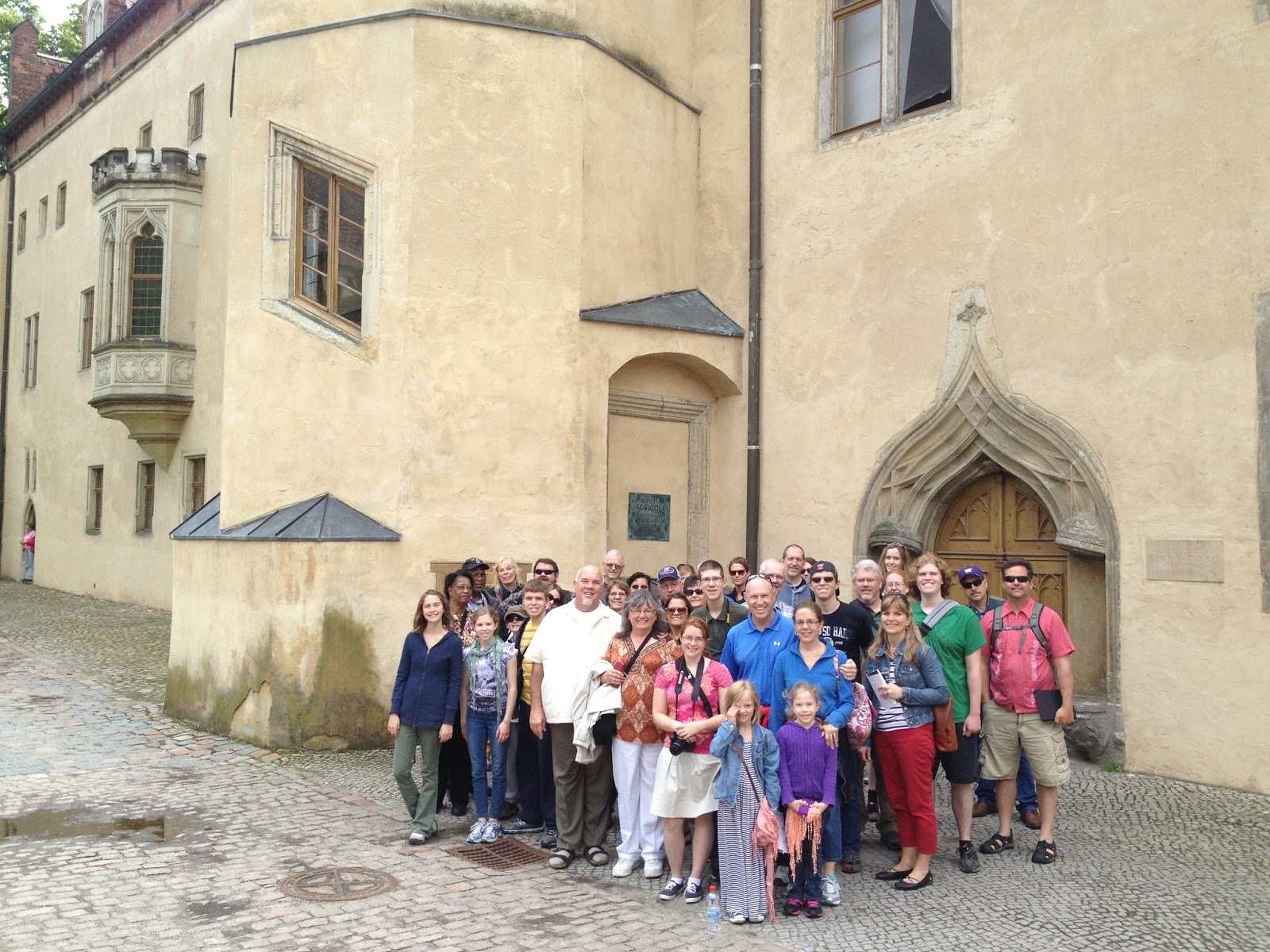
Bond tour group at Luther & Katie's cloister home
All Hallow's Eve, 1517, Luther had timed things appropriately. All Saints' Day, November 1, 1517 Duke Frederick put on a huge exhibition of his latest reliquary acquisitions--the latest additions to his bone collection--pilgrims coming to venerate (and pay handsomely for the privilege), earning 1000s of years off purgatory in the bargain. No coin collector could have been more devout; the duke was serious about his reliquary, and wanted to make Wittenberg into the Rome of Germany. Luther scholar Roland Bainton tallied the elector's treasury of merit: 

"The collection had as its nucleus a genuine thorn from the crown of Christ, certified to have pierced the Savior's brow. Frederick so built up the collection from this inherited treasure that the catalogue illustrated by Lucas Cranach in 1509 listed 5,005 particles, to which were attached indulgences calculated to reduce purgatory by 1,443 years. The collection included one tooth of St. Jerome, of St. Chrysostom four pieces, of St. Bernard six, and of St. Augustine four; of Our Lady four hairs, three pieces of her cloak, four from her girdle, and seven from the veil sprinkled with the blood of Christ. The relics of Christ included one piece from his swaddling clothes, thirteen from his crib, one wisp of straw, one piece of the gold brought by the Wise Men and three of the myrrh, one strand of Jesus' beard, one of the nails driven into his hands, one piece of bread eaten at the Last Supper, one piece of the stone on which Jesus stood to ascend into heaven, and one twig of Moses' burning bush. By 1520 the collection had mounted to 19,013 holy bones. Those who viewed these relics on the designated day and made the stipulated contributions might receive from the pope indulgences for the reduction of purgatory, either for themselves or others, to the extent of 1,902,202 years and 270 days. These were the treasures made available on the day of All Saints."

Luther had taken a great risk posting his 95 Theses decrying indulgences the day before. The duke was his patron, and though he appreciated the popularity his university had gained by Luther's bold teaching and preaching, this was too far. Luther was undaunted because he had seen through the whole hoax of indulgences and a righteousness earned by ones own imagined merit. “The church’s true treasure," he wrote, "is the merits of Christ in the gospel.”

From studying and teaching the Psalms, Galatians, Romans, and Hebrews, Luther had come to know that Rome had flipped everything around and had, thereby, done violence to the gospel, and that venerating the saints and their supposed merits was a supplanting of the merits of Jesus Christ. The realization was at first a personal one. “I must listen to the gospel," he wrote. "It tells me not what I must do, but what Jesus Christ the Son of God has done for me.” 

Transformed by the power of the gospel and the gift of faith, Luther had to tell the Good News to others. And he did, as only Luther could do. “The most damnable and pernicious heresy that has ever plagued the mind of men was the idea that somehow he could make himself good enough to deserve to live with an all holy God.”

Luther knew that the dukes exhibition scheduled for All Saints' Day, November 1, 1517 must be confronted. It was an affront to the gospel of grace, a supplanting of the authority of the Word of God, and an offense to true Christian worship. “The highest worship of God is the preaching of the Word, because thereby are praised and celebrated the name and the benefits of Christ.”

Finally, for Luther the risks to his person were worth it. Why? It was worth it because the Son of God is the only Savior and true friend of sinners. Johann Franck, German Lutheran pastor in the next generation expressed it this way: "Jesus, priceless treasure, fount of purest pleasure, truest friend to me."

Douglas Bond is author of many books, including LUTHER IN LOVE (2017). He leads Church history tours, including the Armistice 100 Tour, June 15-25, 2018, (Reformation tour of France, teen Calvin in Paris, Calvin's birthplace in Noyon; including teen atheist 2/Lt CS Lewis raging at God in the trenches of WW I, Huguenots in Rouen and Amiens, and the failure of Modernism in WW I and WW II). Space is limited so register (what better day to register than All Saints' Day, the day after REFORMATION DAY!). You can purchase a signed copy of LUTHER IN LOVE and his other books at bondbooks.net 

Tuesday, October 31, 2017

Why Luther Did It (Listen to Tetzel as the scoundrel bilks German peasants to build St Peter's)

"I loved this book! I laughed. I wept! I couldn't put it down."
On this Reformation 500 Day, read an excerpt where Dominican Friar Johan Tetzel deceives the peasant multitude near Wittenberg, and where Luther finds himself in a full rowling rage, a man on fire for the Truth:


22 PASSPORT TO PARADISE

"That’s him,” said Carlstadt, nodding toward the mounted friar. “Johann Tetzel. Notorious scoundrel, here to do the pope’s bidding.”

“And Albert of Brandenburg’s,” added Luther, the muscles of his jaw flexing.

“Archbishop Albert, you mean,” said his companion. “Or more accurately, Archbishop, Archbishop, Archbishop Albert. Archbishop three-times over is he. It is a bit of a mouthful to say.”

“And more impossible to do.”

Luther snorted in disgust. “He already has Halberstadt and Magdeburg and now Mainz. Canon Law forbids three archbishoprics, especially for an under-age upstart like Albert.”

“There’s good money in archbishoprics.”

“Indeed, but they come at a price,” said Luther.

“But worth it, so some believe. The banking house of Fugger lent Albert the ducats. It’s purely a business deal.” 
120

“Nothing pure about it, is there?” said Luther. “And the price is his eternal soul; who knows how many other souls along with him.” “Once a man has the revenue of an archbishopric,” continued Carlstadt, “let alone three, he can live like a prince.” “Until he dies,” said Luther.  “Dying and eternity seem entirely forgotten in Rome.” “Rome,” said Melanchthon, a faraway look in his blue eyes. “I have never been. What is it like?” “If there is a hell,” said Luther, “Rome is built over it.” “Is it as bad as all that?” “Worse,” said Carlstadt and Luther in unison.  “If only the putrefaction would confine itself to Rome,” said Carlstadt. “Word is Pope Leo X wanted Albert to pay 12,000 ducats for Mainz; to keep everything holy and biblical, the amount was meant to represent the twelve apostles.” “I have heard,” said Luther. “And Albert countered with an offer of 7,000 ducats for the seven deadly sins.” “Jawohl. Word is, they settled on 10,000 ducats, a vast sum of money.” “Manifestly not for the Ten Commandments,” said Luther, “of which neither of these charlatans has any inclination.” Carlstadt grabbed Luther’s sleeve and looked both ways. “Martin, you must be more guarded. Someone might think you were referring to the Holy Father.” Shrugging, Luther continued, “Tetzel, Albert, Leo—what is the difference?”  “The difference? Martin, surely you are not that naĂ¯ve. You can probably get by with criticizing a hireling friar, but an archbishop, still more, the pope himself? I can smell the faggots burning.” “Sniff away,” said Luther. “Albert colluded with the pope for a commission from ‘His Holiness’ to sell a new and augmented indulgence. I for one do not take kindly to a
121

German prince colluding with a luxury-loving Italian to fleece my poor flock here in our Saxony.” He frowned at the crowds pressing close to see the show. “Just how augmented?” asked Melanchthon. Nodding at the friar stepping up onto a makeshift platform, “I believe Tetzel is about to tell us,” said Luther.  “My dearest people of Wittenberg,” began Tetzel. “Words dripping with fat,” murmured Luther, “as a hog turning on the spit drips the same.”  Smiling expansively at his audience, Tetzel continued, “I have come at the behest of His Holiness himself, Pope Leo X from Rome; the Holy Father has sent me from the Eternal City. And I come bearing rich gifts for all Saxony.” At his signal, one of his attendants bowed before him, holding aloft a gold-gilded velvet cushion. With a flourish, Tetzel took a rolled parchment from the pillow. As if it were made of delicate lace, he unrolled it, and held it for them all to see.  “This, my good friends of Germany, is nothing short of your passport to the celestial joys of paradise. You priest, you noble,” he gestured with the indulgence toward them as he spoke. “You merchant, you virgin, you matron, you youth, you old man, enter now into your church, which is the Church of St. Peter. Visit the most holy cross erected before you and ever imploring you.” Here he paused, gesticulating dramatically at the cross held aloft by one of his courtiers. Draping from it was the scarlet banner and papal seal of Leo X, the banner fluttering in the breeze.  “Have you considered that you are lashed in a furious tempest,” continued Tetzel, “amid the temptations and dangers of the world, and that you do not know whether you can reach the haven for your immortal soul? Consider that all who are contrite and have confessed—and made contribution—will receive complete remission of all their sins.” A murmur of wonder rose from the crowd. 
122

“Complete remission?” came a voice from the crowd. Leering at the friar, the speaker pattered the tips of his fingers together expectantly. Ample flesh bulged around the edges of his greasy leather jerkin. “Did I not promise you I was bearing rich gifts?” replied Tetzel, nodding knowingly at the fellow. “With one of these indulgences, each bearing the papal seal, as you see, you may indulge yourself in sins, that is to say, in the forgiveness of sins—past, present, or future ones—as you wish, and for whom you wish.” He broke off theatrically, cocking his head, cupping his hand to his ear. “Do you not hear them? God and St. Peter call you. Consider the salvation of your souls and those of your loved ones departed.”   After placing the papal certification reverently back onto the velvet cushion, he continued, his voice quavering with apparent anguish. “Do you not hear the voices of your dead parents and other relatives crying out, ‘Pity us! Have mercy upon us, for we suffer great punishment. With a few coins, you could release us from our misery. We have created you, fed you, cared for you and left you our temporal goods. Why do you treat us so cruelly and leave us to suffer in the flames, when it takes only a little to save us?’” As if rehearsed, Tetzel’s attendants brandished two torches, flames hissing, black tentacles of smoke hovering over the crowds. Carlstadt leaned close to Martin’s ear. “What a pious fraud, is this.” “As soon as the coin in the coffer rings,” continued Tetzel, with obvious pleasure at his little jingle, “the soul from purgatory springs!”  At his words, his attendants yanked a drape from a bird cage. Wings beating the air, eight or ten white doves flew upward, cavorting over the wondering faces.
123

“Nothing pious about this fraud,” said Luther through gritted teeth. “He is an infernal, diabolical, antichristian fraud.” “Lay a stone for St. Peter’s in Rome,” continued Tetzel, “and you lay the foundation for your own salvation and felicity in heaven!” “The man is a mountebank,” said Luther, “unworthy to call himself a Christian. This is foul, despicable!” “So vastly generous is His Holiness in this indulgence,” persisted the friar, “so kindly extended to the good people of Germany, that there is no sin beyond its reach. Go ahead. Let your imagination roam the transgress-atorial possibilities, the unrestrained, unbounded trespass-atorial opportunities. Go on.”  Here, Tetzel proceeded to graphically describe the most horrific sinning that one could commit and yet Pope Leo’s indulgence was sufficient. “So virulent an indulgence do I hold in my hand, that one could herein find remission for the most heinous of sins—” He paused dramatically, snatching up the parchment and letting it tremble over the upturned faces of the crowd. “—For the very sin of violating the everVirgin Mother herself!” His congregation emitted a collective gasp at the thought.  Nodding approvingly, Tetzel appeared satisfied with their response.  “Will you not then for a quarter of a florin receive these letters of indulgence through which you are able to lead an immortal soul into the fatherland of paradise?” “Even Lucifer,” said Melanchthon, shaking his head in wonder, “was not guilty of so great a sacrilege in heaven. God help us!”  “A false preacher, such as this cheat,” said Luther, “is worse than the deflowerer of a virgin.” “Which according to common knowledge,” said Carlstadt, his eyebrows raised, “Tetzel is a master practitioner of such
124

deflowering.” He shook his head in disgust. “Look at them. The working poor of Wittenberg leave the walls of their village to come out here and give their quarter florin to this despoiler of souls.” Luther’s heart sank. “Wait! Is that not—? We must stop her. She has nothing.” Holding her grandmother’s hand, little Liesel turned. Waving, she grinned at them. “I believe a devoted woman such as she would gladly forfeit her own soul for her granddaughter,” said Carlstadt. “Perhaps that is the currency with which she is buying the indulgence.” “A swine like Tetzel won’t take souls,” said Luther. “He cares nothing for that woman and the dear little one. He only wants her money—and she has none. I believe I am watching the old dragon from the abyss of hell, parading in all this trumpery before us.” “Wait for me,” called Carlstadt as they marched back to the village. “You are angry, Martin. I cannot keep your pace.”  “Who would not be angered?” said Luther, his jaw set, the folds of his black habit swishing at his ankles, Melanchthon jogging at his side. “I fear for you.” Carlstadt, breathing hard, called after him. “You must calm yourself, act with restraint.” “Rage suits me,” said Luther over his shoulder. “I work better when I am angry, and I have work to do.”

Douglas Bond is author of many books, including LUTHER IN LOVE (2017). He leads Church history tours, including the Armistice 100 Tour, June 15-25, 2018, (Reformation tour of France, teen Calvin in Paris, Calvin's birthplace in Noyon; including teen atheist 2/Lt CS Lewis raging at God in the trenches of WW I, Huguenots in Rouen and Amiens, and the failure of Modernism in WW I and WW II). Space is limited so register (what better day to register than REFORMATION DAY!). You can purchase a signed copy of LUTHER IN LOVE and his other books at bondbooks.net

Wednesday, June 7, 2017

Christian Writers: Fools Confounding the Wise

Small gathering for Inkblots this warm summer evening, AC in the Scriptorium feeling pleasant and comfortable. We morphed into a discussion of the decadence of our society, trans-phobic, trans-perversion, trans-insanity, trans-depravity, trans-rebellion against everything God is and has ordained for the good of his world and humanity. God designed his world to work according to his will and way; defy that and it devolves into deeper decadence and decay. It won't work because it can't work.

I read from Elephants of Style (Bill Walsh of WaPo), getting the difference between affect and effect, a and an (not the article to use with the word historic, the consonant is pronounced, hence a not an). We discussed the irony and incompatibility of rules of grammar and style coming from writers who are vein-bulging champions of moral relativism on every other front (except their teeth-grinding intolerance of Christianity). But should we be shocked? No. Jesus said the world would hate his followers, as it hated and hates him. So what does the Christian writer do? Write to please Jesus, not to please the world.

Jonathan picks up where he left off on his "this is weird" story, sci-fi, madman yarn. Ingrid and the madman going at it. Pushing the button. There is such a fluidity to Jonathan's prose; I love hearing him read. Ingrid offers herself to the madman if only he won't push the button. He is unmoved. It would be immoral, wrong. Why would it be immoral, wrong? Because it just is, stammers Ingrid. Here the madman is the wiseman. Jonathan always is on a mission when writing, here apologetics, defense of the faith, exposing the fallacy of declaring something immoral without a first cause authority over right and wrong. The madman does it, pushes the button. Still nothing happens. Blow after blow on the button, yet nothing happened. Madman falls asleep and seems to persist in sleep. Ingrid and the rest settle back into the banal normality of their relativism. I ask Jonathan about his idea mill. How does he come up with these ideas, Poe-esque darkness, but purposeful, intentional. Allegory exposing the fallacies of secularism. This story came to him when North Korea's nuclear test failed. Hence, nothing happens when the madman pushes the button. Patrick commented that Hume believed that knowledge was unverifiable. And then some discussion of Immanuel Kant followed. Henry Allison, Kant's Transcendental Ideal.

Sydney brought a work of fiction she has been working on for a long time. Set in 1110, Anglo-Dutch War context. Odd creature gnawing on his fingers, wretched creature. Fluid narrative, setting up the scene. I'm hearing "appeared to," often. "Dusk at last." The first dialogue. Her evident (the qualifying adjective, overused, can weaken prose) discomfort. The higher register narrative works in the medieval setting, to my ear. Minute description of human expressions and actions. I love your "He remains" string of syntactical parallelisms. Is it the mother we are to be concerned with? Or whom? Sydney's reading of her work is riveting, engaging. It feels like a psychological exploration, searching, inward. But what is missing is an inciting moment in the story, enter conflict, exerting pressure. The narrative was intriguing, mature vocabulary, complex syntax, but we didn't know who to care about or what the real problem is.

Jonathan commented on the writing style being spot on. What about the characters? It felt like an info dump. He missed the opening hook. There is a great deal of beginning exposition, but what seemed to be missing was the inciting moment. We learned a good deal about the history of this family. Patrick commented that he had a hard time entering into a perspective. Was it the sister? The mother? Jonathan wanted to attach to the wretched creature, but Sydney didn't develop the tension. Sydney told us that the story is going to be about the family, a family member not yet introduced in this opening chapter. We should meet the protagonist in the opening lines. Right at the gate, give the reader the lens for the story and the person to care about. I read opening lines from chapter one and chapter two of The Revolt (Grace Awards finalist along with The Battle of Seattle), where, though I have two points of view throughout the story, I root the reader in their characters in the first lines of each chapter.

Story Grid, by Shawn Coyne, Jonathan has found helpful. Every scene has to have a turn. If the scene begins positive, then there is movement to negative, and visa-versa.

Sydney asks a very good question. She reads and loves the English classics. Which of the classics does this best, sticks with single perspective, avoids intrusive narrator, and begins medias res, right in the middle of the action, then adds backstory as needed throughout the story? Dickens in Great Expectations, medias res, "I'll eat yer heart and liver out!" But Shakespeare does this in almost every play. The inciting moment is the opening scene, then comes the setting and back story.

Join me next March 23-30 (2018) in Oxford for my Creative Writing Master Class.