Showing posts with label Paris. Show all posts

Wednesday, April 17, 2019

How Does a Cathedral Mean?


Notre Dame Paris, 2013

I've been thinking a good deal about Notre Dame burning in Paris. I know I am not alone. My first of many visits to the most visited monument in Paris (yes, more than the Eiffel Tower) was in 1982; our Armistice Centenary Tour visited Notre Dame ten months ago. I will never forget or ever be able to fully express in words what walking into an 850-year-old Gothic cathedral feels like. It still feels that way. 
To the thousands who participated in building it, what did all the splendor mean? To a world secularizing at warp speed, what does a centuries-old stone church mean? I explore some of these questions in chapter 27 of my WWII historical fiction book The Resistance (available at bondbooks.net). My protagonist downed B-17 pilot and his French Resistance escort are forced to hide from the encircling SS manhunt on the precipitous tiles of a Medieval house directly across the street from another French Gothic structure, Bayeux Cathedral. Here's what happened:


27
HEIGHT OF TERROR

T
he alarm now wailed in Evans’ head, unrelenting, inescapable. Then, abruptly, it was no longer internal.
From the street came the roar of engines, tires thrumming on the cobblestones, brakes screeching to a halt, doors slamming, jackboots clonking on the pavement. Crisp knocking on a door. Silence. Fists beating a door. Shouting in German. Rifle butts pounding on a door five stories below.
“Maybe it is another door,” hissed Andre, his face ashen. “Perhaps for someone else?”
Hasty footfalls came from the stairs, then rapid knocking on the door of Andre’s studio.
Through the keyhole came a breathless voice. “They are coming! Waffen SS!”
“For us? Are you certain?”
“Absolutely. At the door of the shop.”
“How much time?”
“Three minutes. No more,” and he was gone.
Aimée grabbed Evans’ arm. “We must hide you!” He drew in breath sharply. His shoulder was not fully healed yet.
“Forget me,” said Evans. “Hide Ruben.”
“It is you they are searching for,” said Aimée, her green eyes wide and imploring. “You are an American flyer. If they find you, they will arrest all of us, including Ruben.”
She turned to Andre. “Is there anywhere?”
“The roof.” With a sweep of his arm, he cleared the workbench. “Out the window. Climb along the gable. Do not fall. Hide behind the chimney. Be sure they do not see you.”
“I want to go home.” There was a quaver in Ruben’s voice; he tugged at Aimée’s hand.
“Evans, you must hurry,” said Aimée, leaning toward him as if to give him farewell kisses on the cheeks.
“No!” said Andre. “You must hide as well. I will take the boy down. He is my cousin. It will look normal with the boy. They are not searching for a little boy.”
Aimée began to protest.
“There is no time. Go now! Hide with the American. We will stall them.”
Swallowing the lump in his throat, Evans followed Aimée out the window and onto the steep, slate roof. He tried not to look down. The hard cobblestones, he knew they were far below.
Scrambling behind the chimney, Evans drew in a deep breath and let it out slowly. He’d flown bombing missions high over enemy-occupied Europe, antiaircraft riddling his Fort, Fw190 fighters swooping in for the kill. Why more raw fear at this?
He heard the SS captain barking orders at his men in German, the harsh commands echoing across the street below and bouncing back at them off the west façade of the cathedral. Dropping bombs from 20,000 feet on munitions factory buildings, dangerous as it was, was detached, impersonal, done with machines. This was close, human, intimate, and—he feared—soon to be face-to-face.
Aimée and Evans pressed against the brickwork of the chimney. It wasn’t much cover, but it was all they had. A soldier glancing up from the street at just the right angle, and they would be seen. They pressed closer together, hard against the ridge and the chimney. Evans heard and felt Aimée’s heart pounding next to him, and the clutching staccato of her breath. Or was it his own?
“All we can do is wait,” whispered Evans, his voice barely audible.
Aimée’s face was pale. “And pray.” She mouthed the words. “I could not bear it if anything happened to my little brother.”
He nodded, trying to slow down the hammering of his heart. Directly across the narrow street loomed the massive cathedral. Evans studied the intricate medieval statuary adorning the west façade. The resurrection of the dead, souls rising from tombs, some to heaven, more to hell. Clearly the stonemason was more interested in the howling torments of the damned in hell.
A spasm fluttered in Evans’ left hamstring muscle. He tried to ignore it. The spasm hardened, constricting and contracting, tightening into an iron fist. If only he could change positions. The pain was excruciating. He tried to relax, but it was impossible, not while clinging to a precipitous roof on a medieval house far above the street. Teeth clenched, a tremor ran through his body.
“What is the matter, Evans?” whispered Aimée.
He swallowed hard and attempted to control the quavering he knew would be in his voice if he spoke.
“Are you ill?”
 “Cramp,” he managed to mouth, “in my leg.”
“I am sorry for you,” she whispered. “Perhaps, pressure directly on the muscle?”
He nodded. Holding on for dear life, how was he going to apply direct pressure to the back of his thigh?
“Think of something else,” she suggested. She bobbed her head at the cathedral façade. “Think of that.”
He looked again at the medieval stonework; the muscle in his leg felt like hard stone. The writhing condemned in the Last Judgment scene looked like he felt at the moment. Evans studied the north portal. It began to make sense. The mason had chiseled stony vignettes from the Passion of Christ. There was the Last Supper, the betrayal, Jesus praying to his father in the garden; and there was the kiss of Judas, the arrest, torture, carrying the cross, brutal crucifixion.
Evans shuddered. The war, the SS bursting into homes, arrests, torture, senseless killing, reprisals, ambush, spies, double agents, secret radio transmissions—being shot down, bailing out, hunted, others in grave danger because of him. How would all that look in stone relief? 
He scanned back through the stone vignettes, the knot in his hamstring subsiding. Why had they done it, carved those scenes in stone, built the entire structure, all in stone?
It suddenly occurred to Evans that from this angle, cowering high atop the roof of a medieval house, he and Aimée were seeing parts of the cathedral others never saw. Statues so high up, so out of sight from passersby, they were impossible to be seen from the pavement. Slowly, he scanned the facade, higher and higher it continued. People had lived in the shadow of Bayeux’s cathedral for nearly 1000 years, and how many hundreds of intricately carved statuary had never been seen by anyone? Yet humble stonecutters had tap-tapped away for years, decades, generations, each successive mason doing his part to create this magnificent place, whether his work would ever be seen by anyone or not. What was so important that centuries of workers would do it?
As Evans mused, the sun began to set and a golden glow radiated from the façade of the ancient edifice. Even if it had been safe to speak aloud, what was on display at that instant was so spectacular, wonder alone would have hushed them.
What had the voice on the BBC broadcast said only a short while ago? “When Christ died, he died for you individually just as much as if you’d been the only man in the world.” Evans wasn’t at all sure what it meant; Sunday School had been long ago; he needed to think more deeply about it. But whatever it did mean, it made him feel that there had to be something bigger, far more important than his own troubles.
Jolted abruptly back to the peril of the moment, Evans and Aimée heard the harsh barking of the SS captain apparently reentering the street below. They could not see anything, but his words echoed from the gulf between the house and the façade of the cathedral.
“Please, God, not Ruben,” whispered Aimée.
Evans nodded in agreement. He wanted to see what was going on five stories below, in the street. He felt so helpless. What good was a flyer without his weapon, his plane? If only he could do something to stop the Germans.
“When will they leave?”
Evans shook his head. He had no idea. How long would they have to hide? All night?
The yelling continued, guttural, harsh, brutal. There was nothing to do but wait. Oddly, as they waited, involuntarily crammed together behind the chimney, high atop the medieval house, they began to feel detached from the commotion, as if their vantage point made them safe, at least for the instant.
“If I tell you something,” whispered Evans, “can you promise not to tell anyone else?”
Aimée looked wary. “Oui, bien sur.”
Evans cleared his throat, loosening the scarf at his neck. “I-I am not a big fan of heights.”
Aimée looked wide-eyed at him, and then her lips twitched slightly, as if she were restraining herself; it was hardly the time for humor.
“You are a pilot. You fly the mighty B-17, the Flying Fortress. The high-altitude bomber of your Army Air Corps. Are you telling me that you are afraid of heights?”
Evans nodded. “Always have been. Never liked climbing trees. Never slept in the top bunk. I told my younger brother it was the best mattress. Until one day he figured it out. I had to pay him off with marbles to keep quiet. And then we got older, but he still remembered.”
“It is courageous to do this.”
“What, to tell you?”
“I suppose. But I think it is courageous to fly high-altitude bomber airplanes when you are afraid of heights, in defiance of your fears.”
“Courageous? Maybe, or maybe just dull-witted.”
Aimée smiled. “You being dull-witted this morning at the checkpoint, it was merely a ruse de guerre.”
Evans nodded. “I get a hitch in my innards just hearing the words high-altitude. I really should have volunteered to do something closer to the ground.”
“Then you would not be here.” Aimée said it as a matter of fact.
Evans stole a glance at her.
Ruse de guerre,” she said. “Comprenez-vous?”
Evans swallowed, avoiding her gaze, her green eyes that looked right through you. Ruse de guerre, he understood. Deception of war. Everyone in wartime engaged in it—generals, prime ministers, spies, deep-cover agents. And so was he.
It was nearly dark. The yelling abruptly stopped. For an instant there was silence in the invisible gulf below them.  Suddenly, vehicle engines roared to life, and the SS sped north down the Rue de Bienvenu.


Read all of The Resistance by Douglas Bond

Wednesday, November 1, 2017

Luther's Timing: Why He Nailed His 95 Theses on All Hallow's Eve

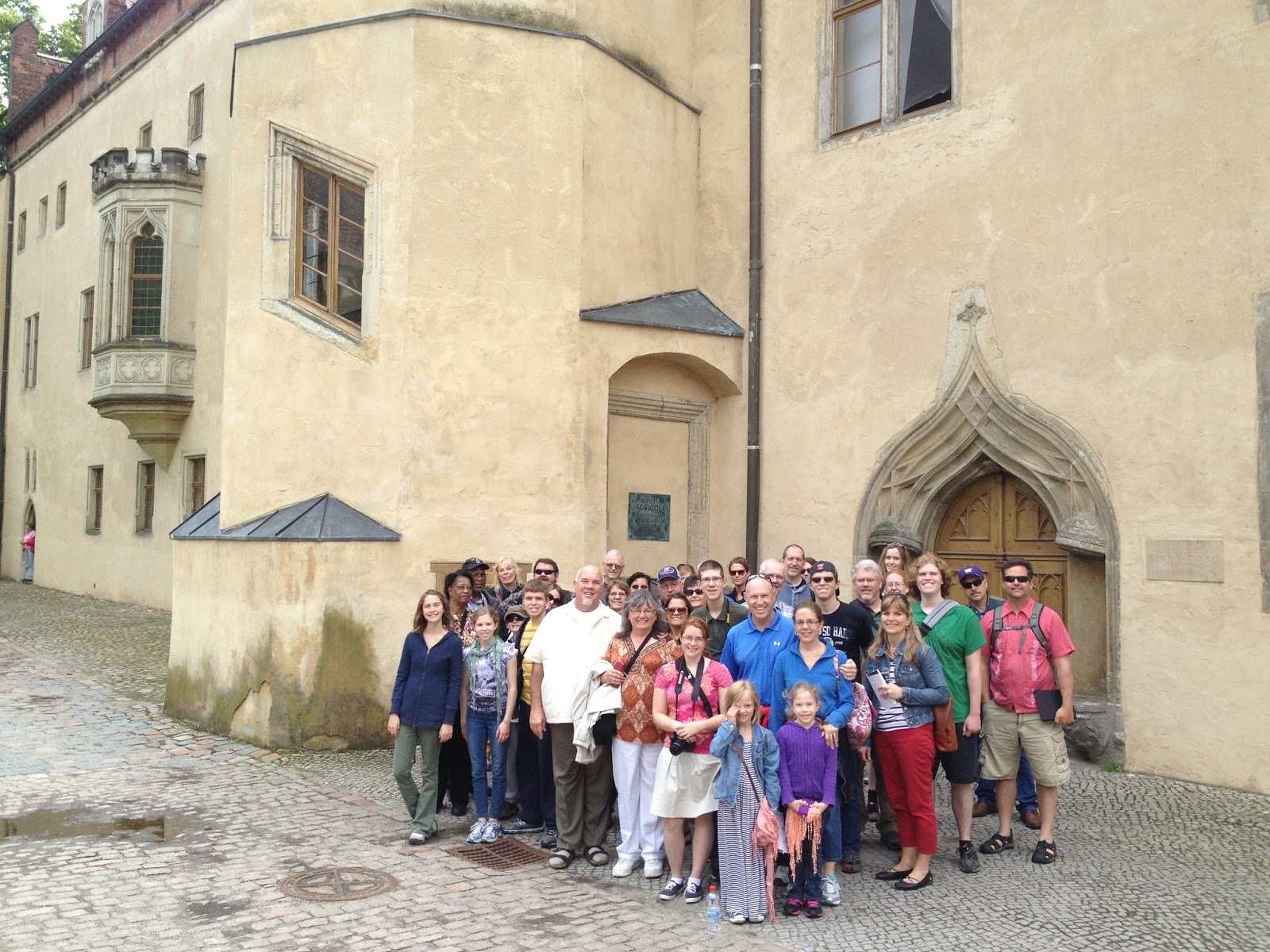
Bond tour group at Luther & Katie's cloister home
All Hallow's Eve, 1517, Luther had timed things appropriately. All Saints' Day, November 1, 1517 Duke Frederick put on a huge exhibition of his latest reliquary acquisitions--the latest additions to his bone collection--pilgrims coming to venerate (and pay handsomely for the privilege), earning 1000s of years off purgatory in the bargain. No coin collector could have been more devout; the duke was serious about his reliquary, and wanted to make Wittenberg into the Rome of Germany. Luther scholar Roland Bainton tallied the elector's treasury of merit: 

"The collection had as its nucleus a genuine thorn from the crown of Christ, certified to have pierced the Savior's brow. Frederick so built up the collection from this inherited treasure that the catalogue illustrated by Lucas Cranach in 1509 listed 5,005 particles, to which were attached indulgences calculated to reduce purgatory by 1,443 years. The collection included one tooth of St. Jerome, of St. Chrysostom four pieces, of St. Bernard six, and of St. Augustine four; of Our Lady four hairs, three pieces of her cloak, four from her girdle, and seven from the veil sprinkled with the blood of Christ. The relics of Christ included one piece from his swaddling clothes, thirteen from his crib, one wisp of straw, one piece of the gold brought by the Wise Men and three of the myrrh, one strand of Jesus' beard, one of the nails driven into his hands, one piece of bread eaten at the Last Supper, one piece of the stone on which Jesus stood to ascend into heaven, and one twig of Moses' burning bush. By 1520 the collection had mounted to 19,013 holy bones. Those who viewed these relics on the designated day and made the stipulated contributions might receive from the pope indulgences for the reduction of purgatory, either for themselves or others, to the extent of 1,902,202 years and 270 days. These were the treasures made available on the day of All Saints."

Luther had taken a great risk posting his 95 Theses decrying indulgences the day before. The duke was his patron, and though he appreciated the popularity his university had gained by Luther's bold teaching and preaching, this was too far. Luther was undaunted because he had seen through the whole hoax of indulgences and a righteousness earned by ones own imagined merit. “The church’s true treasure," he wrote, "is the merits of Christ in the gospel.”

From studying and teaching the Psalms, Galatians, Romans, and Hebrews, Luther had come to know that Rome had flipped everything around and had, thereby, done violence to the gospel, and that venerating the saints and their supposed merits was a supplanting of the merits of Jesus Christ. The realization was at first a personal one. “I must listen to the gospel," he wrote. "It tells me not what I must do, but what Jesus Christ the Son of God has done for me.” 

Transformed by the power of the gospel and the gift of faith, Luther had to tell the Good News to others. And he did, as only Luther could do. “The most damnable and pernicious heresy that has ever plagued the mind of men was the idea that somehow he could make himself good enough to deserve to live with an all holy God.”

Luther knew that the dukes exhibition scheduled for All Saints' Day, November 1, 1517 must be confronted. It was an affront to the gospel of grace, a supplanting of the authority of the Word of God, and an offense to true Christian worship. “The highest worship of God is the preaching of the Word, because thereby are praised and celebrated the name and the benefits of Christ.”

Finally, for Luther the risks to his person were worth it. Why? It was worth it because the Son of God is the only Savior and true friend of sinners. Johann Franck, German Lutheran pastor in the next generation expressed it this way: "Jesus, priceless treasure, fount of purest pleasure, truest friend to me."

Douglas Bond is author of many books, including LUTHER IN LOVE (2017). He leads Church history tours, including the Armistice 100 Tour, June 15-25, 2018, (Reformation tour of France, teen Calvin in Paris, Calvin's birthplace in Noyon; including teen atheist 2/Lt CS Lewis raging at God in the trenches of WW I, Huguenots in Rouen and Amiens, and the failure of Modernism in WW I and WW II). Space is limited so register (what better day to register than All Saints' Day, the day after REFORMATION DAY!). You can purchase a signed copy of LUTHER IN LOVE and his other books at bondbooks.net 

Friday, July 3, 2009

Calvin Tour: first day in Paris

We left Hotel Minerve on the Rue des Ecoles in the heart of the Latin Quarter for a short walk to the Paridis Latin, today a sizzling Paris nightclub, but in the 1140s it was an abbey founded by Bernard of Clairvaux. In the 15th century it was the College Cardinal Lemoine where Lefevre taught free grace, sovereign electing love, and predestination. It was the place where young William Farel came and first heard the glorious gospel that he could be saved, not by his sacremental attempts at faithfulness, but alone by the blood and imputed righteousness of Jesus Christ.

Next we walked up the Rue Cardinal Lemoine to St. Etienne du Mont where Pascal is buried and where Calvin as a student at College de Montaigu only two doors away would no doubt have gone to mass; he very likely would have taken mass many many times in this very church. While a student at College de Montaigu, from 1523-1528, Calvin would have in all likelihood often attended mass at this 13th century church. It is notable that at the Pantheon just across the street are buried two of the most ardent advocates of rationalist philosophy contradictory to Calvin and Reformation Christianity, Voltaire and Jean Jacques Rousseau. I read from the papal indulgence for the 2000 anniversary of the birth of St. Paul—2009, current indulgences in the RC church. Not much has changed. Consider the monstrous irony of selling an indulgence in commemoration of the Apostle of free grace and imputed righteousness! “…having a righteousness, not our own…”

Of particular interest is the College de Fortet one block away on the Rue Valette. Here Calvin lived and studied Greek and Hebrew from 1531-1533, and from here he escaped out the upper window of the tower on the inner courtyard. After Cop’s All Saint’s Address at Couvent de Cordelier, and word got out that Calvin had either crafted the entire biblical exposition, decrying abuses and false doctrine in the Roman church, or contributed significantly to it, Calvin was a hunted man. It is a private courtyard with locked entry, so we were particularly grateful to the Lord for his kind providence in getting our entire tour group of 49 people into the significant Calvin site.

We paused in front of College de Montaigu at the plaque that commemorates Erasmus’s time of study at that college of the University of Paris. It is today the library of St. Genevieve, a vast library with first edition holdings of many great works by the who’s who of Western Civilization. These names are carved in stone on the upper panel of the exterior of the college, including Calvin, Luther, Melanchthon, Margerite de Valois, Clement Marot, even Las Casas. Brittany and I succeeded in getting in Montaigu for all of 2 minutes before we were summarily escorted to the door (not before I managed to make a photograph). Now way for the entire group.

Passing by the vast buildings that make up the Sorbonne, the University of Paris, we made our way to 27, Rue de Conde, the House of the Bronze Horse, gifted by Francis I to his court poet, Cement Marot. Marot became a true Reformation Christian and began versifying Psalms, perhaps right within these walls in the shadow of the Odeon Theatre (Brittany Bond and Gina Biber in front of the House of the Bronze Horse). When word got out, he too was a hunted man and fled first to the court of Renee of Farrar, Christian Duchess, one time betrothed to Henry VIII of England (get in line). Eventually he made his way to Geneva and assisted Calvin and others in versifications of the Psalms for singing in worship, the first edition of which appeared as the Geneva Psalter in 1551.


Making our way over to the Rue des Ecoles Medicine, we entered the gateway into the Couvent de Cordilier, where Nicholas Cop delivered his address; this 1533 address was the Rubicon for Calvin and the other Reformers in Paris. The building is today part of the School of Medicine of the university and frankly in disrepair. There is no plaque commemorating most of these sites, especially none here. Several of us climbed the circular stairway on the southwest tower (see video of this and many other cites on my youtube site), clearly Calvin vintage.

Our morning tour concluded here, and Brittany hailed a taxi to get Harry (87) and Eunice (86) Desoto, our most senior travelers, back to Hotel Minerve, air conditioning, and rest. From there we went on to La Procope Café, which claims to be the oldest coffee shop in the world, established 1685 (the year Louis XIV revoked the Edict of Nantes, and resumed persecution of Huguenots… not sure if this makes coffee shops all bad or not; not being a coffee drinker, I’m a bad one to make that call). We went on to the Musee d’Orsay, where ma belle Cheryl dutifully picked out ten paintings or statues she liked best and briefly explained why. After picking up a cake for Paul Darby’s 50th and He and Dawn’s 15th anniversary, we headed back for another fine dinner in the dungeon (see photos) at the Bistrot de la Montaigna.


After dinner the hearty headed off to the Eiffel Tower, a monument to Modernism, lit up, vast crowds picnicking and drinking wine on the lawn, North African immigrants aggressively hawking mini Eiffel Towers to everyone. Back to hotel late, tired and full of Paris. I do wonder how many people have been so charmed by Paris that they’ve happily sold their souls for the lights, the cafes, the wine, the women, the monuments to man’s achievements—it is all so charming and happiness inducing--until one is awakened with cosmic rudeness in hell.

Wednesday, July 1, 2009

Picnic at sunset on the Seine

Brittany and I had a delightful dinner picnic on the banks of the Seine hosted by her friend Gina, a wonderfully committed Christian who is studying in Paris. We watched the sun set and had a rigorously stimulating conversation (I love these) about the things of God with a Colombian man named Eduardo who now lives and works in Paris. He is a Christian who believes in gifts of healing and of wealth. "I believe in the prosperty gospel," he told me. We discussed these things as Seine boats chugged by loaded with tourists from all over the world. He explained all the miracles he had seen and experienced, everyone of them not a miracle in the biblical sense of the word; a leg straightened, a skin problem instantly cured, a government check that covered three months rent (this is France so far from a miracle for the governement to be throwing away other people's money!). I asked him if he's someone raised from the dead, or blind from birth and everyone, believer and unbeliever alike, knew the man was blind from birth, had he seen these kinds of real miracles? It comes down to two things at least: How do you define what a real miracle is? [God acting supernaturally above natural order he has established in the world], and Are we to insist that sign gifts, miracles, are to be the ordinary, the normative, experience of Christians throughout every period in redemptive history. I don't think he had thought of these things and examples from Scripture that help us answer these and other related questions. About an hour and a half discussion, the Louvre glowing in the fading evening light across the river... charming setting, Paris is.

Tuesday, June 30, 2009

Calvin Escapes from Paris

St St. Etienne du Mont is the church where Blaise Pascal is buried, and the relic of St. Genevieve, patron saint of the city of lights rests in an elaborate sarcophogus, shown in the video clip on the title link above. Calvin studied at College de Montaigu diagonally across from this 13-century church, and from 1531-33 lived on Rue Valette in an upper tower room at the College de Fortet. It was from here that he was forced to flee for his life out an upper window down a rope, escaping the city disguised as a vinter. I find it impossible to believe that devout teenage Calvin did not cross the street many times and attend mass in this church. He wrote little about his own life, so there is no written record of this, but one only needs to visit this incomparable church to believe that Calvin, committed papist that he admits he was in his youth, did not often enter these walls.


Readers of my book The Betrayal, a novel on John Calvin, will notice the striking similarity of the back courtyard arch near the College de Fortet, University of Paris where, in 1533, Calvin escaped out the window of his tower rooms .


Notre Dame, Paris, one of the best known cathedrals in the world, was a pilgrimage sight throughout the middle ages, pilgrims coming to venerate the alleged crown of thorns, the stone on which the finger of God wrote the Decalogue, and other relics. Calvin believed the idea of pilgrimage was unbiblical, one of the false sacraments "contravening reformation." Calvin was consumed with zeal for the glory of God, and pilgrimage shifted glory away from God to saints and their moldering remains. He would disapprove, incidentally, of Calvinists going on pilgrimage to Paris, Geneva, Strasbourg, and Noyon as we are doing as I write. However, I think he might have approved if we did this with the single goal of learning more of the majesty of God, and being consumed, as Calvin was, with worship, adoration, proclamation, and service to our Sovereign Lord and loving heavenly Father. The plaza stretching in front of the cathedral was one of the favorite martyr sites in Paris, and twice, in 1542 and 1544, piles of Calvin's now famous (infamous to Roman Catholics) Institutes were put to the torch. Calvin had prefaced the Institutes to Francis I, monstrous persecutor of Christians, as an appeal to stop the torturing and killing of Christians in his realm.


August 23, 1572, the chiming of the bell "Marie" on the 12th century square tower of the royal chapel, St. Germain l'Auxerrois, next to the Louvre (once the royal residence in Paris) was the agreed upon signal to begin the St. Bartholomew's Day Massacre. 3,000 Huguenots were killed in this neighborhood in Paris, with estimates of 20,000 throughout the country. In 1523, fourteen-year-old Calvin lived with his uncle Richard Calvin on the Rue de Vallette, a nearby street that no longer bears that name.

Click on the title linked above to my youtube account for video clips of all these places and much more.

Sunday, June 28, 2009

First Day in John Calvin's Paris

Brittany and I arrived in Paris this morning bright and early... well the day was pretty bright, I, however, was not. I had taken benedryl to help me sleep on the plane and it hadn't worn off. It's now evening and I've been sitting on our fifth floor balcony overlooking the Latin Quarter and thinking about Calvin walking the streets below 500 years ago. I thought as I relaxed after a long day of walking and exploring back alleyways of what he wrote about justification solely as a gracious act of God, "Whatever men study to add from the power of free will to the grace of God is only a corruption of it [the grace of God]; just as if one should dilute good wine with dirty water." I reflected soberly on his apt metaphor.

We did spend a wonderful Lord's day, first at the Scots Kirk for morning worship (Calvin would not have been impressed; the minister seemed more impressed with political correctness than than the majesty of Christ). Next we sniffed out several places where I had read about Calvin's connection to those places but had not been successful at finding any actual guide book material on them (this is the majority of Calvin sites in Paris).

We found the Couvert du Cordiliers, which is reported by some historians to be the church that Nicolas Cop preached his All Saint's Day sermon, penned in all likelihood by Calvin himself, an exposition of the beatitudes that clearly defined Cop, the rector of the University of Paris and son of the royal physician, with the the Reformation rediscoveries of justification by faith and Christ alone for salvation.

We found the weary old house King Francis I gave to court poet, Clement Marot, who later had, like Calvin, a "sudden conversion" and was forced to flee France for his life. In Geneva, Calvin put him to work helping with the versification of Psalms for the Geneva Psalter (I asked at a used book faire if the seller had one; my daughter confirmed that my French was correct; the problem was, he'd just never heard of a psalter before, and he was selling religious books... tragically sad).

We visited St. Etienne du Mont where St. Genevieve, patron saint of Paris is buried (and reflected on what Calvin wrote about pilgrimage to venerate such relics as a chief error "contravening reformation"), also, and more importantly, where Blaise Paschal is buried, and the Tour St. Jacques where he made important discoveries about the effects of altitude on barometric pressure (I'm sure his discovery helped us get here in a pressurized aircraft cabin safely). We also bumped in to Hemmingway, James, Joyce, Louis Pasteur, and Erasmus related sights. We discovered a tiny street named Rue de Jean Cauvin, near the University of Paris where he studied.

We ended up at St. Sulpice, the large Roman Catholic church to see what got Calvin so upset about the established church in his day. Not much has changed (more about the latest papal indulgence later). But the organ playing was good and so was the singing (you can watch and listen at http://www.youtube.com/my_videos or at the link on the title of this post).

Monday, May 25, 2009

Bond article in MODERN REFORMATION

Modern Reformation, special John Calvin quincentenary issue, June/July, 2009, features an article by Douglas Bond, On The Road: In the Footsteps of John Calvin. Click here to order a commemorative copy of the magazine http://twitpic.com/5kk63. Below is an excerpt:

History is filled with ironic convolutions. Consider the bungling of Scottish moderns placing a life-size bronze statue of John Knox in the ambulatory of St. Giles, Edinburgh, the very church in which Knox preached against idolatry. Or consider John Calvin decrying simony after his conversion when funding for his entire education had come from benefices his father had secured for him in his childhood.

Or consider thousands of Calvinists flocking to Geneva July 10, 2009 to commemorate the 500th birthday of the man who considered the medieval sacrament of pilgrimage to be one of the "faults contravening the Reformation." Is this yet another instance of self-contradictory theological buffoonery, a quest for merit tallied by stamps in the passport?

Tempting as these conclusions are to critics, I think not. As he lay dying, Calvin insisted that his body be buried in an unmarked grave. Some believe this was Calvin trying to avoid being the object of what he termed the “fictitious worship of dead men’s bones.” I’m inclined, however, to think that his dying request is yet another myth-buster; he didn’t want his bones enshrined because Calvin was so taken with the glory of Christ that the veneration of John Calvin never occurred to him. And for such humble piety alone Calvin would be worthy of our perennial attention.

SANCTIFICATION BY IMITATION
Theodore Beza, Calvin’s successor, in whose arms Calvin died, wrote of him on the final page of his account of Calvin’s life, “Having been a spectator of his conduct for sixteen years… I can now declare that in him all men may see a most beautiful example of Christian character, an example which is as easy to slander as it is difficult to imitate.” ...

THE BETRAYAL, A novel on John Calvin, by Douglas Bond, available soon.