“We must beware lest our ears be more intent on the
music than our minds on the spiritual meaning of the words. Songs composed
merely to tickle and delight the ear are unbecoming to the majesty of the
church and cannot but be most displeasing to God.” (John Calvin)
Playing at worship
One pundit quipped that Americans “worship their work, work at their play, play at their worship.” I suspect that most Christians would
object. Entertainment evangelism “worship,” for them, is the best thing that’s
happened to church; the building is full, and look how happy everybody
is.
But the numbers may be skewed.
According to the Barna Research Group, though five out of six males consider
themselves on some level to be Christians, only two out of six regularly go to church. They may be
full, but many American churches are two thirds female and one third male.
There are many reasons for this,
but changes in music may take center stage. But the debate over worship music,
ironically, isn’t very much about worship. Few proponents of entertainment worship music ask what
music is appropriate for the worship of God. Instead, with the best of intentions,“They imitate the nations
around them” (II Kings 16:10; 17:15-41) in order to be relevant to their tastes and evangelize them.
A leading church-growth expert candidly admits this. “What kind of music do you
listen to?” he asked the folks in his community. “I didn't have one person who
said, ‘I listen to organ music.’ Not one. It was 96-97% adult contemporary,
middle-of-the-road pop. So, we made a strategic decision that we are
unapologetically a contemporary music church.”
Well-intentioned
Christians have reinvented what goes on at church by shifting the question. Young church planters generally ask: “What does the world like to listen to?” rather
than “What music is appropriate to worship God in the splendor of his holiness” (I Chronicles 16: 29b-30a)? Thus, church growth becomes the
all-excusing rationale for what people sing in church. And they tell us it’s
working. “Right after we made that decision and stopped trying to please
everybody,” claimed one church-growth expert, his church “exploded with growth.” End of
discussion.
Or
is it? Roman emperors packed out arenas by giving entertainment-crazed citizens
what they liked. People showed up in droves. We too are a culture that values
amusement. We like to feel good. We like to sway and clap. We like rapid images
passing before us. We like celebrity. And we’ll pay for it. Church growth
proponents argue that cashing in on the postmodern infatuation with
entertaining music will fill churches. So give them what they want.
The late Neil Postman, in his book Amusing Ourselves to Death cites the
executive director of the National Religious Broadcasters Associations who
seems to agree with the church-growth philosophy: “You can get your share of
the audience only by offering people something they want.”
Postman, though no Christian, made
the perceptive observation: “This is an unusual religious credo. There is no
great religious leader—from the Buddha to Moses to Jesus to Mohammed to
Luther—who offered people what they want. Only what they need.”
When the church fashions worship to
entertain the world, to give people what they want, it inevitably creates, as
one journalist termed it, “a Christian ghetto watering down the gospel.” Moreover,
when the goal is to make Christian worship appealing to a feminized culture we
inevitably alter the message and make it less offensive--and less Christian.
Whenever Israel imitated the pagan worship
of the nations around them, God became angry and judged them. Thus, John Calvin
urged that “all human inventions in worship be removed and driven from us,
which God himself justly abominates.” Far from aping the world, Christian men
ought to stand against the impulse to reinvent worship so it looks and sounds
like the world.
Loud, loud, loud!
In Screwtape Letters, C. S. Lewis described heaven as a region of
music and silence. The demon Screwtape is frustrated by this reality: “Music
and silence—how I detest them both!” He boasts that in hell:
No moment of
infernal time has been surrendered to either of those abominable forces, but all
has been occupied by Noise—Noise, the great dynamism, the audible expression of
all that is exultant, ruthless, and virile—Noise which alone defends us from
silly qualms, despairing scruples, and impossible desires. We will make the
whole universe a noise in the end. We have already made great strides in this
direction as regards earth. The melodies and silence of Heaven will be shouted
down in the end. But I admit we are not yet loud enough, or anything like it.
But
contemporary church growth enthusiasts, however, don’t seem to agree. “We are
loud,” says one mega-church pastor. “We are really, really loud. I say, ‘We're
not gonna turn it down.’”
Conversely, Lewis sees music and
silence as complimentary features of heaven. He gets this, of course, from biblical
passages where God calls us to “Be still and know that I am God,” and to “sing
for joy.”
But does high-volume rock ‘n’ roll
fit with the music and silence that Lewis describes, or does it sound more like
the noise and loudness Screwtape and many church growth leaders prefer? This
isn’t as hard a question as we’ve made it. Nevertheless, church growth
advocates and most musicians agree with pop music expert Don Butler, “Every
style and form of music can become gospel, whether it’s jazz, pop, rock ‘n’
roll, or rap” (Inhouse Music, March/April 1991).
Tolkien readers
will immediately think of Boromir, who, rather than destroy the ring, urged the
fellowship to use the power of the ring--for good ends. Like the
post-conservative church, Boromir, too, was certain that he would not be
corrupted by it. He was wrong.
Beware. If
entertainment evangelism advocates can convince you that music is amoral,
merely a matter of taste, then the discussion ends—and so does discernment. Wise
young men, however, will be suspicious of conclusion that sweep away moral
judgment.
Moral or amoral?
In the preface to
the Genevan Psalter of 1545, Calvin wrote of music that “there is hardly
anything in the world with more power to turn the morals of men.” Yet
Christians today insist that “Music is amoral.” As if to say, “Just use the ring!”
But historically
nobody has thought music was amoral. Agnostic Ralph Vaughan Williams in his
Preface to The English Hymnal wrote, “Good music for worship is a moral issue.
The eternal gospel cannot be commended with disposable, fashionable music
styles, otherwise there is the implication that the gospel itself is somehow
disposable and temporary.” Tragically, well-intentioned Christians, confused by
the amoral argument, may be undermining the gospel by making it appear
throwaway to the watching world.
Paste in whatever
words you want, loud entertainment music already conveys its own message.
Certainly it makes people clap and feel exhilarated, but it’s not conducive to
careful thinking about the whole counsel of God. Entertainment music creates a
feel-good atmosphere, but it doesn’t work well to make men feel bad. It does
excitement and infatuation well but is largely bankrupt on conviction and
repentance--essentials not only of biblical evangelism but of sanctification and true growth in grace.
Traditionally,
music in church was employed to commend the objective message, to play second
fiddle to the words. But entertainment evangelism switches this around. Eager
to “imitate the nations around them,” musicians force the high objective truths
of the Bible into the background. Thus, praise songs repeatedly state adoration
but with few if any doctrinal reasons given to biblically support and adorn
those statements. And increasingly the object of adoration is vague.
Gene Edward Veith, writing for World Magazine, concluded his review of
a wide range of popular Christian materials: “So much of this Christian
material says nothing about Jesus Christ.”
How ironic! I thought evangelism
was the reason for using entertainment music. So why remove much of the explicit Christian
content from the lyrics? Though the Bible is clear, Christ is “a stone of
stumbling and a rock of offense” (I Peter 2:8), still we’re afraid to offend
the world. The Spirit of God only removes the offense through the objective
truths of the Word of God--the very thing that many post-conservative Christians are
watering down in their music. Little wonder the church looks and sounds and
acts like the world--instead of the reverse.
Look at me!
Visiting a church one Sunday morning, I led my family cautiously through
a minefield of microphone wires and amp chords to our seats—just beneath a
speaker the size of a piano. My kids stared wide-eyed at the bongo drums, the
Starbucks coffee in nearly every hand, the female worship leaders and
effeminate males on stage in their Hawaiian shirts. One of my young sons leaned
over and whispered, “Is this an entertainment show?”
One thing is
indisputable: the seeker-friendly service is shaped by the entertainment
industry. Of course they’re using entertainment as a means to an end:
evangelism. Most church leaders want to get them in the door by entertaining them with a really good band. But is
this compatible with the spirit of celebrity seen throughout the entertainment
world?
Michael Bloodgood, heavy-metal
bassist and Calvary Chapel pastor, thinks it is. “We’re like Billy Graham with
guitars. Rock and roll is neutral. It depends on the spirit.”
Check out the album covers on the
latest ads from your Christian bookstore if you want to discern the spirit.
You’ll discover shameless aping of secular musicians: provocative females,
touchy-feely males, and armed-crossing hauteur. Plunk in
the CD and you will hear desperate mainstream-wannabes screaming to be noticed
by secular record labels.
Late rock musician Keith Green saw
all this coming. “It isn’t the beat that offends me, nor the volume—it’s the
spirit. It’s the ‘look at me!’ attitude I have seen at concert after concert,
and the ‘Can’t you see we are as good as the world!’ syndrome I have heard on
record after record.” That was decades ago. Things have not improved.
British pastor, John Blanchard in
his little book Pop Goes the Gospel
says this worldly exhibitionism sets up Christians to act like “stars instead
of servants.” He argues that the entertainment model inevitably leads to a
groping for celebrity status and is why entertainment evangelism “so easily
encourages worldliness.”
What historian Paul Johnson observed about
culture in general the church seems desperate to imitate. “Entertainment [has]
displaced traditional culture as the focus of attention, and celebrity has
ejected quality as the measure of value.”
I don’t listen to the
words
Getting the musical cart before the
objective-content horse is not simply a contemporary issue. Calvin faced it in
the sixteenth century: “We must beware lest our ears be more intent on the
music than our minds on the spiritual meaning of the words. Songs composed
merely to tickle and delight the ear are unbecoming to the majesty of the
church and cannot but be most displeasing to God.”
Long before Calvin, Augustine wrote
approvingly of church singing, but added strong caution. “Nevertheless, when it
happens that I am more moved by the song than the thing which is sung, I
confess that I sin in a manner deserving punishment.”
What would these saints say about
Christian worship today? Their concerns predated the development of instruments
and amplification technology designed to create psychological euphoria with
loud, penetrating musical noise. A thoughtful young man, a future leader in the church, must
ask: “Does entertainment music draw attention to itself and to the
performers, or does it aid in making understandable the objective meaning of
the words being sung? Does it awaken discernment or distract?” The jury is in. Most Christians, however, refuse to hear
the verdict.
What is the
universal response when parents ask kids why they listen to secular music with
trashy lyrics? “I don’t listen to the words.” Amusement music is produced to
affect an emotional response from the music itself rather than an intellectual
response to the meaning of the words. Which compels the conclusion that
entertainment music is probably a poor choice to “renew the minds” of unbelievers. I
wonder how many entertainment-music-loving church goers are too distracted and “don’t listen to the words”?
Who’s evangelism?
J.I. Packer wrote
that “When evangelism is not fed, fertilized and controlled by theology it
becomes a stylized performance seeking its effect through manipulative skills
rather than the power of vision and the force of truth.” John Blanchard exposes
the problem of depending on music to do what only the Spirit and Word of God
can do: “Musical conditioning is not the same as the Holy Spirit challenging
the mind to think, the spirit to be still, and the heart to be humbled in the
presence of God.” In this they are only stating what the church has thought and
practiced for centuries—until now.
Luther made a clear distinction
between worthy and unworthy music. “We know that the devil’s music is
distasteful and insufferable.” But many Christians roll their eyes when someone
says, “Rock has always been the devil’s music.” But it was rocker David Bowie who
said this. He went on. “You can’t convince me that it isn’t. I believe that
rock ‘n’ roll is dangerous.” Still the church imagines that by using music
styles conceived in the sexual revolution it is plundering the Egyptians. It
may prove the reverse.
Burk Parsons, managing editor of Table Talk, and founding member of the
Backstreet Boys, quit rock and roll. Why? “The world of show business is the
world of man-centered entertainment. The foundational philosophy of
man-centered entertainment is to do whatever it takes in order to attract
millions of fans and to make millions of dollars.” This requires the
“entertainment gurus” to track all the latest cultural fads and follow the
“whims and fancies” of the music listening public, like many candidly admit doing. Parsons
continues, “This has become the philosophy of many evangelicals [who] have
exchanged God-centered worship for man-centered entertainment that is founded
upon the ever-changing principles of the culture rather than upon the
unchanging principles of the Word of God.” He calls us to worship according to
the Word of God, “which transcends the current trends of modern culture.”
Entertainment church-growth experts
claim, however, that no church will grow if it does not change over to entertainment music. One wonders how Spurgeon, Calvin, Edwards, or Luther did it
before guitars. Church planters are correct about the power of loud entertainment music to change people. Decades ago,
rocker Jimi Hendrix understood this. “Music is a spiritual thing of its own.
You can hypnotize people with the music and when you get them at their weakest
point you can preach into the subconscious what you want to say.”
London preacher Martyn Lloyd-Jones wrote
concerning music’s power, “We can become drunk on music. Music can have the
effect of creating an emotional state in which the mind is no longer
functioning as it should be, and no longer discriminating.”
Blinded by a flawed theology of
salvation, I wonder if Christians now expect music to do what only the Holy Spirit
can do: woo sinners by changing their mind and will, not by first altering
their emotions, but by drawing them by the power of the Word to repentance and
faith in Christ.
Worship like a man
Examination of entertainment church music
exposes a number of problems: over-familiarity and sentimentalism; the tendency
to bring God down to man’s understanding; lyrics written by young people who
are musicians first, rather than hymn poetry written by experienced, gifted
Christians with theological training; the tendency to sing about what we’re
singing about; simplistic repetitiveness; lack of biblical progression of
thought; in short, the dumbing-down of the message in order to fit it into the
entertainment medium.
But let me speak man-to-man with
you about the feminization of Christian worship. This has happened in many
pernicious ways but perhaps nowhere more uncomfortably for Christian young men
than in singing.
In contemporary worship, the girls
stand caressing the air with their hands, swaying with the pounding rhythm of
the music, their voices hushed and breathy, eyes pinched closed, crooning along
with the worship leaders.
What are most guys doing? Shuffling
their feet uncomfortably. Embarrassed by the public display of emotions, and
embarrassed--or allured--by the provocative outfits and yearning posture of the
female worship leaders or soloists.
Christine Rosen
in the Wall Street Journal, connected
plummeting male church attendance with the growing number of women taking
leadership roles in the church. In his recent book, Steve Farrar decries the
“feminization of our boys” in contemporary worship. “Am I in a church or a
spa?” he asks. “At a deal like that, you don’t bring your Bible, you bring your
moisturizer.”
In his book Why Men Hate Going to Church, David Murrow argues that because
contemporary worship is “tilted toward the feminine heart, created for
sensitive women and soft-hearted men to meet Jesus,” a masculine man feels
emasculated, “like he has to check his testosterone at the sanctuary door.”
In the canon of classic hymns,
however (see appendix), men for centuries have sung of battles and fighting, of
conquest and triumph, in short, of the manly Christian themes found in the
Psalms.
“But today’s praise songs are
mainly love songs to Jesus,” wrote Murrow, offering the example, Hold me close, let your love surround me…
I’m desperate without you… Jesus, I’m so in love with you. Another song a
student gave me begins Your love is
extravagant; your friendship—mmmm--intimate. These “Jesus-is-my-girlfriend”
songs represent a genre choked with songs no Christ-honoring, self-respecting
young man can sing.
A serious Christian man is stumped.
Women worship leaders and effeminate men make you feel unspiritual if you don’t
sing and behave like women. What are you to do? Know for starters that “you
don’t have to be a girlie man to be a godly man.”
This is war--culture war. It’s time
to break ranks with feminized worship and restore biblical manhood to the
church. It begins with you and your generation. Prepare yourself to step up
with manly leadership. Worship God in the splendor of his holiness. Cultivate a
deep appreciation of what men in the church have sung through the centuries.
Then “Rise up [young] men of God; be done with lesser things.”
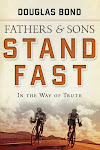
Excerpt from Bond's 2008 book
Stand Fast, the first in his Fathers & Sons series for dads to read with their teen sons. Bond is author of twenty-six books, New Reformation Hymns, and articles in Modern Reformation, Table Talk, and other journals. He is a frequent speaker at churches and conferences, and leads
Church history tours. He also hosts
The Scriptorium, a weekly podcast on Church history, literature, writing, practical theology, art, and life. Subscribe to
bondbooks.net to follow





 Posts
Posts