Showing posts with label Reformation. Show all posts

Wednesday, October 30, 2019

REFORMATION ROMANCE: Part 2, Marriage Luther and Katie's Way

[Read Part 1]
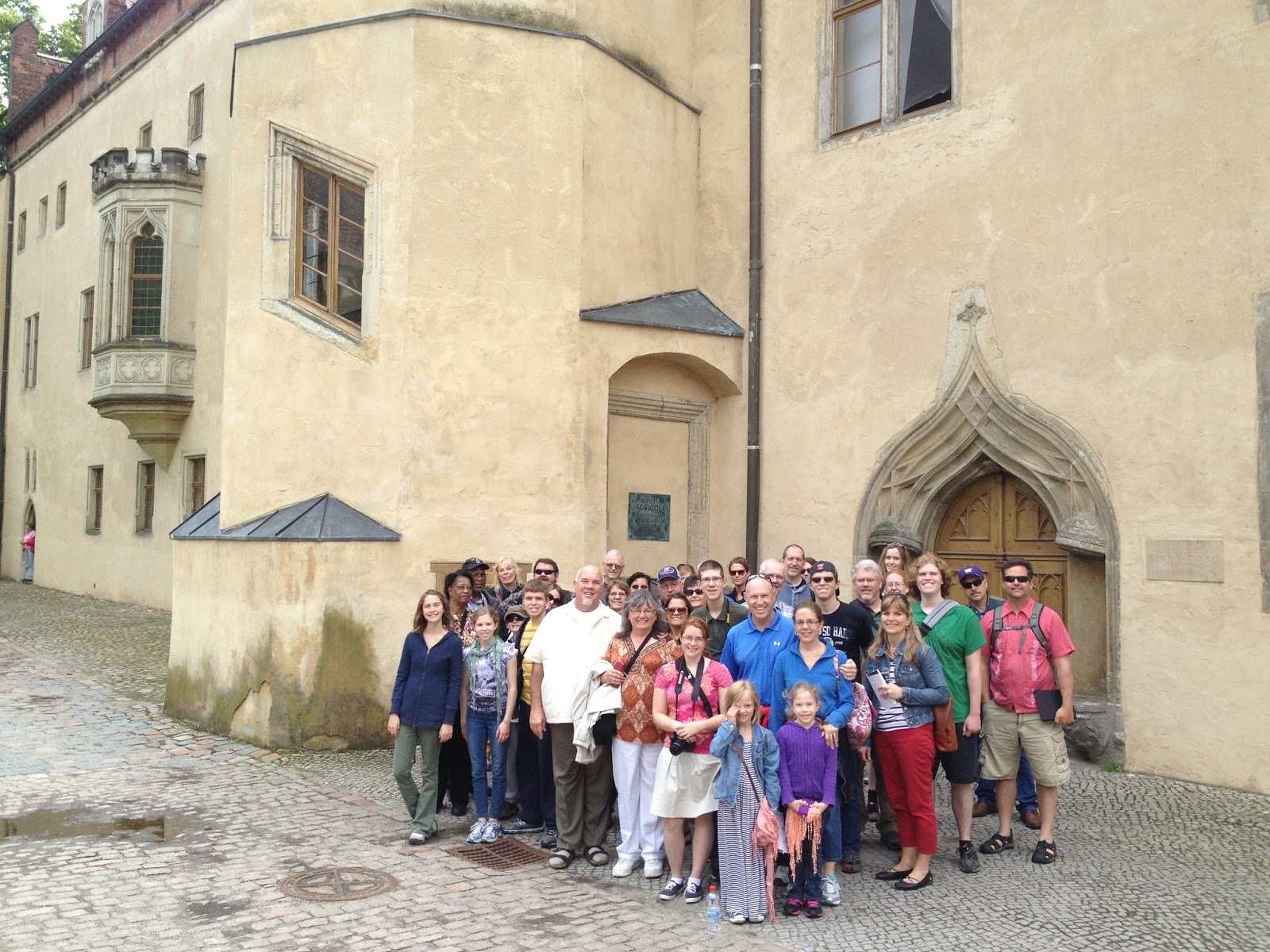
Bond travelers at Augustinian cloister, Wittenberg
SACRAMENTAL CORRUPTION OF MARRIAGE
Pause with me in our narrative of Luther and Katie’s life together. How had marriage gotten so corrupted by the Medieval Church? In one of his influential pamphlets, “The Babylonian Captivity of the Church,” Luther made a frontal assault on the “foul contagion” of the entire sacramental system of Rome.

He decried making transubstantiation, indulgences, pilgrimage, baptism, marriage, monasticism, and penance into means of earning salvation. Even baptism and the Lord’s Supper Rome had mangled and distorted until they bore no resemblance to the two sacraments Jesus had established. “What Rome has done with the sacraments,” declared Luther, “I compare to a lie, which like to a snowball, the longer it is rolled the greater it becomes.” Luther wanted to restore a biblical understanding of justification that comes not of works or sacraments, but by grace alone, through faith alone, in Christ alone.

Chief among the trumpery of Rome’s sacerdotal system was the garbling of marriage into a sacrament. According to canon law, monasticism and priestly celibacy were the higher order sacraments, but for the secular vocations marriage had been morphed into a sacrament, a means by which the lower order of society might have a better chance at achieving salvation. To Luther this was yet another instance of doctrinal bilge water spewing from Rome.

Far from having a lower view of marriage, however, Luther wanted to restore marriage to its rightful place in God’s economy of grace. Just as there was no inherent grace in taking monastic vows of celibacy, so there was no salvific grace to be gained in marriage. Moreover, it was doubly scandalous when men who had taken vows of chastity so shamelessly violated those vows. Alexander VI, the pope of Luther’s youth, kept several mistresses and fathered numerous illegitimate children; on his pilgrimage to Rome in 1510 Luther witnessed priests consorting with prostitutes at specially sanctioned brothels reserved exclusively for clerics.

Master of the invective insult, Luther declared of the pope: “You were born from the behind of the devil, are full of devils, lies, blasphemy, and idolatry; are the instigator of these things, God’s enemy, Antichrist, desolater of Christendom, and steward of Sodom.” Due to the stranglehold such abuses had on the common man, Luther felt justified in resorting to such vitriol. Later, however, upon more sober and gospel reflection, Luther said, “I am more afraid of my own heart than of the pope and all his cardinals. I have within me the great pope, Self.” Nevertheless, he was called in violent times to decry unsupportable abuses. Rome itself he declared, “the most licentious den of thieves, the most shameless of all brothels…”

If marriage was not a sacrament, however, what was it? “Marriage is the God-appointed and legitimate union of man and woman in the hope of having children or at least for the purpose of avoiding fornication and sin, and living to the glory of God.  The ultimate purpose of marriage is to obey God, to find aid and counsel against sin; to call upon God; to seek, love, and educate children for the glory of God. To live with one’s wife in the fear of God and to bear the cross; but if there are no children, nevertheless, to live with one’s wife in contentment; and to avoid all lewdness with others.”

Though at first adamant in his refusal to marry, it was only when Luther moved from writing theoretically about marriage to entering into the covenant of marriage itself that he came to see it as a lovely school of character, an ordinary means, gifted by a gracious God, whereby a husband and wife might grow in grace together and in the knowledge and love of Christ.
MATRIMONIAL TRAIN WRECK... Part 3


Douglas Bond is author of LUTHER IN LOVE and more than twenty-five other books of historical fiction, biography, devotion, and practical theology. He is lyricist for New Reformation Hymns, directs the Oxford Creative Writing Master Class, speaks at churches and conferences, and leads Church history tours in Europe. Watch for his forthcoming book God Sings! (And Ways We Think He Ought To); preorder a signed copy of God Sings! today at bondbooks.net and receive a free copy of Bond's New Reformation Hymns album.

Thursday, October 24, 2019

REFORMATION ROMANCE: Love and Marriage Luther and Katie’s Way, Part 1

Apostate monk marries apostate nun

“He’s merely a monk who wants a wife,” so the pope dismissed Martin Luther when first he heard of the Saxon monk’s decrying of the papacy. But then in 1521, during his compelled sequester in the Wartburg Castle, Luther began hearing of many former priests taking wives. “Good heavens!” he retorted. “They won’t give me a wife.” Even his colleagues Carlstadt and Melanchthon had married. But Luther was, at first, adamant, no one was going to give him a wife. Not that he was a sexless stone, but it made no sense for a man under the sentence of heresy, the stake looming, to marry—only to leave his bride a widow. 

Perhaps the matrimonial news prompted Luther to set aside his German translation of the New Testament (and dozens of other writing projects) and write his great treatise on Christian marriage. “This will empty the cloisters,” a prophetic friend observed. Overnight Luther’s treatise circulated widely.

Even into nunneries. Luther received a letter, a passionate appeal for his counsel from more than a dozen nuns who desperately wanted to flee a nunnery near Wittenberg. Though escaping from a monastic cloister in 16th century Germany was a capital offense, Luther gave them a theological argument for why non-biblical vows are not binding. These girls wanted out, but they needed help. As if in a romantic comedy, Luther and his merchant friend Leonard Kopp cooked up a scheme to smuggle the apostate nuns out of the nunnery, by some accounts, in pickled herring barrels. “A wagon load of vestal virgins has just come to town,” said one of Luther’s students at the news, “all more eager for marriage than for life. God grant them husbands lest worse befall.”

The night before Easter in 1523, lest worse befall, Luther put on yet another hat: Matchmaker, the roaring, German, beer-swilling, pugilist version of Jane Austen’s Emma. He felt duty bound. After all, he had started the barrel rolling by decrying false doctrine in the Roman Catholic Church, including the unbiblical teaching about clerical celibacy. He had to finish it.

Setting to work with his illimitable zeal, Luther soon had suitable circumstances arranged for all but one of the runaway nuns, spunky twenty-six-year-old Katharina von Bora. After several failed attempts—choosy Katharina turned down more than one offer of marriage—she laughed off an aged candidate with the quip that she would rather marry Luther than Dr. Glatz. All in jest.

A jest, however, that began its work on Luther. After a visit home wherein he shared his problem of finding a husband for an apostate nun, his father, with Teutonic bluntness, told Luther to marry the girl and give him offspring. Finally Luther was resolved. He would do it, “to please his father, to spite the pope and the Devil, and to seal his witness before martyrdom.”
[To be continued--what does Katie think of the idea?]

Douglas Bond is author of LUTHER IN LOVE and twenty-seven other books of historical fiction, biography, devotion, and practical theology. He is lyricist for New Reformation Hymns, directs the Oxford Creative Writing Master Class, speaks at churches and conferences, and leads Church history tours in Europe (Rome to Geneva Tour, 2020). Watch for his forthcoming book God Sings! (And Ways We Think He Ought To); preorder a signed copy of God Sings! today at bondbooks.net and receive a free Rise & Worship cd.

Wednesday, January 30, 2019

Doctrines of Grace: Particular Redemption and Irresistible Grace (part 4 podcast on Dort)

Doctrines of Grace: Particular Redemption and Irresistible Grace
Ephesians 3:14-21
From my visit to Amsterdam, 2007 

World means world?
“Absolute sovereignty,” wrote Jonathan Edwards, “is what I love to ascribe to God. But my first conviction was not so.”
Let’s be honest. Our first conviction is more accurately to hate absolute sovereignty. And if we hate and cavil at absolute sovereignty in predestination, we really get our back up and gnash our teeth at Jesus dying only for the elect. 
A young man, however, who cares more about what the Bible means than how it at first makes him feel will search and know what it teaches about particular redemption. Called “The Calvin of England,” John Owen offered three options for the Bible’s teaching on the atonement: Christ died for all the sins of all men, or for some of the sins of all men, or for all of the sins of some men. There are no other rational options. So which is it?
Many insist that it is the first: Christ died for all the sins of all men. For them, when the Bible uses the word “all” and “world” it means every man, woman, and child that has existed or that ever will exist. The locus classicus of this position is I John 2:2 where it says that Jesus is “the propitiation for our sins, and not for ours only but also for the sins of the whole world.”   
Honest Arminians recognize the problems with this conclusion. For example, an Arminian does not think that “propitiate” in I John 2:2 means that Jesus actually satisfied the wrath of God for every man, woman, and child. Scrupulous as they are about “world” meaning “world,” here they insist that “propitiation” doesn’t mean “propitiation”; here it means “potential propitiation.” Obviously, if Jesus’ atonement satisfied the wrath of God for all without exception, there’s no more wrath; he sends no one to hell. Since propitiation is a legal term meaning complete satisfaction, the reader who wants to know precisely what the Bible means, closely examines the various ways the Bible uses the word “world.”  
A. W. Pink points out that in the New Testament “world” or kosmos, “has at least seven clearly defined different meanings.” So when Jesus prays in John 17:9, “I pray for them. I am not praying for the world, but for those you have given me,” clearly by “world” he means unbelievers, and by “them” and “those you have given me,” he means believers, his sheep, the elect. Here, even Arminians must agree that “world” does not mean all men throughout all time.
Similarly, when Moses records that “all mankind” perished in the flood (Genesis 7:21), no Arminian insists that “all” means “all” and “mankind” means “mankind.” Clearly not every man, woman, and child that ever lived or would live died in the flood. “All mankind” didn’t include any of us, nor did it include the eight humans who survived the flood--including Noah.
But what about “For God so loved the world” in John 3:16? Did Jesus mean that his Father sent him to actually ransom, redeem, pardon, atone for, and propitiate—to actually pay the sin debt of every man, woman, and child in the universe? Return to the context. Jesus was speaking to a Jewish scholar who believed the Messiah was coming just for Jews. Here Jesus was declaring to Jewish Nicodemus that the Messiah has come not just to save ethnic Jews, but the elect from all nations—the world.
Given the varying use of “world” in Scripture, careful readers will interpret passages that, on the surface, sound universal in light of passages that speak more specifically. Comparing John 3:16 and related passages with Revelation 5:9 helps bring clarity: “You are worthy… because you were slain, and with your blood you purchased men for God from every tribe and language and people and nations.” Notice how particular and specific the language is. Jesus actually “purchased men for God,” and he did so without ethnic or racial distinction, pitching his love on men from the whole world.

Sheep means sheep                                                          
John Owen’s second option, that Christ died for all the sins of all men, except the sin of unbelief, is favored by other non-Calvinists. This interpretation relieves God of being charged with unfairness, and the only condition of salvation that man contributes is belief. Believe and you have set yourself apart from the rest. But there are serious problems with this view. For starters, the Bible in many places says plainly that the wrath of God is coming for a laundry list of sins, not just for unbelief.
Calvinists believe that Christ actually atoned for all the sins of some men—the elect--that he actually did as he claimed in John 10:11, “I am the good shepherd. The good shepherd lays down his life for the sheep.” The language Jesus uses has no hint that he meant he was only potentiality or conditionally laying down his life. The words indicate an actual, definite act, accomplished for and applied to specific individuals—the sheep. Sparkling clarity follows when Jesus says to unbelievers a few verses later, “you do not believe because you are not my sheep” (10:26). The sheep believe because they were ordained to eternal life (Acts 13:48), and because Jesus actually—not just potentially--laid down his life for their sins.
In a variety of ways, the Bible answers the question, “What must I do to be saved?” It clearly states: “Believe, seek, come, call.” But it answers a second critical question about salvation, “Why did I believe?” It answers with equal clarity--we just don’t like the answer.
Jealous to protect God’s fairness, many nonsensically answer the second question with a variant of the answer to the first. “Why did I believe? Because I just believed.” And then they plug their ears. Real men don’t read their Bibles this way. The Bible relentlessly answers the question why a sinner believes, so we must hear it: Sinners believe because God chose them, Christ redeemed them, and the Spirit called them.
There’s not a lack of clarity here. We proud sinners simply don’t like the debasement required by the answer. We don’t like hearing that we’re dead in trespasses and sins, that God predestined some to life and others to damnation; that the elect are redeemed by Christ, their debt paid in full, their guilt and punishment borne on the cross by their good shepherd. Nor do we much like hearing that what makes us differ from a lost sinner is the Holy Spirit effectually calling us out of darkness into the splendid light of the new birth. Believing all that is high-demand. It costs us our pride.
           
Dead made alive
“Born, as all of us are, an Arminian,” wrote C. H. Spurgeon, “when I was coming to Christ, I thought I was doing it all myself, and though I sought the Lord earnestly, I had no idea the Lord was seeking me. I do not think the young convert is at first aware of this.”               
Arminianism, like the flat-earth theory, draws ultimate conclusions based on immediately observable evidence only. Thus, someone who believes in a flat earth does so because what he sees from his observable vantage point looks flat. As Spurgeon suggests, many mistakenly conclude that when a sinner hears the gospel and chooses to believe, his choice is the cause of forgiveness and salvation.
But what makes one man hear, repent and believe in Christ, while another hears the same sermon but snorts in derision and persists in unbelief? After one such sermon, Luke records that, “All who were appointed to eternal life believed” (Acts 13:48). All heard the same sermon, but not everyone believed. This text and many others explain why: God mercifully predestined some to eternal life. That alone is why they believed.
Jesus used the metaphor of the wind blowing where it wishes to explain the mystery of the Holy Spirit’s work in salvation, and he used the metaphor of new birth. Just as no one has anything to do with his first birth, so the sinner is born again by the mysterious working of the Spirit, not by anything the dead sinner can will or do. Correspondingly, Paul tells us that we are “dead in trespasses and sins,” but that it is God who makes us alive in Christ by his Spirit.
“Dead men tell no tales,” so say pirates, nor can dead men will or do anything pertaining to their salvation. We must be born again, made alive, given the gift of faith by “the Spirit penetrate[ing] into our hearts,” as Calvin termed it. Anything short of this gives man credit for the divine work of regeneration in our hearts.

We call or he calls?
Though C. S. Lewis was an extraordinary Christian apologist, there were some holes, shall we say, in his theology. One of these reoccurs in the form of philosophical arguments favoring freedom of the will over against divine sovereignty. Put simply, Lewis was probably more of an Arminian than he was a Calvinist.
Nevertheless, writers are sometimes at their best when writing poetry or imaginative fiction, so in the Narnia books Lewis wonderfully illustrates the sovereignty of grace and the effectual calling of God’s Spirit. In The Silver Chair when Aslan tells Jill that he called her out of her world, Jill disagrees. “Nobody called me and Scrubb, you know. It was we who asked to come here. Scrubb said we were to call… And we did, and then we found the door open.” Jill, like most, mistakenly thought her calling was what opened the door. Lewis’s Lion wisely replied, “You would not have called to me unless I had been calling to you.”
Similarly, in The Magician’s Nephew, Lewis has Aslan utter “a long single note; not very loud, but full of power. Polly’s heart jumped in her body when she heard it. She felt sure that it was a call, and that anyone who heard that call would want to obey it and (what’s more) would be able to obey it, however many worlds and ages lay between.”
As it did Jill, the power of this call ought to fill us with the deepest wonder at the grace of our God, who alone elects, redeems, calls, and keeps all his sheep so that not one of them is lost.

Flat earth
Arians in the early church had trouble figuring out how God could be three and one at the same time, so they rejected the biblical doctrine of the Trinity, and, thus, the deity of Jesus Christ. When we frail mortals have trouble grasping high and grand doctrines concerning God, our inclination is to reduce things down to the puny level of human understanding. Error always follows. 
From our flat-earth vantage point, predestination makes God not behave as nicely toward all sinners as we think fairness requires of him. Call these systems what you will, adherents insist that it wouldn’t be fair of God to do anything more for those who will believe than he has done for those who won’t. Thus, they insist that Calvinism can’t be right because it violates God’s fairness by making him act with favoritism toward some. Consequently, modern evangelism has created several extra-biblical jingles that have become inviolable.

Love and voting
The first well-intentioned jingle goes like this: “God loves the sinner, but hates the sin.” I wonder. After all, it’s not the sin that gets thrown in hell. It’s the sinner. Nobody wants to be “loved” like that. If God loves in the same way and to the same degree both the man who is saved and the man who will be damned, then “love” and “hate” have no meaning, and we’ve made a mingle-mangle again.
The Bible, however, uses these terms in precise ways. “Jacob have I loved. Esau have I hated.” So in Psalm 5:6, God declares that he “hates all those who do wrong.” Though “all” means “all” to Arminians, “hate” here just can’t mean “hate.” They insist that God, Christ, and the Holy Spirit are obligated to love all sinners exactly alike and leave the rest up to the sinner. Though heaps of biblical evidence suggest otherwise, the measure of God’s love, for them, is its extent not its effect; it must extend to everyone who ever lives or it’s not real love because love is fair.
But is this an accurate understanding of love? No wife would measure the worth of her husband’s love by how widely it extends to all women; does her confidence in his love for her come from her knowledge that he loves all women without exception? Of course not! On the contrary, she measures his love by how exclusive, individual, and particular it is, by how he lavishes it on her alone. So Christ’s love for his bride is particular, individual, and definite, and is savingly lavished on his bride, the church. Nevertheless, Arminians insist that Christ’s love isn’t real unless it is the same for all—even the already damned.
The other jingle often used in modern evangelism goes like this, “God cast a vote; Satan cast a vote, and the sinner casts the final vote.” Anyone with his Bible open ought to see through this like a ladder. Aside from the obvious problem of placing God and Satan on equal terms in their hand-wringing passivity, nowhere does the Bible give man such ultimate self-determination. In all the evangelism recorded in the New Testament, I recall no such nonsense. Though zealous, well-meaning Christians say things like this, we do well to stick with the evangelism of Jesus and the apostles.

Cavils at Calvin
A frequent cavil at Calvinism insists that men who believe it will not care about evangelism and missions. But what of Paul, the quintessential world missionary, who taught these doctrines systematically throughout his epistles? Oft-maligned Calvin had a ministry marked by deep concern for the lost, wherein he established an academy precisely for training preachers and missionaries. Harvard, Yale, and Princeton were all established by Calvinists as theological training grounds for Christian preachers and missionaries. What’s more, nineteenth-century missions were largely pioneered by a long list of Calvinists. 
Another favorite cavil goes like this. If predestination is true, then why pray for the lost? Perhaps no one has more succinctly turned this cavil back on the detractors who raise it than J. I. Packer when he asks how you pray for the lost:

Do you limit yourself to asking that God will bring them to a point where they can save themselves? I think that what you do is to pray in categorical terms that God will, quite simply and decisively, save them. You would not dream of making it a point in your prayer that you are not asking God actually to bring them to faith. You entreat him to do that very thing. Thus, you acknowledge and confess the sovereignty of God’s grace. And so do all Christian people everywhere.

            Something about the kneeling posture helps us proud sinners get things right.  Perhaps there’d be less mingle-mangle about predestination and sovereign grace if we spent more time on those knees, humbly appealing to God on behalf of dead sinners whom he alone can save.

Does it matter?
Then comes the final cavil at Calvinism: Calvinism is merely theological wrangling that has no relevance to a Christian’s life and calling. But if we truly believe that all Scripture is God-breathed and so profitable for doctrinal belief and for training in righteousness, then the Bible’s teaching on the sovereignty of God must be important for us to understand.
So how ought believing the doctrines of grace, in the sovereignty of God, in total depravity, predestination, definite and particular atonement, and the effectual calling of the Spirit, how ought all this to affect a young man’s faith, devotion, and worship of Christ?
John Bunyan, perhaps said it best when he at last saw his sin as a “most barbarous and a filthy crime,” and that in his depravity he “had horribly abused the holy Son of God.” Seeing the depth of your sin and the corresponding depth of electing love and of Christ’s substitutionary atonement applied to your miserable life by God’s Spirit, ought to prompt in you a burning love for the Lord Jesus. Bunyan put it this way, “Had I a thousand gallons of blood within my veins, I could freely have spilled it all at the command and feet of this my Lord and Savior.”
Stand fast on these high truths, and feel the force of them. Hold fast to truth, and walk humbly with your God, working out your salvation with fear and trembling. And so make your calling and election sure by gratefully pursuing holiness, without which no young man will see the Lord.   

Douglas Bond, author, speaker, tour leader, hymn writer, publicist. Listen to Bond's podcast at bondbooks.net/the-scriptorium-podcast

Wednesday, November 1, 2017

Luther's Timing: Why He Nailed His 95 Theses on All Hallow's Eve

Bond tour group at Luther & Katie's cloister home
All Hallow's Eve, 1517, Luther had timed things appropriately. All Saints' Day, November 1, 1517 Duke Frederick put on a huge exhibition of his latest reliquary acquisitions--the latest additions to his bone collection--pilgrims coming to venerate (and pay handsomely for the privilege), earning 1000s of years off purgatory in the bargain. No coin collector could have been more devout; the duke was serious about his reliquary, and wanted to make Wittenberg into the Rome of Germany. Luther scholar Roland Bainton tallied the elector's treasury of merit: 

"The collection had as its nucleus a genuine thorn from the crown of Christ, certified to have pierced the Savior's brow. Frederick so built up the collection from this inherited treasure that the catalogue illustrated by Lucas Cranach in 1509 listed 5,005 particles, to which were attached indulgences calculated to reduce purgatory by 1,443 years. The collection included one tooth of St. Jerome, of St. Chrysostom four pieces, of St. Bernard six, and of St. Augustine four; of Our Lady four hairs, three pieces of her cloak, four from her girdle, and seven from the veil sprinkled with the blood of Christ. The relics of Christ included one piece from his swaddling clothes, thirteen from his crib, one wisp of straw, one piece of the gold brought by the Wise Men and three of the myrrh, one strand of Jesus' beard, one of the nails driven into his hands, one piece of bread eaten at the Last Supper, one piece of the stone on which Jesus stood to ascend into heaven, and one twig of Moses' burning bush. By 1520 the collection had mounted to 19,013 holy bones. Those who viewed these relics on the designated day and made the stipulated contributions might receive from the pope indulgences for the reduction of purgatory, either for themselves or others, to the extent of 1,902,202 years and 270 days. These were the treasures made available on the day of All Saints."

Luther had taken a great risk posting his 95 Theses decrying indulgences the day before. The duke was his patron, and though he appreciated the popularity his university had gained by Luther's bold teaching and preaching, this was too far. Luther was undaunted because he had seen through the whole hoax of indulgences and a righteousness earned by ones own imagined merit. “The church’s true treasure," he wrote, "is the merits of Christ in the gospel.”

From studying and teaching the Psalms, Galatians, Romans, and Hebrews, Luther had come to know that Rome had flipped everything around and had, thereby, done violence to the gospel, and that venerating the saints and their supposed merits was a supplanting of the merits of Jesus Christ. The realization was at first a personal one. “I must listen to the gospel," he wrote. "It tells me not what I must do, but what Jesus Christ the Son of God has done for me.” 

Transformed by the power of the gospel and the gift of faith, Luther had to tell the Good News to others. And he did, as only Luther could do. “The most damnable and pernicious heresy that has ever plagued the mind of men was the idea that somehow he could make himself good enough to deserve to live with an all holy God.”

Luther knew that the dukes exhibition scheduled for All Saints' Day, November 1, 1517 must be confronted. It was an affront to the gospel of grace, a supplanting of the authority of the Word of God, and an offense to true Christian worship. “The highest worship of God is the preaching of the Word, because thereby are praised and celebrated the name and the benefits of Christ.”

Finally, for Luther the risks to his person were worth it. Why? It was worth it because the Son of God is the only Savior and true friend of sinners. Johann Franck, German Lutheran pastor in the next generation expressed it this way: "Jesus, priceless treasure, fount of purest pleasure, truest friend to me."

Douglas Bond is author of many books, including LUTHER IN LOVE (2017). He leads Church history tours, including the Armistice 100 Tour, June 15-25, 2018, (Reformation tour of France, teen Calvin in Paris, Calvin's birthplace in Noyon; including teen atheist 2/Lt CS Lewis raging at God in the trenches of WW I, Huguenots in Rouen and Amiens, and the failure of Modernism in WW I and WW II). Space is limited so register (what better day to register than All Saints' Day, the day after REFORMATION DAY!). You can purchase a signed copy of LUTHER IN LOVE and his other books at bondbooks.net 

Tuesday, November 1, 2016

The Most Damnable and Pernicious Heresy--Luther the day after Reformation Day

The day after Reformation Day
All Hallow's Eve, 1517, Luther had timed things appropriately. All Saints' Day, November 1, 1517 Duke Frederick put on a huge exhibition of his latest reliquary acquisitions--the latest additions to his bone collection--pilgrims coming to venerate (and pay handsomely for the privilege), earning 1000s of years off purgatory in the bargain. No coin collector could have been more devout; the duke was serious about his reliquary, and wanted to make Wittenberg into the Rome of Germany. Luther scholar Roland Bainton tallied the elector's treasury of merit: 


"The collection had as its nucleus a genuine thorn from the crown of Christ, certified to have pierced the Savior's brow. Frederick so built up the collection from this inherited treasure that the catalogue illustrated by Lucas Cranach in 1509 listed 5,005 particles, to which were attached indulgences calculated to reduce purgatory by 1,443 years. The collection included one tooth of St. Jerome, of St. Chrysostom four pieces, of St. Bernard six, and of St. Augustine four; of Our Lady four hairs, three pieces of her cloak, four from her girdle, and seven from the veil sprinkled with the blood of Christ. The relics of Christ included one piece from his swaddling clothes, thirteen from his crib, one wisp of straw, one piece of the gold brought by the Wise Men and three of the myrrh, one strand of Jesus' beard, one of the nails driven into his hands, one piece of bread eaten at the Last Supper, one piece of the stone on which Jesus stood to ascend into heaven, and one twig of Moses' burning bush. By 1520 the collection had mounted to 19,013 holy bones. Those who viewed these relics on the designated day and made the stipulated contributions might receive from the pope indulgences for the reduction of purgatory, either for themselves or others, to the extent of 1,902,202 years and 270 days. These were the treasures made available on the day of All Saints."

Luther had taken a great risk posting his 95 Theses decrying indulgences the day before. The duke was his patron, and though he appreciated the popularity his university had gained by Luther's bold teaching and preaching, this was too far. Luther was undaunted because he had seen through the whole hoax of indulgences and a righteousness earned by ones own imagined merit. “The church’s true treasure," he wrote, "is the merits of Christ in the gospel.”

From studying and teaching the Psalms, Galatians, Romans, and Hebrews, Luther had come to know that Rome had flipped everything around and had, thereby, done violence to the gospel, and that venerating the saints and their supposed merits was a supplanting of the merits of Jesus Christ. The realization was at first a personal one. “I must listen to the gospel," he wrote. "It tells me not what I must do, but what Jesus Christ the Son of God has done for me.” 

Transformed by the power of the gospel and the gift of faith, Luther had to tell the Good News to others. And he did, as only Luther could do. “The most damnable and pernicious heresy that has ever plagued the mind of men was the idea that somehow he could make himself good enough to deserve to live with an all holy God.”


Luther knew that the dukes exhibition scheduled for All Saints' Day, November 1, 1517 must be confronted. It was an affront to the gospel of grace, a supplanting of the authority of the Word of God, and an offense to true Christian worship. “The highest worship of God is the preaching of the Word, because thereby are praised and celebrated the name and the benefits of Christ.”

Finally, for Luther the risks to his person were worth it. Why? It was worth it because the Son of God is the only Savior and true friend of sinners. Johann Franck, German Lutheran pastor in the next generation expressed it this way: "Jesus, priceless treasure, fount of purest pleasure, truest friend to me."

Douglas Bond is author of a number of successful books, with LUTHER IN LOVE, forthcoming Winter, 2017, a biographical novel on Martin and Katharina Luther. Bond speaks at churches and conferences, and leads Church history tours, including the LUTHER 500 TOUR, June 15-25, 2017.