Saturday, November 23, 2013

Fort Nisqually latest visit--ideas flying in my imagination!

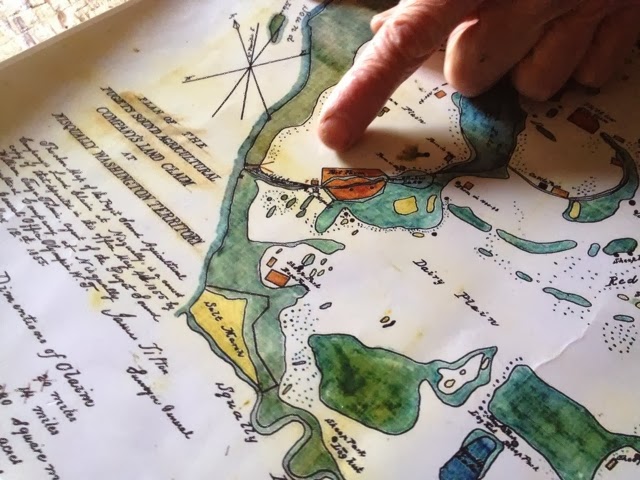
My youngest munchkins and I had so much fun at Fort Nisqually yesterday afternoon! We were met by Education Curator, Michael McGuire (note the Scots name--this tale will have a significant Scots connection... because Hudson Bay Company and the PNW had a huge Scots connection, and because I'm writing it!). They've offered me their small research library for writing right there at the fort. What could be better? I absolutely love writing on location. Giles got to "shoot" a Northwest trade musket and wear a beaver skin top hat, and Gillian was enchanted with the Cheif Prefect's house built in 1855, the oldest building in Puget Sound, and right in the middle of the fort--and ten minutes from our home! Here are some pictures from this visit:


My youngest munchkins and I had so much fun at Fort Nisqually yesterday afternoon! We were met by Education Curator, Michael McGuire (note the Scots name--this tale will have a significant Scots connection... because Hudson Bay Company and the PNW had a huge Scots connection). They've offered my their small research library for writing right there at the fort. What could be better? I absolutely love writing on location. Giles got to "shoot" a Northwest trade musket, and Gillian was enchanted with the Cheif Prefect's house built in 1855, the oldest building in Puget Sound, and right in the middle of the fort. Here are some pictures from this visit:

Friday, November 15, 2013

Today I start my newest book: historical fiction set in the Puget Sound!

Gillian at Fort Nisqually (very near our home)

NEW BOOK STARTED TODAY! P&R Publishing has created a new series/collection of my books, THE HEROES AND HISTORY SERIES; Hostage Lands, Hand of Vengeance, with my forthcoming books on Wycliffe (1300s England) and the Huguenots (1500s France) soon to join the new collection.

The H&H series is designed to be the place where other ideas I have for historical fiction will collect themselves together into what we hope will be an invaluable collection of books for anyone who loves history.

Most recently I will be immersed (after a fun family visit to nearby Fort Nisqually) in a 19th-century Pacific Northwest, Hudson Bay Company yarn set in the Puget Sound and Fort Nisqually (very near my home). There would be a Scots connection (my lens may be a young Scots voyager), as there were many Scots immigrants (and some French Canadians) employed by the HBC.

I guess it would be sort of a Bond version of some of the favorite frontier stories out there for young adult readers. Mine will have lots of beaver trapping, PNW trading musket shooting, salmon fishing, horses, HMS Beaver steamer for the HBC, small boat sailing, Douglas fir felling, log cabin building, trading and friendship with coastal Indians, frontier tensions between American and British settlers, the Pig War, and the rising storm to the Civil War.

I'm really, really excited about beginning this book TODAY! Pray for me. Now I'm back to work...

Monday, November 11, 2013

DUNCAN'S WAR the movie--AFM launch in California

AFM launch poster for the film
The last several days have been an exciting flurry of activity. Duncan's War the movie has been germinating in the imaginations of two film-industry fellows in California. I first met Phillip Moses when I was speaking at a conference in southern California fall of 2010 (his wife was a student of mine years ago at CHS). They drove down from the Bay area, and we chatted about books and film after one of my addresses. Some time later he called me and floated the initial idea of making a big-screen film of Duncan's War. We have had multiple conversations (phone, email, texts, facebook, etc) since.

To be honest, I have vacillated from excited to incredulous, to excited again, to incredulous again--and now to excited. For the first time in more than two years, I actually am beginning to believe these guys will do this, and do it well. One of my big concerns has been that I don't want to dilute the book by turning it into a movie. Novelist John le Carre expressed his chagrin at what film can do to good fiction when he said, "Having your book turned into a movie is like seeing your oxen turned into bullion cubes." I so do not want to
see that happen to Duncan's War. Neither does the producer.

Many of you have messaged me asking how you can help. A number of you are in the film industry or aspiring to be so. It takes a significant team to produce a quality film. So connect with the producer, Phillip Moses, here https://www.facebook.com/DuncansWar. And if you know talented young actors for the film, especially ones who've grown up in the heather and the moorlands, post their contact information to Mr Moses; he's the man, or to James Chung, art director; he's also the man.

And for those of you who are enthusiastic about this, though you may not be an actor, know an actor, or be involved in film making, all of you can like and share the Duncan's War the movie facebook page: https://www.facebook.com/DuncansWar. Film executives and distributors at the AFM conference in LA are watching, sometimes with bewilderment, but they are watching the mounting enthusiasm for this movie. Tell them what you think; they're listening. Like and share today.

Maybe it is not playacting after all!

Monday, November 4, 2013

INKBLOTS--What to do when someone doesn't like what you write

Writing and hunting turkey
'Blots: five of us on this chilly autumn evening, fire on the grate, Pinot Noir in the glass, and convivial work to be done. Patrick leads off with a short story, a space travel, Martian sci-fi yarn. Though this is not my preferred genre, P certainly does write with ease and intentionality. Ray Bradbury did a series of sci-fi short stories like this. Gene Wolfe is a favorite sci-fi author that P likes to read and finds inspiration from reading him (we all have authors that do this for us). How to write what you want and sell what you write, a book Skip Press P recommends, he reads to find helpful instruction in the craft of writing.

Doug Mc suggested I read otherwise than last, as usual. I explained some of the challenges I have faced with criticism of this manuscript, then I read from chapter 31 of HAMMER OF THE HUGUENOTS, the climactic rescue of Pierre Viret. There's always something to glean from critics, even when they don't get it right; they have still helped unearth areas where the piece can be improved. Alan commented about my use of toilet as an alternate to garderobe and the suggestion was that toilet is too modern and latrine might be better. Alan liked the wheelbarrow passing over different surfaces and the effect on Philippe concealed in the wheelbarrow. Maybe the beginning of the chapter may be a bit slow and could be tightened. I'll give serious consideration to that. Thanks, gents.

John reads from French Cousins. This is a warm grandfatherly narration of the life of his grandchildren, both American and French. John has done a wonderful job of giving us his grandchildren's perspective on fun things, in this case, Proctor Treats, free candy, all you can eat. I can see and hear more of the children bantering back and forth. John is using some fabrication--I would prefer to call it projection and combination--to give the children the ability to speak when they may have been too young to speak or to use the vocabulary he gives them. Pirate speak.

Alan takes us back to St Brendan and the 9th century. Alan is working on two ancient tales, 1st century prose but tonight its 9th century blank verse (unrhymed iambic pentameter). Ancient Irish tale, bring on the corned beef and cabbage (and boiled potatoes). Celtic Church, not connected to the RC church in any meaningful way. Mernoc walking on the water, blind, holding a lantern, living on a rocky island off the coast of Ireland. He and Brendan row to the promised land, like heaven. The Navigatio, in Latin. Brendan's navigation. Brendan makes a prophecy that three can join him in the boat but for two it will end badly. I love watching Alan, a dentist by day, as he sits on the edge of the love seat, holding his laptop cradled in his arms, enthusiasm in his tone and radiating on his face--I feel like this is what 'Blots is about at its very best. the Imago Dei, we, image bearers of God, we, different and diverse in genre, like giddy children--agitated and eager, lisping and laughing, awed and wondering--imitate our Creator with imaginative words woven together to delight each other. It doesn't get much better than this. This is so Beowulf! I feel like we are in the mead hall, the horn passing, the harp not far behind. Alan has been reading Lewis on narrative poetry--it shows.

Dougie Mc reads from his post-war tale, his characters in Georgia, late sixties, Vietnam in a rolling boil. D says he's writing just for himself right now. I think he may be on to something. Lewis maintained that we need to write what we need, if we are to write the most authentic, effective, enduring manner. I like the flashback to the hardware store proprietor's promise about the shotgun shells. Maybe more specific flashbacks to help build tension. Whine of mosquitoes. I wish readers could hear D do his turkey call imitation, not once but over and over. We asked how that was spelled. However he had spelled it, there were lots of red squiggly lines under the "word." This was an intensely detailed and nuanced man on the hunt, turkey hunt. Never switch from female turkey to Tom or he'll be gone in a heartbeat. This a classic example of writing what you know. D has hunted turkey, called them, blown their heads off, and bagged them. J says D uses his name Bruce too much. Alan commented that there are good visual description but more smells would help, pine forest, swamp smells, exhaust from the pick up truck, gun oil.  

Thursday, October 31, 2013

"I hate God!" declared Martin Luther

95 Theses, October 31, 1517
Happy Reformation Day! I'm so happy that by grace alone Luther did not continue in his hatred of God. I thought I'd post a few Luther-related excerpts from my forthcoming non-fiction book GRACE WORKS, And Ways We Think it Doesn't (P&R, April, 2014):


...Another expression of our sinfulness emerges in our resentment at the very fact of it. We're quick to accuse God of being too tough on us, of being too harsh. His standard is too hard. Why doesn't he just lighten up a bit? I’ve long thought that Jesus’ words, “Be perfect as my heavenly Father is perfect” (Matthew 5:48), read in isolation from the good news, constitute the scariest verse in the Bible. Martin Luther came to the place where he admitted that he hated God for his holy requirement of perfection from us. “This word is too high and too hard that anyone should fulfill it,” he wrote.
This is proved, not merely by our Lord's word, but by our own experience and feeling. Take any upright man or woman. He will get along very nicely with those who do not provoke him, but let someone proffer only the slightest irritation and he will flare up in anger, if not against friends, then against enemies. Flesh and blood cannot rise above it.[1]
But that doesn't mean we don't keep trying to win God's favor by our efforts. Luther told of his own desperate labors to appease God's wrath, "I was a good monk, and I kept the rule of my order so strictly that I may say that if ever a monk got to heaven by his monkery it was I. If I had kept on any longer, I should have killed myself with vigils, prayers, reading, and other work.”[2]
Only when we, like Luther, come to know how impossible it is for us to keep God's law, how futile it is for us to think we can win God over by our efforts, never mind how sincere or strenuous, will we be ready to hear the good news.
As true as it is that "all have sinned and fall short of the glory of God," Paul hastens to tell us in the next verse that hopelessly unworthy sinners "are justified by his grace as a gift, through the redemption that is in Christ Jesus" (Romans 3:23, 24)...


...The great champion of justification by faith alone, Martin Luther, understood just how essential getting the distinction between law and gospel is: “Whoever knows well this art of distinguishing between Law and Gospel, him place at the head and call a doctor of Holy Scripture.”[1]
Why did Luther have such extravagant praise for preachers who don’t make a mingle-mangle of law and gospel? I think it’s because he understood the enormous damage done to the gospel by law-creep, when men allow the slightest degree of law-keeping conditionality to creep into the message of the gospel...


...Notice that the same words are being used, and it sounds pretty good. But rearranging the order, even slightly, destroys the freedom of the gospel. The operative word is “alone” and nudging the keystone of that word out of place brings down the entire structure. For Luther the doctrine of justification by faith alone was “the issue on which the church stands or falls.” R. C. Sproul warns that there is a “full-scale assault” launched within Protestant evangelicalism against the doctrine of justification by faith alone. Without this doctrine, “the gospel is not merely compromised, it is lost altogether.”[1]


...“It is just as impossible to separate faith and works,” wrote Martin Luther, “as it is to separate heat and light from fire!” He called all those who don’t believe and teach this “the greatest of fools!”[1] The instant we begin to separate them, we inevitably make works a requirement, a condition, of faith. Hence, Satan’s strategy is by all means to get us to separate faith and works--and to preen ourselves for the wisdom of our new discovery—but he never wants us to realize that we’ve become the greatest of fools...

...I doubt Luther would have thought a doctrine of temporary forgiveness was anything like entering the gates of paradise, as he referred to his conversion. Imagine Luther’s glee at the discovery: “At last, I get it. Whatever else justification is, it is forgiveness, but only temporary forgiveness. O the joy! My burden is lifted—sort of, at least for the moment.” Temporary forgiveness would be more like having your head smashed in the gates of paradise as they clanged shut.
Or imagine a hymn of praise to God about temporary forgiveness. The cry of the five bleeding wounds of the Savior in Charles Wesley's hymn would have to sound more like this: "Sort of forgive they cry, sort of forgive they cry; maybe not let that sort of ransomed sinner die." I can’t imagine a doctrine of temporary forgiveness warming anyone’s heart to praise.
Not only does it make for ridiculously bad hymn poetry, such a declaration is devastating to the central doctrine of justification by faith alone; if justification is about forgiveness of sins and the Bible teaches that you can be justified and have forgiveness of sins—and then lose or forfeit it, the entire structure of reformational theology crumbles.
It is precisely here where the confessional standards help Christians in every generation to continue to believe what the Bible teaches and... 

Families with kids will want to check out my second Mr Pipes volume, Mr Pipes and Psalms and Hymns of the Reformation; I wrote a fun chapter on Luther where Annie and Drew and Mr Pipes get locked in Coburg Castle for the night, where Luther had been sequestered during deliberations on the Augsburg Confession of Faith.

[1] Martin Luther, An Introduction to St. Paul's Letter to the Romans, (Erlangen: Heyder and Zimmer, 1854), 125. Accessed on-line: http://www.iclnet.org/pub/resources/text/wittenberg/luther/luther-faith.txt


[1] R. C. Sproul, citing Martin Luther, Molehills out of Mountains (Stanford, Florida: Ligonier Ministries, May, 2010), 7.


[1] Martin Luther, Dr. Martin Luthers Sämmtliche Schriften, St. Louis ed. (St. Louis: Concordia Publishing House, N.D.), 9:802.


[1] Martin Luther, as cited in Roland Bainton, Here I Stand (Nashville: Abingdon, 1980), 34.
[2] Ibid.

Tuesday, October 29, 2013

John Knox--not a Metro Male: JOHN KNOX at 500 (1514-2014)


Excerpt from THE MIGHTY WEAKNESS OF JOHN KNOX,  by Douglas Bond (Reformation Trust, 2011).

John Knox’s Mighty Weakness
 “John Knox felt toward [Scotland’s] idolaters,” wrote historian Roland Bainton, “as Elijah toward the priests of Baal.”[i] Recollect what Elijah was called to do to the priests of Baal, by the express command of God, drawing his sword and cutting down 450 of the deceitful clerics. Men called to be prophets—to do feats such as Elijah was called to do--are not generally touchy-feely, kinder-gentler, metro males. Far from it. In redemptive history, the Elijahs have been tortured voices crying in the wilderness, lone men called to take their stand against gnashing critics, men charged with the profoundly unpopular task of declaring God’s word to people who have taken their stand with the enemies of God’s word. Such men inevitably find themselves in the crosshairs of critics. For his Elijah-like zeal, Knox is—as was his spiritual, theological, and pastoral mentor, John Calvin—“as easy to slander as he is difficult to imitate.”[ii]

As with any mere man, besieged by controversy in turbulent times, called upon to do significant things, ones that affect the fortunes of many people,[iii] staunch critics have found plenty in John Knox to criticize. He had rough edges, some would call them tragic deficiencies, even fatal flaws. Like all great men, strip him of his God-given might, and the thundering power of his calling, and what remains is a mere mortal, a small man, “low in stature, and of a weakly constitution,”[iv] one who, when first called to preach, declined, and when pressed, “burst forth in most abundant tears” and fled the room.[v] But then such was Elijah, cowering in a hole, feeling sorry for himself, and begging God to deliver him from his enemies. Yet by the grace of God, who alone makes weak men strong, Elijah and Knox lived lives that were characterized far more by power and influence than by weakness and obscurity.

What transforms a man from a hand-wringing nobody into a theological thunderbolt, a bull-horn of bravery, a commando of conviction, into the unflinching left tackle of the Reformation? Is it mere hyperbole to say that “Knox was a Hebrew Jeremiah set down on Scottish soil”?[vi] With the zeal of a Jeremiah, Knox thundered against the “motley crowd of superstitions” that infested religious life in sixteenth-century Scotland, and he considered his country’s devotion to such error as far worse “than the idols over whose futility Hebrew prophets made merry.”[vii] When God’s messengers mounted the rooftops decrying people’s transgressions against Yahweh—Hebrew ones or Scottish ones--the multitudes responded, not surprisingly, with rancor and violence.

So it has been with John Knox. In his lifetime he was denounced by regents, queens, and councils, and his effigy was hoisted high and burned at the Mercat Cross in Edinburgh.[viii] Ridiculed as “Knox the knave,” and “a runagate Scot,” he was outlawed and forbidden to preach by the Archbishop of St. Andrews, with orders issued to shoot him on sight if he failed to comply. Knox did not comply. Years later a would-be assassin fired a shot through a window of Knox’s house at Trunk Close in Edinburgh, narrowly missing his mark.[ix] And still Knox preached.

And what of his legacy since his death in 1572? The English Parliament, 140 years after Knox’s death, condemned his books to public burning. In 1739 George Whitefield was ridiculed for preaching “doctrine borrowed from the Kirk of Knox.” Perhaps more than any other, he has been portrayed as “the enfant terrible of Calvinism,”[x] and has been characterized in books and film, and at his own house, now a museum, as a “blustering fanatic.”[xi] Moderns dismiss him as a misogynist for his untimely treatise against female monarchs, and for his unflinching stand before charming Mary Queen of Scots, denouncing her sins, and calling her to repent. In 1972, the 400th anniversary of his death, it was decided that such a man as Knox was an inappropriate subject to commemorate on a Scottish postage stamp. As a crowning blow, the Edinburgh Town Council ordered the removal of the stone marking his grave, relegating his earthly resting place to obscurity under a variously numbered parking stall.[xii] In my most recent visit to Edinburgh the “JK” once legible on a small square marker was completely obliterated.

As faithless Israel resented Jeremiah’s prophesy of doom and destruction for her whoredom against the Lord, so, for the most part, has Scotland come to resent the life and ministry of John Knox. Knox himself, however, would have been little troubled by such neglect, even hostility. It seems to be an essential quality in truly great men of God that they care far more for the glory of Jesus Christ than for themselves, which is reason enough to examine closely the life of such a man as John Knox...

CONSIDER JOINING AUTHOR Douglas Bond and his wife Cheryl on the Knox @ 500 Scotland Tour in 2014. Space is limited.


[i] Roland H. Bainton, The Reformation of the Sixteenth Century (Boston: Beacon Press, 1952), 181.
                                              
[ii] Theodore Beza, Life of John Calvin (London: L. B. Seeley and Sons, 1834), 76.

[iii] Patrick Fraser Tytler, The History of Scotland from the Accession of Alexander III. To the Union (Edinburgh: William P. Nimmo, 1869), 2:355.
[iv] Howie, The Scots Worthies, 63.

[v] John Dickinson Knox and William Croft Dickinson, John Knox’s History of the Reformation in Scotland (New York: Philosophical Library, 1950), 1:83.
[vi] Mark Galli, The Hard-to-Like Knox, Christian History, (Issue 46, Vol. XIV, no 2, 1995), 6.
[vii] Alexander Smellie, The Reformation in its Literature (London: Andrew Melrose, 1925), 245.
[viii] Howie, The Scots Worthies, 52.
[ix] Ibid, 56-57.

[x] Wayne Martindale and Jerry Root (Eds), The Quotable Lewis (Wheaton, Illinois: Tyndale House, 1989), 365.

[xi] Bainton, The Reformation of the Sixteenth Century, 180.

[xii] Iain Murray, John Knox: The Annual Lecture of the Evangelical Library for 1972 (London: Evangelical Library. Edinburgh: Banner of Truth Trust, 1973), 3.