Friday, February 14, 2014

Inkblots: Vietnam, Russia, Zombies, and Indian War

Original Native Puget Sound residents
INKBLOTS, four of us tonight. We all expressed gratitude to be back together again and talked about getting together again in two weeks, twice a month instead of once. John shared about the PMWA Writers Resource (www.pmwa.org) that one of our remote 'Blots in Spokane area (Alisa, a former student of mine) discovered. Worth checking out, maybe, maybe-ish, maybe-ish-ness, maybe-ish-nessification.

Patrick shared more about using Kickstarter to fund self-publishing a book or album or whatever. He's jazzed about this and his enthusiasm is contagious.

Dougie Mac leads off reading from his Vietnam War novel. He expressed what I so often feel, the research is fascinating, stimulating, and a blast.  I totally agree with that. This yarn starts with two brothers from Georgia (former SS guy from Karl story from WWII, and the parallel story is two Vietnamese brothers, rising to a confrontation during the war. DM reads an episode in the swamp near their home in GA, cypress trees and spanish moss trailing into the water. I like the dead and dying trees from the flooding described as skeletons. Beaver warning against danger with a splash from its tale. Alligator on the beach, threat, foreshadowing of coming danger later in the war. I love the stare down with the alligator and the boy winning, the 'gater disappearing without a wake into the swamp. Well done thoughts on absolutes in engineering, and longing for everyone to work within the boundaries of the absolutes. It could have been overwritten and preachy but I feel like you kept good control and avoided falling into superficiality. Convincing and well written. Shooting the deer, reading all the signs, self talk about wanting her boyfriend not her, flicking tail, she knows something isn't quite right, clearly DM has been there bow hunting for white tale in Eastern Washington. I wonder if your references to Lewis and Merton might work better if they were kept anonymous, described and strongly hinted at but not quite so obvious. Just my initial impression on this part. Patrick comments about using an inclusio like musicians will resolve the concerto where it began. I suggested considering an opening chapter that created war tension and suspense, on the flight into Vietnam, seeing conflict from the air, a fire, smoke, troop movements even. Then second chapter goes to back story leading up to deployment. Also suggested creating more uniqueness to each of the brothers' voices, always a good plan to create individual unique characters.

John reads next, from his Russian novel. Origins of the governess, since there was some push back on authenticity. She could be a daughter of a diplomat. She could have been a French Huguenot immigrant. The governess terrified as her home is under fire, Nina has been hit and is dead. And Tamara is dead too. The governess is sick, weeping, then realizes she is in imminent danger as the troops advanced and would be upon her any moment. She is accosted by two soldiers who attack her to violate her. It is a disturbing scene and the chapter ends. The next chapter, the two rapists are interrupted by their commander and ordered to leave the girl alone. DM suggested a varied verbiage to avoid using the same words. The ideas for this came from a lengthy conversation with a Russian woman at work who just started spilling her family's history. Intriguing yarn. Keep going on this.

Patrick reads next a sci-fi short story he has been working on. Protagonist volunteers for suicide mission implied but not explicitly stated. Marines securing an area so they can evacuate civilians, and the soldiers know they are going to die in this operation. An explosion takes out some of Captain Su's unit has a flashback dream recalling his family and the family dog who seems pretty vicious, bites him for attention. His father counsels his son in the meaning of life, understanding purpose, repeating a mantra from his father's counsel. He awakens a prisoner. Interrogated. Patrick's characters though fantastic seem very real, and their speaking is intentionally odd, cold inhuman way of speaking implies robotic voices to my ear, well done.  Original sin, religion a pretext to meddle with nature of who we are. Mormons. Zombies attempting to convince the captain to embrace their scheme, they wanted him as a male specimen for their breeding plan to raise their kind of food. They offer him a good life, women to breed with, working for the Zombies, all will be well. The reader is forced to grapple with the offer, given the terminal situation he finds himself in. Patrick chose not to go inside Captain Su's head and show him grappling with the moral implicattions of the Zombies' offer. Let the reader do the grappling.

I read from my Puget Sound Indian War novel The Noble Savage, now in third person. Last time these guys urged me to write in first person, but some of the reasons they gave made me want to write in third this time. One fellow who had read Duncan's War recently made his case for me writing in first person because it worked so well in that book... which was in third person. Hence, I launched in using third person for this book. Here's a sample from chapter three, Charlie Salitat and William Tidd:


“White man walking in forest,” said Charlie, moments later, “loud like ox cart. White man on horseback, loud like railroad train.”
“Stalking me back there like you was, you was making heaps of racket yourself,” said William, falling in beside Charlie and his speckled pony. “And how do you know what a railroad train sounds like anyway? There’s no railroad anywhere near here.”
“Yet,” said Charlie. “No railroad yet, but I hear stories from James McAllister, other settlers too. Railroad train make big blast, chug-chug, clatter-clatter, screech-screech, like Hudson Bay steam ship Beaver using loud engine not whispering sails. Railroad make more big noise—clatter-clang, clatter-clang. Noclas tell me about railroad trains coming west. Soon will be here. More white people. No peace, no quiet then.”
Charlie was being Indian, so William decided it was time to change the subject. “How does an Indian know where the beaver will be?” he asked.
“Steam ship, Beaver?” asked Charlie. “Clatter, hiss, clatter, bang.”
“Ah, no, Charlie,” said William. “Beaver, the real kind, you know, big teeth, thick fur, flappy tail? Beaver beaver. How do you know where to find them?”
Charlie narrowed his eyes at William and brought his horse so close their knees jostled against each other. He lowered his voice, as if to keep the mysteries of trapping from the ears of an eavesdropping beaver...


Friday, February 7, 2014

3-Star Generals Pass The Flag at JLBM

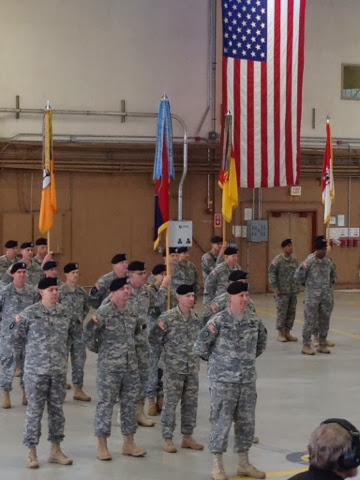
I think the most cynical critic of our military would have been impressed by the order and discipline of the change off command ceremony yesterday at Joint Base Lewis McChord near my home in Tacoma, Washington. My friend Chaplain Will Anderson leaned over to me at one point and said, "I don't think I've ever seen so many colonels in one place." For me that would include generals and other dignitaries, including a Medal of Honor recipient. 

I was impressed reading the names on the backs of all the hats in front of me, at just how diverse America and our military is. Names that represent every flavor, from Scandinavians, Germans, Koreans, French, Scots, to other Asians, Samoans, and soldiers whose names clearly have their origins in the Middle East. The ceremony gets its traditions, including the bugle signals, presenting of the colors, from more than one hundred and fifty years ago. There is definitely a liturgy to everything we witnessed. 

Afterward we chatted with an Apache helicopter pilot, soon to deploy to Afghanistan in Will's unit. Gazing at a $35,000,000 machine bristling with weaponry that made my teeth chatter (or was that partly from the cold weather, it was 14 this morning in the temperate Puget Sound region with a light dusting of snowfall here at sea level), I asked the pilot if he was anxious about being in combat. His reply, "I hope they shoot at me when I'm flying this thing. That means I get to shoot back." Later I asked the chaplain about pilots and about the condition of this pilot's soul. "Cocky, fearless, and lost as a goose," he replied. 

Pray for our chaplains as they minister the gospel to their needy parishes, and pray for our troops, safety under fire, yes, but for their souls, for them to be enlisted in the ranks of Christ's army, and taking the words of His liturgy on their lips and from their hearts.

Wednesday, February 5, 2014

Radio Interview--Pilgrim Radio with Bill Felton

Tomorrow afternoon I have another radio interview, this one with Bill Felton with Pilgrim Radio (http://pilgrimradio.com/Home.php). Bill interviewed me about THE MIGHT WEAKNESS OF JOHN KNOX a while back when that book released, and he wants to chat tomorrow in a pre-recorded session about my latest book with Ligonier's Reformation Trust, THE POETIC WONDER OF ISAAC WATTS. As it is February, the month we celebrate Valentine's Day, I thought I'd include an excerpt from a romantic episode in Watts' life fromhe book:


Smitten with an admirer
As happens with popular authors’ works, Watts’ Horae Lyricae began drawing fan mail. One such letter came from a young woman, Elizabeth Singer, a poetess in her own right. Her father was a friend of Thomas Ken, author of the Morning, Evening, and Midnight hymns, all three ending with the well-known doxology “Praise God from whom all blessings flow.” Ken had encouraged Elizabeth’s ’poetic interests and had urged her to begin a versification of Job 38.[i]
Elizabeth wrote Watts a versified fan letter in which she, perhaps a bit indiscreetly, said that his poetry on love made her forget all her other suitors and gave her a deep desire to meet him. When they met, Watts, who had thought himself above susceptibility to romantic love, was smitten. Standing before him was a lovely woman with shining auburn hair, sparkling blue eyes, and a fair complexion with, as Watts described her, a “lovely blush” on her cheeks. Her carriage was gracious and her voice was “harmoniously sweet.” She was just Watts’ age and, what is more, she wasn’t too tall. What she saw was another matter: “Before her stood not even a moderately presentable Englishman, but a minute, sallow-faced anatomy with hook nose, prominent cheekbones, heavy countenance, pale complexion, and small gray eyes.”[ii]
Watts, however, was not about to let the opportunity pass him by. This man of eloquence, the celebrated poet of Horae Lyricae, had given hints of his longings “for social bliss,” that is, for marriage:

Give me a blessing fit to match my mind,
A kindred soul to double and to share my joys.[iii] 

He was sure the lovely woman before him must be the fulfillment of those longings. Therefore, he formulated his words and made ready to propose marriage to her. But when he did so, Elizabeth gently but candidly declined. “Mr. Watts,” she said, “I only wish I could say that I admire the casket as much as I admire the jewel.”[iv] She could not see herself married to a man whose jewel, whose inner poetic beauty, was encased in such an unattractive shell.
Watts may have inadvertently expressed some of his forgivable disappointment at being slighted by Miss Singer in a hymn entitled “Love to the Creatures Dangerous,” as seen in these representative stanzas:

How vain are all things here below!
How false, and yet how fair!
Each pleasure hath its poison too,
And every sweet a snare.

The brightest things below the sky
Give but a flattering light;
We should suspect some danger nigh
Where we possess delight.

The fondness of a creature’s love,
How strong it strikes the sense!
Thither the warm affections move,
Nor can we call them thence.
[v]

We feel in these lines how deeply Watts’ own senses had been stricken by Elizabeth and how difficult it must have been for him to call his romantic affections away from her beauty. Watts and Miss Singer, however, managed to remain friends from afar and kept up an active correspondence throughout their lives. At thirty-five, she married the nephew (who was twenty-two) of Watts’ instructor Thomas Rowe[vi]; Watts never married. He concluded his jilted love poem in keeping with his Christ-centered outlook on all of his life:

Dear Savior, let thy beauties be
My soul’s eternal food.
[vii]

His next published collection of poems would even more clearly keep the beauties of his dear Savior before his and his readers’ minds and hearts.


[i] Fountain, Isaac Watts Remembered, 44.
[ii] Ibid.
[iii] Watts, Horae Lyricae, 466.
[iv] Cited in Fountain, Isaac Watts Remembered, 44.
[v] Watts, Works, 311.
[vi] Jeffery, English Spirituality in the Age of Wesley, 96.
[vii] Watts, Works, 311.