Sunday, January 29, 2012

Song to Synergism, what a hymn would sound like if Jesus only paid most of it...

Man and God cooperating in creation
I’ve long thought that one of the significant problems with synergistic theology is that it doesn’t sing very well. “Jesus paid it all,” would have to sound something like, “Jesus paid most of it; most of it to him I owe,” which of course is far worse than just bad poetry.

What I’ve observed is that whatever their declared theology, when hymn writers set their quill to paper to write a hymn of praise to God they feel constrained to extol the free mercy of God in Christ. But I have long wondered what a hymn would sound like written by someone who believes that God and man are in a responsible partnership in salvation. So I attempted to project myself into the theology of synergism (which is actually so much easier than any of us really wants to admit) and out came this:


I praise and worship Father thee
Since I have chosen free
To bow before your majesty
By my own liberty.
    O God of fairness, with my voice,
I praise you for my choice!

The Father leaves us, every man,
To choose him if we can;
My will he never violates
While passively he waits.
    O God of fairness, with my voice,
I praise you for my choice!

The Son who did his best for all
Leaves me alone to call;
Along with all the human race,
I’m left to choose my place.
    O God of fairness, with my voice,
I praise you for my choice!

The Spirit draws—but not too much;
My will he’ll never touch,
But leaves me free to choose my faith,
The captain of my fate.
    O God of fairness, with my voice,
I praise you for my choice!

It would not make a bit of sense
To earn my recompense,
If I don’t have ability,
My free will and my liberty.  
O God of fairness, with my voice,
I praise you for my choice!

With apology, by Douglas Bond, January 29, 2012

Sunday, January 15, 2012

I had a wonderful time hearing PAUL TRIPP at Mars Hill, Bellevue

PAUL DAVID TRIPP -- Getting at the Heart of Parenting

Mars Hill Bellevue – January 13-14, 2012 [my notes and comments as I listened, so apologies to Paul if it looks like I’m putting words in his mouth, not my intention; don’t read these as exactly what he said; they’re through my filter]

Judges 2:6 an entire generation of children grew up who did not know God or their redemptive history; they grew up to be pagans.

Parents’ job is profoundly more than modifying behavior. Parenting is much bigger and much more significant than behavioral modification.

Family is to be a theological community, the primary community in which God works for the salvation of his people. Cannot understand anything outside of God the planner, purpose of all. Calvin, “There is no knowing that does not start with knowledge of God.” You cannot understand anything outside of the existence, character, and plan of God. The physical world reveals him, he everywhere visible in it. The whole earth is filled with his glory. It is not weird and unnatural to talk about God all the time; it is abnormal not to talk about him, to see him in every detail, vast, nuanced—God is everywhere present (design of nose—funny). Stunning creative ability of God, his glory in everything. Baking bread. He illustrates showing his kids God in everything (yeast). Our kids have a perverse ability to look at the world and not see God. So do we.

Our job is to give eyes to our children so they become aware of the presence of God around them. Kids were designed to be revelation receivers. Drop-dead awe of God. Show them this in the Bible. Blow are kids away by the stupendous attributes of God. Children are interpreters: “Human beings made in the image of God do not live life based on the facts of their experience but based on their interpretation of the facts.” Kids constantly think, interpret the facts of their experience. Only valid interpretations of things are at the feet of the Creator.

Kids are revelation receivers. Worship is first a human characteristic before our kids enter into a particular religious experience. Johnny wants to be his own god, his will and way in everything. If God is not at the center of their world, they will put themselves there, the place for God and God alone.

We often resort to intimidation, which actually drives our kids away from God not toward him; obey or God will crush you like a bug, does not warm their heart toward God.

Family is supposed to be a sociological community. Designed by God to life in selfsacrificing love of neighbor. Family is the place to teach this; here they already have to learn to live in close proximity to human beings they did not choose to live near, like neighbors.

We parents don’t like to teach love because it takes love to teach love, it takes self sacrifice to teach self sacrifice. We often do things not because we love our children but because we love ourselves. It will make my job easier, my primary goal all too often.

Designed to be a redemptive community. If we keep telling them they were designed to love, to serve, to worship. Produces frustration because of sin and their desire to love, serve, and worship themselves. And their inability to do what we tell them frustrates them because they can’t do what is required. “There’s nothing you could ever say that would drive me away, because I love you. I’m your dad.” We can’t do it nor can our kids do it. They need to know this. Then show them Jesus, redeemer, destroyer of death, forgiver, helper, enabler by grace and power. Teach our kids to despair in themselves and turn to Jesus. We want outward performance, accomplishment, self-righteous Pharisees, who grow up to want nothing to do with religion. But this is not the gospel. We need God to open our eyes so we can help open our kids’ eyes. Stop chasing the dream, giving yourself to your job or career. Church, school, state, are not there to do what God has ordained and called parents to do and to be. What needs to change in my heart, home, life.


Session 2 Friday evening

Luke 6:43ff Out of the abundance of the heart the mouth speaks. The heart is the directional system, controls behavior… It will never work to just try to control the behavior of your children. We must train the controller of the behavior, the heart. My words are always what we have in our heart. I didn’t mean to say that, ought to be, sorry for saying what I was thinking in my heart, more accurate.

Lasting change always travels through the pathway of the heart. Prov 4:23 “Above all else guard your heart for from it is the wellspring of life.” We say and do what is in the heart, whether good or bad. We want to go from bad behavior to good behavior without addressing the heart.

Threatening is the first way we do this.

Manipulation used to buy their changed behavior. Get them to change behavior so they get something or avoid something bad. Moral economics: is the reward proportionate to what I will have to forgo to get it?

Guilt comes next.

“In all these we are asking the Law to do what only grace can accomplish.” We must confess and take personal responsibility for my words and behavior without excuse or shifting blame. Kids suffer from spiritual blindness, blind to the blindness; our kids think they know themselves, have an accurate view of themselves. We must ask what right now is it that God wants my child to see that they are not seeing and how can I help them see it?

You cannot grieve what you don’t see, you can’t confess what you haven’t grieved, and you can’t confess … without heart change. Who had it first? Prior possession absolves the kid of the obligation to share. Say you’re sorry. Jesus is so happy when you say you’re sorry. By this we teach kids to do their crimes out of your sight, and if caught, acquiesce quickly; mom is easily appeased. We need to hit these moments much more clearly with the gospel. That is, don’t deal with outward behavior change. Show Giles what is going on in his heart. There is no repentance when he pulls a face at Gillian when she tattles on him. Heart.

As I confess, as I repent, I need grace, wisdom, power, and I reach out for the help of the Savior. We must get at issues of the heart. Attitudes of the heart are what caused the bad behavior. That is what we must address, not just the bad behavior. How to get at the heart.

1.    What was going on?

2.    What were you thinking and feeling as it was happening? Heart

3.    What did you do in response to what you were thinking? Take responsibility

4.    Why did you do it? What were you seeking to accomplish? Motives   

5.    What was the result? Harvest, reap what is sown

We want event parenting. Change in a heap. Instant repentance. Over and done with. Perfect kid resulting. No. It is process parenting that gets at the heart. Be committed to process. No repentance without seeking the Savior. And we parents must begin with out own hearts. Do I know my great need of my Savior. When I am angry because the kids have interrupted my world and I discipline them, I am not pointing them to the Savior. Grace, it’s always grace.

1.    I will tend to turn moments of ministry into moments of anger.

2.    I personalize what is not personal. The real problem is their heart and need for Jesus and his grace

3.    I will be adversarial. They are obsticles to my happiness.

4.    Settle for quick fixes that do not get at the heart. It’s not parenting. It’s not Christian. Child is utterly unchanged by the encounter.

To go after the heart of my children, I must start with my own heart. If I am going to be a tool of rescue, I too must be rescued.


SATURDAY morning, 37 degrees and raining in Bellevue, WA. Breakfast bagel and Earl Grey Latte at Tullys with my darling wife and short walk in light drizzle from Hyatt Regency to Mars Hill Bellevue. Rich time together.

Paul launched into 0-5 years and the phenomenal development of language by observation and interpretation. Authority is bedrock, God’s not ours.

Lies: self-sufficiency. I can do it on my own. Kids don’t usually ask for more instruction and rules. They think they can do it on their own until they get so frustrated that there is a breakdown.

Ephesians 6:1-4 especially “Fathers do not provoke children to anger but bring them up in the nurture and admonition of the Lord” We as parents do not have independent authority. We are under authority and our kids must know this. Ours is representative, reflective, or ambassadorial authority, representing the one who is the ultimate authority. My job is to make authority attractive, to show it as the good thing it actually is. Submitting to authority is actually the path to freedom, though our culture lies, lies, lies about this. Flips it on its head. So parents must exercise authority as God does, never nasty, mean, bullying, so unlike God’s way with sinners, with parents, with me. Kids will struggle and rebel against God’s authority when they see fathers abusing their sub authority and so distorting kids’ view of authority.

We should be saying to ourselves: I can’t do this. How can I be like God in my exercise of authority? Answer: you can‘t. Must have enabling grace, vertical goal, redemptive goal for child’s heart. Parent is daily, visible means of bringing our kids to God.

“Obey: willing submission to my parents that causes me to do what I am told.” Key quality her is willingness. So never congratulate child for coerced obedience, but press forward by grace to see it come from willing heart. “Disobedience in a tuxedo” is when they do what we ask but they do it kicking and squalling.

So often we resort to arrogant tough-guy exercise of authority. So unlike God and his way with sinners. Yes, at last he gives them up, he laughs when calamity comes, he casts them into hell. But we’re a long way from that and that is God’s ultimate role, never ours. Seldom is disobedience result of audio or retention problems. Whisper, let’s go for ice cream and they will hear from the back forty of the yard; call them to take out the garbage and it’s a different story. I forgot… did they? Tell them you’ll take them to Disney World and they will remember and hold you to it for decades. No forgetting here. Our role is to help them see why this is true in their hearing and remembering.

Children not indentured servants to make my life easier. Kids will realize that dad is abusing his power when we order them around to make our lives easier. Teach them to help and serve others in the house, as you are doing by example.

Careful here. We should not let kids start ordering parents about. Wrong-headed exercise of service and authority when we don’t train our children to respect and submit to parents’ authority. Boys will try to be daddy of mommy, and Christ-centered mommy seizes that moment to train his heart to understand authority, his role to submit, yours to submit to God as ultimate authority, and yours to lead and guide him, not he you.

Go well… think about the future. What result does God have for our child in the future? What do we want them to be like when they are teens? Twenties? Etc? start training their heart at 0 years. Grace of God works this


Goal of Parenting: Rescue and restoration: Role of Rod, spanking. God cautions about taking our our irritation, anger, frustration by physical manipulation, shaking, yanking, slapping, hitting, even spanking in this context is sin.

Biblical spanking (Proverbs 13 spare the rod spoil the child, he who loves his son disciplines him faithfully. It is grace to spank my child when they opening rebel, when they defy authority. To fail to spank at this point is sin. Get a hold of your own heart first. Take the child to private place, no need for public demonstration. The word will spread throughout the house, no worries there. Slow down the process. Discuss the offence. Seek and acknowledgment of the offence from the child. Give them an opportunity to confess. Keep the discipline centered on the gospel of forgiveness, a price for sin. Then discipline letting them know how many blows are coming. Then hold them, pray with them, be tender. This ought to be relationship building time. Tell them you don’t like doing this and hope you never have to again, and mean this. Foolishness is bound up in the heart of our children and the rod of correction will drive it far from them. We have God’s word on this. [I prefer the order to be spanking early in the process; I’ve found that they are often so preoccupied with anticipation of the pain and suffering coming that they have a hard time concentrating on my words; afterward when they are crying, I’m holding them, praying and talking tenderly with them, they are more open to hearing the words of the gospel, forgiveness, love.]

Don’t do emotionally reactive parenting. We only act when we are upset. Our children will read the emotions and weigh out what they can get away with today. We need grace to be like God, who never turns, never varies the standard, immutably perfect standard. Yikes. I need grace totally always.

Have I mentioned how much I despise computers? This is after my total computer-ac arrest and new operating system and software, so I’m looking at a very foreign (dare I say, hostile?) screen. It’s sort of mocking me, that’s what its doing, sneering, tongue wagging; I can tell from its expression that it thinks in its heart of hearts that I am a techno moron, an informational meathead. I’m not reading into things here, trust me. All that to say, my 6-hour battery life is dying so I will be fading away, drifting into technological oblivion momentarily…. Paul said heaps more good things... Aarrrgh!...   

Friday, January 6, 2012

INKBLOTS covered important ground last night--critical writing topics

INKBLOTS – January 4, 2012
Six of us tonight, Gnarly Head red, cozy fire. I’m working on a borrowed computer as mine is toast, caput, fried, mortified—and still don’t know about data recovery. I have a backup system with an external hard drive but I had been lazy and had not back upped for… well, I really don’t want to admit how long. Lesson learned—painfully—but much less harm done than it could be.
David K is going the self-publication route with Winepress and shared with us about their initial edit, lots of input, critique, and pre-typesetting evaluation, which was pretty brutal. They nailed him for shifts in point of view, which I ribbed him for, because I’d been calling him out on that for a number of months. Dave shared how his initial response to their critique was devastating, and made him defensive, but the more he read and reread what they said, it began to make sense, and he set to work revising. We discussed rereading Elements of Style, and Beyond Style, and Secrets of Successful Fiction. I find these books super helpful—there are many others, but these have helped me, over and again.
Dave read another new first chapter, since the critique said that it didn’t set the hook well enough and too much back story. “Three would live; three would die,” motif throughout the chapter. Dougie Mc suggested going inside the head to make it personal. Three guns, three knives. It is a very short chapter; maybe too short, not enough development to make it alive, not enough flesh on the bones—good bones, but needs muscle and sinew, perhaps. I missed what happened when he heard the rustling behind him and the other guy had a gun? I was not clear what happened. These killings trouble me. There is no context to understand them in. It moves so fast that the reader is going to have trouble knowing who they are supposed to care about, who is in the right, why the killings were necessary. I think it needs a clearer point of view, a real human being the reader rapidly begins to care about, who must kill or be killed. Make him a conflicted genetically engineered strong man, who wonders about his purpose, his design as a killer. It begins in 2013 but if it is futuristic then it needs to be further ahead in time; George Orwell wrote 1984 in the 50s.
Jennifer reads a nonfiction reflection essay. It is a lyric overview of church history from Athanasius to Anselm, Assisi to Huss, Luther to Knox, Tyndale to Askew, Waldensians to Covenanters, Bunyan to Edwards, Carey to Carmichael, and then the persona finds herself connected to this heritage. What about actual hymn phrase beginning and ending, inclusion, bookends to the sweeping overview of church history. I suggested this was a sketch that was a piece of an argument for the essential importance of inspiring our children with connecting them to heroes of church history so that they are less and less impressed with pop culture. Or is this an opening reflection on sketches that go close on each of these characters, but directed with application to mothering our children.
We talked about using Writers’ Market to find periodicals, where the markets are for the kind of writing a person is inclined toward. And reading articles by Starr Meade and Joni Erickson and others, like Susan Hunt, Noel Piper.
Dougie reads a chapter from our Savonarola biography (this is fun; he does all the work; I waltz in and blast him to smithereens—love it). I gave us 9 weeks to research and write it—what’s the problem? My initial impression is great improvement in flow, cohesion, and a conversational style that is accessible to many readers. Shmoozer and the schmoozed might be a bit much. Good choice of quotation on real beauty versus external adornment of women—“you’re ugly.” Great line, though some women may not appreciate your candor. Shows Savonarola’s frank, confrontational, no-Mr.-nice-guy style. Wealthy have nowhere to hide when he launches in on them. Eight line quotation works pretty well. Much longer and we might lose the reader. Seems like smooth transitions from narrative to quotation. Good come-backs from Savonarola that show his character and intrepid nature. Nothing deterred this dude. Go into Lorenzo’s point of view when Savonarola was preaching to him in his own palace. Did it make him angry? But he was dying so he let it go, or what? We discussed reading chapter 4 out of context and what immediately preceded it.
John S reads revisions of his modern fiction novel, an expose on the evils of abortion. Recaps for those who don’t remember the flow of the tale. Avoid “came his reply” for attributions. Keep it concise and unobtrusive: “he replied” is far better and less distracting. Attributions are purely functional. Don’t draw attention to them by overstating them. “There was a slight hesitation.” Same thing: “She hesitated” is far better. Less is almost always more. Swap 5 words for 2 and you have significantly upped the pace, and kept the main thing the main thing: the actual drama of the story, not the commentary on who is speaking and how they spoke it. “Came bursting from her trembling lips,” is too wordy, as is “she suddenly blurted out.” Blurting is by definition sudden. Just blurted. I would go through and evaluate how you can make your attributions more concise, less obtrusive. Over writing or double attribution.   

Saturday, December 17, 2011

My Son Cedric Featured in Challenger Films, The Winning Edge

Airing on Fox and other media outlets in cities across the US, is a feature film on my second eldest son (it aired in Seattle area at 8:30 Saturday morning). Cedric is an athlete, training for the Olympics. He is a flat-water sprint kayak racer who has been a multiple National Champion, has been on 3 US Junior Worlds teams (racing in Russia twice, Czech Republic, and training in Slovakia and Italy), and the US Senior team, racing in Hungary, August of 2011.

He was chosen for this feature because of overcoming challenges in his life as an athlete and student. The producers of the film are more concerned with helping young adults make right choices and with the practical implications of right living and sports than with any overt message of the gospel of grace, the forgiveness of sins in Christ (though Challenger Films, as I understand it, is a Christian film maker). I say this, because I was waiting to hear the source and enabling to overcome temptations and challenges. It never came. Cedric would have a great deal more to say about overcoming sin in his life that what is here. Nevertheless, here it is, and it does underscore the grace of God, that no one is exempt from sin, and that there is a way out. But if falls short of giving us the way out--Jesus, the Way, the Truth, and the Life.

Then there's the fact that the content of this film, and what Cedric candidly talks about, is sort of personal, which makes me wonder why I am writing a blog post on it and embedding the film. Watch and see. If you have fallen into the enslaving trap of measuring your spiritual health, your skill and worth as a parent, your faithfulness as a Christian, by your kids' successes, and then the realities of being a sinful parent, raising sinful kids in a sinful world have kicked in (and I do mean 'kicked' here), then give this a watch. It reinforces the axiom that God makes us parents to keep us humble. Still more, if you have turned from grace and think that God owes you blessings because of your faithfulness in raising your kids, get ready for a shocker. And then turn and cling to Jesus and his grace; he alone is the Author and Perfecter of faith--in us and in our kids. Praise be to God!


TRWE ’11 -’12 Broadcast Station List
Fox stations:
New York - WNYW/WWOR (Fox O&O)
Los Angeles - KTTV/KCOP (Fox O&O)
Chicago - WFLD/WPWR (Fox O&O)
Philadelphia - WTXF (Fox O&O)
San Francisco - KTVU/KICU (FOX/Independent)
Dallas - KDFW/KDFI (Fox O&O)
Washington, DC - WTTG/WDCA (Fox O&O)
Houston - KRIV/KTXH (Fox O&O)
Phoenix - KSAZ/KUTP (Fox O&O)
Minneapolis - KMSP/WFTC (Fox O&O)
Orlando - WOFL/WRBW (Fox O&O)
Tucson - KMSB (FOX)
Portland, ME - WPFO (FOX)
Gainesville - WOGX (Fox O&O)

To see Cedric on other media outlets and cities, click here: http://realwinningedge.com/images/pdfs/trwe_airings.pdf

Friday, December 16, 2011

INKBLOTS had a rousing evening of reading, critiquing, chatting, and all

INKBLOTS, December 15, 2011
Four men and a crackling fire, Chateau Saint-Michel Merlot. 

Doug McComas leads off with a chapter from our new adult biography on Savonarola. He broke off a few times to express his frustration at the challenges of the new genre, adult non-fiction. Reading aloud is like sweeping a dusty room on a dry hot day—dust flying everywhere. “Wow, I’m starting to break into a sweat here.” Was this Lorenzo or Girolamo who said this? Oh, it was McComas. Some very good specific description of Lorenzo’s banking and lavish lifestyle. Remember to keep the Savonarola thread as you establish the Florentine context. Especially with a 30,000 word count, which goes so fast.

I read the introduction to our Savonarola biography. McComas suggested that I tighten up the part about the Duomo. Ken observed that whatever the genre we need to be telling a story. Avoid great information and facts but not conveyed in story. Story is what everyone loves.Good point always.

Ken reads a play he and his wife collaborated on writing. Episcopalian priest, boys school, taught by Father Flye, St Andrews, Sewanee. WW II with letters, taken prisoner by Japanese officer who had studied at Cambridge and knew Latin, and so conversed with Alice’s father who had studied under Father Flye and had learned Latin. Saves Alice’s father’s life by getting medicine to him. The officer later died on Okinawa. Alice and Jun (guy) at 60’s nightclub. Romance scene between two very incompatible people, dog and monkey. Love triangle motif. Though it is a bit hard to follow—not the fault of the writing, but of the medias res entry (midway in drama)—it is engaging dialogue, authentic, fast-pace, true-to-life. Then Ken let it out that he originally wrote the dialogue in Japanese and translated it to what it is. A friend of his told him that no Japanese would have ever written this. I’m afraid of trying to write live theatre. But Ken told us all that we should try our hand at it. It seems to me that there is such a multi-faceted deal with drama, the drama text itself that the playwright pens is only one component. Ken promised to read us more (at our insistence). Fun material.

John S up. Re-wrote chapter after reading the blog from the last ‘Blots meeting. Emma, protagonist of John’s contemporary fiction, reflecting on her life in Lyons and her circumstances, now pregnant, the father a race her own father had no time for. Aaron drowns a fly in his soup. The kids had just heard that they were not natural born, but adopted. Would it be realistic for her to have forgotten the shocking news she just dropped on her family: that she was pregnant? Is this important to what you are trying to do here? This is much improved, I think, over the first reading of it. I feel like it is dragging when you bring in Confucius. I feel like it is stalled here, a bit. I think you need to keep the pace moving, shorter flashes to her inner thoughts (important to keep these) but tighten them. “Sigh of relief” is awfully overused; try an alternate description of this common phenomenon. Fun joke with dog and wife, though I think you have to be a husband to get it. Vary sentence and paragraph beginning; the first seven paragraphs began with “She.” Write with point of view integrity, so that you deduce that the parents were exhausted, rather than just saying that they were, which would be a shift to their point of view.

John S read a bit of Hemmingway, who he has made in no uncertain terms that he does not much like Mr. No-Adjective. Ken jumps back in with comments about the importance of not stating that someone was angry, but show them anger. Show, don’t tell. Back to Hemmingway, Big, Two-Hearted River. This title from the guy who says to use no adjectives! Lots about grasshoppers. Virtually no dialogue, all narrative. John finds him repetitive and redundant and says things over and over; did I mention that John thinks he repeats himself? Just goes on and on like that. Meanders along. Old Man in the Sea, D McComas liked. We talked about how old films seem too slow now, and that may not be a good thing, benumbed as we are by action films with clipped dialogue. Not necessarily a good thing, we all agreed. Though the reality is that some old novels would never be published today. There are some genuine improvements in standard of writing and story telling.    
        

Friday, December 9, 2011

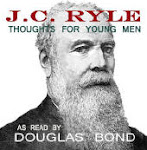
Listen FREE! Ryle, Thoughts for Young Men, read by Douglas Bond

Merry Christmas! I have benefited so much from reading and rereading John Charles Ryle's incomparable little volume THOUGHTS FOR YOUNG MEN over the years that I finally decided to do it as an audio book. My friend Rich Young (former heavy-metal guitarist) plays his original classical guitar renditions of some of my favorite hymns in the background. I hope you and the young men in your family and life will benefit from listening. Access them by clicking on the link above or here: J. C. Ryle, Thoughts for Young Men, read by Douglas Bond.   

Here's how Ryle begins:

"When the Apostle Paul wrote his Epistle to Titus about his responsibility as a minister, he mentioned young men as a group requiring particular attention. After speaking of older men and older women, and young women, he adds this advice, "Encourage the young men to be self-controlled" (Titus 2:6). I am going to follow the Apostle's advice. I propose to offer a few words of friendly exhortation to young men.

I am growing old myself, but there are few things that I can remember so well as were the days of my youth. I have a most distinct recollection of the joys and the sorrows, the hopes and the fears, the temptations and the difficulties, the mistaken judgments and the misplaced affections, the errors and the aspirations, which surround and accompany a young man's life. If I can only say something to keep some young man walking in the right way, and preserve him from faults and sins, which may hurt his prospects both for time and eternity, I shall be very thankful. There are four things which I propose to do:
I. I will mention some general REASONS why young men need exhorting.
II. I will note some special DANGERS which young men need to be warned about.
III. I will give some general COUNSEL which I beg young men to receive.
IV. I will set down some special RULES OF CONDUCT which I strongly advise young men to follow. On each of these four points I have something to say, and I pray to God that what I say may do good to some soul."

Thursday, December 1, 2011

Author Interview: Another P&R author asked for interview--probing questions


With Sinclair Ferguson in Geneva, 2009
Brock Eastman, another P&R author contacted me a while ago and asked if he could interview me for his blog. He asked a number of good questions that got me thinking and then reflecting on how I began to write, why I keep writing, as well as questions about what I eat or drink when writing and if I listen to music when writing. Fun stuff. Here were his questions and my answers.

 Q: Everyone seems to have a "how I got published" story. What is yours?
It was back in the days before 9/11 when more publishers were accepting unsolicited manuscript submissions. I sent sample chapters and a synopsis of my Mr Pipes and the British Hymn Makers to seven publishers. Eight days later I had a phone call from one of them enthusiastic about the project. A couple of months later I had another publisher call and we chatted for a long time about future book ideas simmering in my imagination. Eleven years later, and somehow, unaccountably, without any childhood burning passion to be an author—I have managed to write a few books (signing my 20th book contract today, in fact).

 Q: When did you realize you wanted to become a writer?
I always tried to get out of writing when I was in high school. So in journalism class I was the photographer, shooting pictures and working in the darkroom. I tried to make myself indispensible as a photographer in large part so I wouldn’t have to write articles. It just seemed like too much work. Then in college something started to change. I got so I was secretly looking forward to writing those history essays. And then I submitted an article to the college newspaper and started writing more of those. But it would be years later when I was working on my master’s thesis that I began to realize I wanted to do more writing. Then I wrote a few more articles, this time ones that I was getting paid for writing. But there’s a big difference between a 1,500 word article and a 70,000 word book.

My older kids, to whom I regularly read aloud in the evening, began asking me to TELL a story, not just read one. I hemmed and hawed. Then started in on a story of frontier days (not very good, I’m sure, and made up on the fly); it lasted for a month or more. They wanted another, and another. I felt cornered, but there was to be no escaping.
Then one sleepless night in 1999, ideas started cascading about using contemporary fiction as a frame tale in which to explore the lives and poetry of the church’s hymn writers. I sat up in bed, furiously scribbling the ideas on notepaper. And off I went.

 Q: Tell me a little about your books.
I have written primarily fiction for young adult readers, most of which is historical fiction published with P & R Publishing. But I have also managed to write several non-fiction books, biographies with Reformation Trust and Evangelical Press. I call these my big-people books.


 Q: What are some of the strongest influences on your writing (and several other questions combined from the list below, if that’s okay)?
I would need to go back to my childhood to answer this one. My father was a mathematician and engineer, but more importantly, an earnest, godly Christian man, a man who, because of his dyslexia, had a difficult time reading aloud. Nevertheless, he daily read Scripture aloud with us at our family devotions, slow, methodical, one-word-at-a-time slogging it sometimes was. But I came to appreciate deeply his reading because I think it represented just how much attention he was determined to give to every word of that great Book, every jot, every tittle.

Meanwhile, my mother, a college English professor, loved great literature and read aloud to us from Shakespeare and many other classic authors, including Chaucer in Middle English! We loved it. My mom would take us to children’s theater and even adult plays. I’ll never forget, “A horse, a horse! My kingdom for a horse!”

In college I began reading serious theological books, works of the Reformers and Puritans. Honestly looking back on it, I was too often motivated to do this because I thought it made me a big shot, a heady, erudite dude. But, as is God’s kind way with me, he was mercifully feeding me, often in spite of my flawed motives, with important foundational understanding of the nature of justification by grace alone, through faith alone, in Christ alone. These truths are the most important influences on my writing, and if they ever cease to be so, may I give my energies to crocheting pot holders. They are also the most important truths that I want my writing to adorn and that I want to make attractive to my readers.

I have been influenced by many great authors, mostly dead ones, but not all dead. Writers of imaginative literature like Lewis, Rosemary Sutcliff, Chesterton, Arthur Ransome, and poets like Donne, Cowper, Rossetti. But always I come back to the great theologian preachers like Spurgeon. If I can borrow from two of my all time favorites (Augustine quoted by Calvin), “I count myself among those who learn as they write and write as they learn.” I regularly read and listen to the best of the not-dead proclaimers of the good news today: Sproul, Ferguson, Piper, Begg, Horton, Tullian T., Driscoll, and others.   

 Q: How do you write? What’s a normal writing day like for you?
I write my fiction after a bike ride or a good walk to a quiet location where I’m not likely to be interrupted. Sometimes that is a dark corner in the library of the university not far from my home. Other times I write in the loafery, a room downstairs that used to be the bedroom of my oldest son. With caution, I also write in the summer in my classroom, especially when writing non-fiction biographies where I need to be near piles of books that don’t pack around real well on my bike. But this can be a problem, because well-meaning colleagues poke their head in for a chat. I’m a social sort of guy so I always like the interaction, however totally it derails my train of thought and sets me back sometimes hours.

 Q: What was your favorite book as a teen?
Maybe Hans Brinker and the Silver Skates and Great Expectations.

 Q: Describe your feelings when you opened the box and saw the first published copies of your very first book?
It was really thrilling to open the box and pull out my first book, that shiny new book called Mr Pipes and the British Hymn Makers—and then to see my name on the cover, but it also carried with it considerable anxiety: will this book only be the proof that I am an utter failure as an author, the badge of my literary ineptitude? We authors, many of us, are miserably insecure, but that’s when I am looking to myself and my skills (real, perceived, or longed-for) and efforts. It is so liberating to refocus my energy and purpose in writing. Stunk and White in the final chapter urge writers to write for an audience of one—themselves. But the Christian author wants to write for an audience of One, Jesus Christ, plus nobody. The best writing results when I disappear—I must decrease; Christ must increase; only then I’m starting to get things right.

 Q: What can you tell us about any future releases you have planned?
There are a few new books of mine scheduled to release in 2012. In May by new biography with Evangelical Press, AUGUSTUS TOPLADY, Debtor to Mercy Alone will be available. In June THE THUNDER, my adult novel on John Knox releases along with my 8th-century Anglo-Saxon tale, HAND OF VENGEANCE. And in September my biography with Ligonier’s Reformation Trust, THE DOXOLOGICAL GENIUS OF ISAAC WATTS will be available. Just signing a contract for a biography on Girolamo Savonarola, an amazingly passionate, fearless forerunner of the Reformation in decadent Florence, the birthplace of the Renaissance.   
I have several other things in the cooker, both fiction and non-fiction, including a childrens picture book in verse that explores themes from the book of Job

  Q: Coke or Pepsi?
Neither, thank you very much. They upset my stomach, as does—unforgivable as it is to admit this living as close to Seattle as I do—coffee, yuck!

 Q: Soft shell or Hard Shell tacos?
Soft

 Q: Favorite place to vacation?
We love sailing in the San Juan Islands north of us in Washington State. My wife’s favorite city on the planet is Strasbourg, France, and I think I agree with her on this one. Marvelous city with charming old-world sites and lots of church history connections—and good food and drink!

 Q: Favorite season?
Autumn

 Q: Do you have a particular drink or food you consume when you write? Like coco, raspberry tea, animal crackers?
I sometimes munch on trail mix and often drink tea. My all-time favorite tea drink is a London Fog Latte, made with Earl Grey tea. For herb tea I love Licorice spice—yummy and fuels the imagination.

 Q: Do you have a favorite Bible verse?
Too many to narrow it down really, though Psalm 93 and 16 are two of favorite Psalms.

 Q: Favorite pasta dish?
Smoked salmon fettuccine

 Q: Do you listen to music while you write? If so what are some examples?
I am a lover of great music! Just recently listened through Bach’s St. Matthew’s Passion, following the libretto with my 8-year-old son. Though that may seem like a stretch to some (and like child abuse to others), he loved it and asked to listen some more after we’d finished it (we played chess some of the time while listening too). But I generally only listen to music in the editing and revision stages of writing and then I’m pretty selective. Then it would be Bach or Handel or maybe even Alison Kraus and some bluegrass to mix things up a bit.

I do, however, intentionally listen to music that is part of the story, as when my protagonist was in Paris with John Paul Jones in Guns of Providence and they heard Haydn’s latest symphony, or when writing about the Anglo-Saxon harp being played with Beowulf in the mead hall in Hand of Vengeance, or when writing about Toplady or Watts and their hymns, or bagpipe music when writing the Crown & Covenant Trilogy (which could be played live by either of my two eldest sons) that sort of thing.